
Etruscan City Of Cerveteri With Magnificent House-Like Tombs Decorated With Scenes From Life And Death
A. Sutherland - AncientPages.com - Today, the town of Cerveteri is particularly famous for the numerous Etruscan cemeteries located on the surrounding hills.
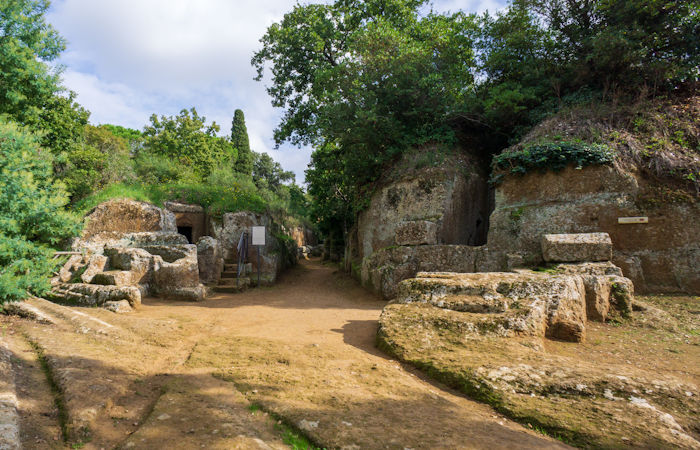
Etruscan necropolis Cerveteri Rome Province, Italy. Credit: Adobe Stock - Massimo
We know about the Etruscan civilization, after being conquered by Rome, thanks to its tombs that exist in massive necropolises outside of the Etruscan cities.
Necropoli were massive graveyards in which the Etruscans buried their family members to preserve their bodies and souls. Other surviving sources of their architecture are the remains of temples, city walls, houses, and even roads carved in stone.
The ancient city of the Etruscans, Caere (now Cerveteri) was founded according to tradition by Pelasgians in c. 1400 BC.
Cerveteri, a town on the West coast of Italy, is located in the province of Rome in the Italian region Lazio, just about 40 km North of Rome.
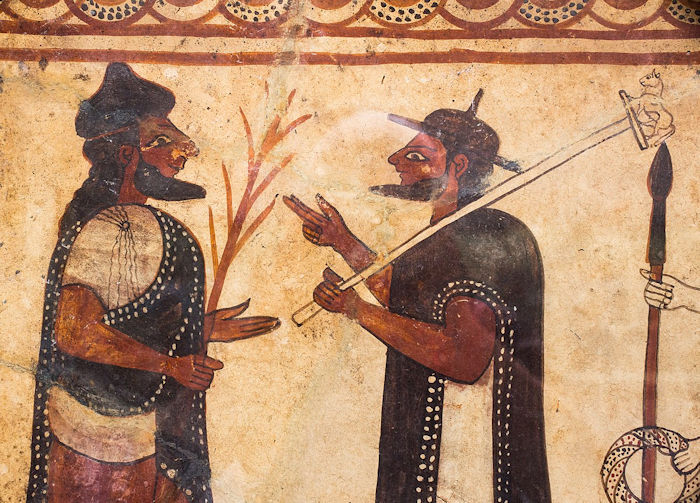
Painting on terracotta panels of the judgement of Paris from Cerveteri (Boccanera tomb). Credit: ArchaiOptix - CC BY-SA 4.0
Known by the Etruscans as Cisra, it was once one of the metropolitan areas of the ancient Mediterranean. The Romans called it Caere, and at that time, the Etruscan city was one of the most important Etruscan cities, with an area more than 15 times larger than the town of Cerveteri, as we call it today.
A rich and powerful city was an ally of Carthage and developed good relationships with its southern neighbors, the Romans. Formed from the Villanova culture settlement, Cerveteri belonged to the Federation of 12 Etruscan cities and was one of the richest and most important in Etruria.
It flourished in the 7th century BC and the 6th century BC, thanks to maritime trade through the Etruscan ports in Altium (now known as Palo), Pyrgi (Santa Severa), and Punicum (Santa Marinella). At its height, around 600 BC, the city's population was most probably from 25,000 to 40,000 people.
Cerveteri Became Part Of A Coalition Fighting The Romans
In the 3rd century BC, Cerveteri was part of a coalition fighting the Romans; after the defeat of 273 BC, the flourishing Etruscan city lost half of its territory to pass under the authority of Rome in 90 BC.
It received only incomplete civil rights - "ius sine Suffragio" (without the right to vote). All those who lived in Caere and did not have the right to vote were called in Rome - caerites.
Due to close contact with Rome at the end of its long history, the Etruscan Caere became a sort of "satellite state" of the Roman capital and was eventually transformed into a prefecture in 273 BC.
During the decline of Etruscan cultures, also gradual decline of Cerveteri began in the 5th century BC. However, the sixth century BC marked the influence of Greek culture on Cerveteri, which became the main center of Ionian-Etruscan art.
Cerveteri And Etruscan Gigantic Tombs
Necropolises, at first glance, resemble extinct cities and house-like graves, of which some resemble the Hobbit's household. Some of them have the shape of round bunkers; others form groups of mounds.
Cerveteri's rock-cut tombs imitate beautifully decorated houses, chambers with carved furniture, and decorations like frescoes, ceramics, and ancient paintings. Cerveteri's frescoes depict scenes from the life and death of the then-living Etruscans.
The ancient artists wanted to immortalize various scenes related to hunting, erotic acts, feasting, dancing, racing, and multiple faces of demons waiting for the dead.
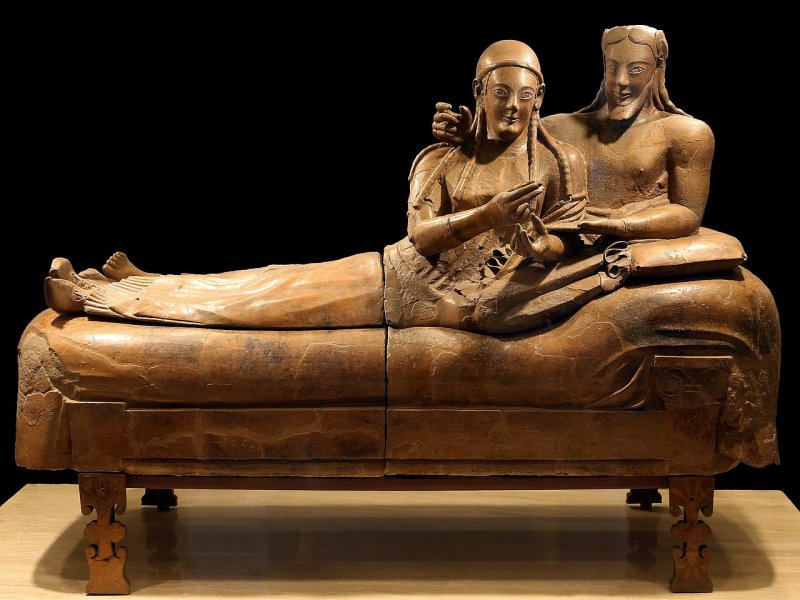 Sarcophagus of the Spouses from Caere, now in the National Etruscan Museum at Villa Giulia in Rome. Image credit: Sailko - CC BY-SA 4.
All these treasures represent famous Etruscan artwork, of which one of the most famous is the Sarcophagus of the Spouses.
Religious Traditions Of Etruscan People And Network Of Corridors And Stairways
The city of Cerveteri has yet another fascinating area. It is a religious complex in the city's center, known as the "hypogeum of Clepsina," containing a network of corridors and stairways and an underground room with frescoes, sketches, and inscriptions. The hypogeum represented the cult place of the community's ancestors and the seat of rituals associated with its foundation, its destiny, and the people's religious and cosmological beliefs.
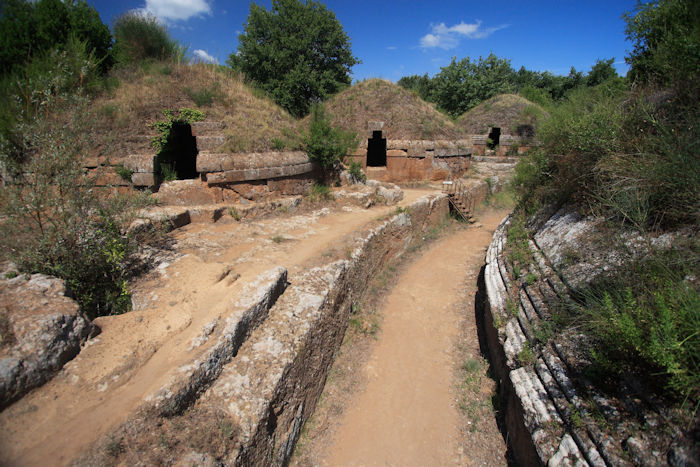
Cerveteri necropolis. Credit: Adobe Stock - francescodemarco
There is still much to discover in the region of Cerveteri, Veies, Tarquinia, or Vulci necropolises of Etruria, located in an area that covered part of what are now Tuscany, Lazio, and Umbria.
Their constructions are essential for understanding the Etruscans' mythology, religion, everyday life, and architecture.
For now, in Tarquinia, approximately 6,000 burial sites have been discovered, though not all are possible to visit and contemplate the atmosphere of ancient Etruscan people's atmosphere of life, death, and traditions.
Written by – A. Sutherland - AncientPages.com Senior Staff Writer
Copyright © AncientPages.com All rights reserved. This material may not be published, broadcast, rewritten or redistributed in whole or part without the express written permission of AncientPages.com
Expand for referencesReferences:
Haynes S. Kulturgeschichte der Etrusker
History, Captivating. The Etruscans
More From Ancient Pages
-
 Thousands Want To Drink Red Liquid From The Granite Sarcophagus In Egypt
-
 Will Ancient DNA Unravel History Of The Scythians From Central Asian Steppe?
-
 Female Demon-Like Spirits That Can Lure Men Into A Deadly Circle Dance
-
 Cyprus’s Copper Deposits Created One Of The Most Important Trade Hubs Of The Bronze Age
-
 What Was Lex Salica?
-
 Mysterious Mummified Woman With A Christian Cross On Her Chest Dashes Hopes Of Finding First Russian Fortress In Yakutia
-
 Older Than Dracula: In Search Of The English Vampire
-
 Headless remains related to Huns or Sarmatians puzzle archaeologists in Kazakhstan
-
 Face Of Man From The Lost Medieval Village Of Dzwonowo Reconstructed Using 3D Printing Technology
-
 Phoenicians: Powerful Traders And Their Remarkable Seafaring Achievements
-
 Two Rare Funerary Busts Rescued From Destruction In Palmyra – Restored In Italy
-
 1500-Year-Old Mystery Of The Sandby Borg – Excavation Of Ringfort On Öland, Sweden
-
 Unique Flagship ‘Gribshunden’: Spectacular Discoveries
-
 Unusual Iron Age Burial With Warrior And Sword Discovered On Gotland, Sweden – Was He From The Roman Empire?
-
 Ancient Graffiti Unearthed At Roman Vindolanda Reveals What One Roman Thought Of Another
-
 Kylfings – Unknown Warriors Mentioned On Norse Runes – Were They Members Of The Varangian Guard?
-
 Subterranean Kingdom Of Shahmaran And The Land Of The Snakes
-
 World’s Oldest Burial Site Reveals Homo Naledi Buried Their Dead 100,000 Years Before Humans
-
 Unexplained Accounts Of Mysterious Fires – No Traces But It Happened – Part 2
-
 Ancient Mystery Of The Maya ‘Star War’ Glyph And Its Connection To Venus

