
Disappearance Of The El Argar Civilization – Why Has No One Lived In The La Almoloya Region Again?
A. Sutherland - AncientPages.com - A few years ago, a unique archaeological wealth of La Almoloya site, located in Pliego, Murcia, was revealed by archaeologists in Spain.

Golden earlobe tunnel-plugs from La Almoloya grave 38 - figure by J.A. Soldevilla, courtesy of the Arqueoecologia Social Mediterrània Research Group, Universitat Autònoma de Barcelona.
The uncovered site was once the cradle of the "El Argar" civilization that lived in the south-eastern part of the Iberian Peninsula during the Bronze Age. Their society flourished between 2,200 and 1,550 BC in the southeast part of what is now Spain.
Around 1550 BC, about 3550 years ago, the Argaric communities ceased to exist. Since then, no one has lived in La Almoloya again.
However, elite women may have ruled El Argar 4,000 years ago before it happened.
The research on the archaeological site of La Almoloya (Pliego, Murcia) was carried out in 2013 and delivered a considerable number of finds. Now, both sites are accessible to the general public.

Some of the objects found in the AY38 burial. Courtesy of the Arqueoecologia Social Mediterrània Research Group, Universitat Autònoma de Barcelona.
La Almoloya is located on a plateau 585 m above sea level in the northern foothills of Sierra Espuña, in the municipal boundaries of Mula and Pliego. The area has an extension of approximately 3,100 m2 and an oval shape, 85 meters long and 35 meters in maximum width. It overlooks a territory of at least 1000 km2. This horizontal visibility gave the place great strategic value and was doubt one of the reasons why a group of people decided to live here about 4,200 years ago.

View of the interior of La Almoloya grave 38 - figure courtesy of the Arqueoecologia Social Mediterrània Research Group, Universitat Autònoma de Barcelona.
They succeeded, and La Almoloya would become one of the most remarkable political centers and perhaps one of the first and the richest and, at the same time, most great societies of the European Bronze Age.
El Argar is considered an early example of a class-based state with divisions in wealth and labor. Known as" El Argar," they were one of the first bronze-using societies in the region and built cities and impressive monuments. The site was discovered in 1944.
Today, once again, we'll look at this great site because, over the last years, scientists have gained much more information about "El Argar.
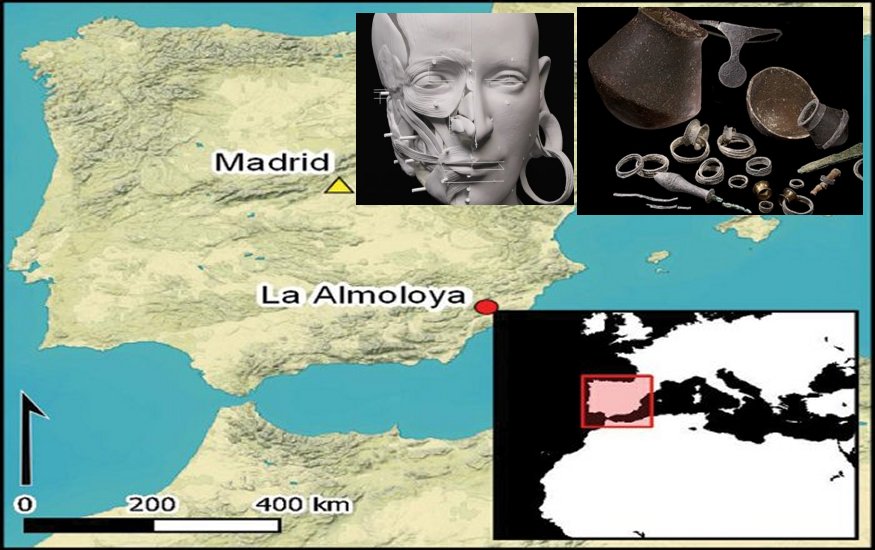
Background image source: Antiquity
Several items were recovered from the interior of the buildings, including objects made with metals, bones, stones, fabrics, and ceramics, all in exceptional states of conservation.
Of the fifty tombs excavated from under the La Almoloya buildings, one stands out in particular.
It reveals the remains of a man and woman buried with their bodies in a flexed position and accompanied by some thirty objects containing precious metals and semi-precious stones.
"These grave goods have allowed us to grasp this individual's economic and political power and the dominant class to which they belonged," researchers announced.
One of the most outstanding pieces is a silver crown-like diadem that encircled the woman's skull.
The woman's remains were discovered beneath the ruins of the first palace unearthed in Western Europe, dating back to the Bronze Age (about 3,200 -1,200 BC).
The palace-like building was destroyed in a fire shortly after the individuals were buried.
The royal tomb indicates that she and probably other women of the El Argar society were mighty.
Fascinating Grave 38
The funerary goods in Grave 38 and the diadem discovered in La Almoloya is the only one to be preserved in Spain.

Some of the funerary goods from Grave 38 in La Almoloya. The silver diadem was found placed on the head of the woman with the disc-shaped appendix pointing downwards. Image credit: ASOME-UAB
The remains of a man aged 35 to 40 and a woman between 25 to 30 were found in a large ceramic jar located beneath the room's floor. According to genetic analysis, these two individuals died simultaneously or closed together in the mid-17th century BC. They were unrelated but did have a daughter buried near them. The woman had several congenital abnormalities and markings on the ribs that could indicate she had a pulmonary infection at the time of death. Meanwhile, the male also had wear and tear on his bones due to extensive physical activity like horse riding.
Researchers reconstructed the woman's face.
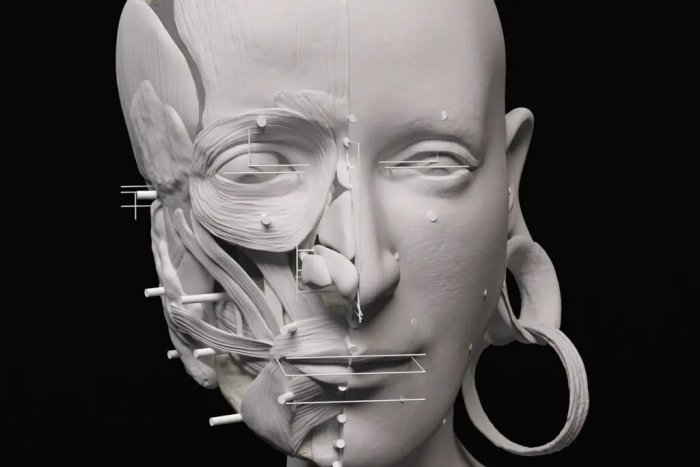
Facial reconstruction in a person's progress buried in Spain 3,700 years ago. Credit: Joana Bruno/ASOME/Autonomous University of Barcelona
Also, other El Argar tombs of the elite women contained prestigious funerary goods. However, especially diadems indicate these women's notable roles played in society.
Interestingly, the discovered diadems were symbolic, emblematic objects made for these women representing the dominant ruling class", according to Cristina Rihuete, one of the researchers involved in their study.
"Each piece is unique, comparable to funerary objects relating to the ruling class of other regions, such as Brittany, Wessex, and Unetice, or in the eastern Mediterranean of the 17th century BCE, contemporary to our Grave 38".

General view of the main buildings discovered in La Almoloya (Pliego, Murcia).
Were The Women Rulers, Or They Only Worn Emblematic Objects Symbolically?
This question has not been answered yet.
For now, it is only confirmed that in this fascinating advanced society, women of the dominant classes were buried with diadems, the men, on the other hand, were buried with a sword and dagger.
Did El Argar's men play an executive role while some women were government members?
Updated on February 10, 2024
Written by A. Sutherland – AncientPages.com Senior Staff Writer
Copyright © AncientPages.com All rights reserved. This material may not be published, broadcast, rewritten or redistributed in whole or part without the express written permission of AncientPages.com
Expand for referencesMore From Ancient Pages
-
 Why Was The Pineapple A Status Symbol Once?
-
 White Temple Of God Anu In Sacred Precinct Of Kullaba At Uruk
-
 Is Biblical Mount Sinai Located In Har Karkom Where Mesopotamian Moon God Sin Was Worshipped?
-
 Last Supper Of 15-Million-Year-Old Freshwater Fish
-
 Incredible Ancient Machines Invented By Hero Of Alexandria – An Engineer Far Ahead Of His Time
-
 Proof That Neanderthals Ate Crabs 90,000 Years Ago Is Another ‘Nail In The Coffin’ For Primitive Cave Dweller Stereotypes
-
 The Mysterious Metaphysical World Of Isaac Newton
-
 Old Royal Crime – Dark Riddle Of Young Princes In The Tower Of London
-
 Dangerous Anomaly Inside Mysterious European Mountain Remains Unexplained – Examining Evidence – Part 2
-
 Many Samurai Had Swords With Secret Crucifixes And Hidden Christian Symbols To Avoid Persecution
-
 Prehistoric Spread Of Millet From East Asia To Central Europe – New Study
-
 Mystery Of The 3,500-Year-Old ‘Screaming Woman’ Mummy Solved
-
 Ice Age Cycles Played A Key Role In Early Human Interbreeding
-
 On This Day In History: Louis Braille – Creator Of Alphabet For Blind People Died – On Jan 6, 1852
-
 Figurines Unearthed At 9,000-Year-Old Çatalhöyük Site Symbolize Elderly Women, Not Goddess Cybele
-
 Oklahoma’s Mysterious Hollow Hill – The Unexpected – Part 2
-
 Are Thunderbird Petroglyphs In Bighorn Basin Linked To Golden Eagle Nests?
-
 Unique Ancient Map Depicting The Earth As Seen From Space Restored Digitally
-
 Magnificent Alsengem Among 30,000 Archaeological Objects Discovered In Kalmar, Sweden
-
 World’s Oldest Recorded Solar Eclipse Re-Writes History Of Egyptian Pharaohs

