Ogham: Unique Celtic Alphabet Used By Druids And Abandoned During Christian Era
A. Sutherland - AncientPages.com - Ogham is ancient writing, of which the earliest examples date back to the 4th and 6th centuries A.D. The language of the inscriptions is Irish, but many inscriptions were found to have other equivalents in Roman and Latin; inscriptions in Scotland used the Ogham script with Old Norse or Pictish.
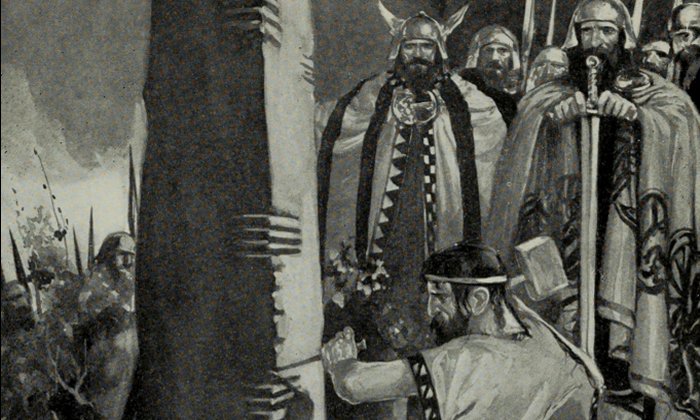
Carving of Ogham letters into a stone pillar - illustration by Stephen Reid (1873 - 1948), in: Myths & Legends of the Celtic Race by T. W. Rolleston (1857 - 1920), published 1911, p. 288. source
About 360 ogham stones have been recorded in Ireland (in Munster, Kerry, Cork, and Waterford), and the total number is more than 400, including those found in Britain. The ogham stones found in Scotland, Wales, and the Isle of Man are all linked to the Irish settlements that existed during the decline of the Roman Empire.
Numerous ancient literary sources suggest that the script was used by Celtic druids about two thousand years ago and functioned even in the times of St. Patrick in the 5th century. It was also practiced by bards, intellectuals, and others who knew how to read the Oghams.
Each Ogham letter has five lines, and it is pretty simple. Each line is read from bottom to top; the more content, the higher the stone. It has no tricky grammatical problems.
Ancient writing was preserved not only in stone but was also practiced using wood. Still, wood would not survive long due to weather and the passage of time.
The Oghams were found chiefly on boundary stones and burial markers across Scotland, Wales, Ireland, and England. However, burial markers were not many since it took a great deal of effort to dig a huge hole, find an appropriate boulder, move and place it next to the deceased person and then have a stone cutter properly mark it. It is believed that any ogham burial marker was for a person of some fame or money (or both).
An inscription was found in 1975 in Ratass Church, Tralee, County Kerry. Image credit: Jaqian - CC BY-SA 3.0
Ogham inscriptions were carved starting at the bottom left-hand side of the stone face. The Ogham is usually read upwards along the left-hand edge of the stone, sometimes across the top, and then down to the other side.
It is believed that the letters of Ogham are much older than the inscriptions. They were used for inscriptions on stones and contained a series of twenty characters arranged in four groups; each group formed one to five notches disposed of in one of four patterns: up, down, diagonal, and straight through.
They are carved on the edge of a piece of stone or wood.
Legends, Tales And Unknown Origin Of Ogham
The word 'ogham' is of unclear origin. The Ogham alphabet graphically represented the Pictish and Irish languages on stony monuments, mostly between 400 and 600 BC. When the spread of Christianity in Europe began, the system was considered a pagan legacy, and gradually, people stopped using it. However, the knowledge of the Ogham alphabet is still alive, and its samples attest to its use as late as the 19th century. Today, many people use the ogham as a divination tool, although there are only a few examples from ancient literature.
Ogham (Ogam), dated to 2200 BC, was an alphabet named after the ancient Irish god Ogma. Image credit: Runologist - CC BY-SA 4.0
There are several theories and pure guesses about its origin, but precisely when this mysterious system was introduced is unknown. Some relate the ogham to the runic alphabet, while others believe it is much older. In mythology, ogham was usually used in magic (mainly spells), but ancient Ogham stone inscriptions contained important messages only understood by heroes, magicians, gods, and warlords.
Legend has it the writing comes from the name of the Irish god Ogma, the Celtic god of eloquence and literature, and the invention of it is attributed to him as he was skilled in poetry and speech and created the system for the chosen ones – people who possess the knowledge. Ogma is known from the Irish lore as one of the Túatha Dé Danann.
Damian McManus, Professor of Early Irish at Trinity College, Dublin, and Head of the Department of Irish quotes it in "A Guide to Ogham." It reads as follows: "The inventor here is Ogma mac Elathan who is said to have been skilled in speech and poetry and to have created the system as proof of his intellectual ability and with the intention that it should be the preserve of the learned, to the exclusion of the rustics and fools."
Another legend is related to the Ogham stones with a small hole drilled in them. It says that those wanting to seal a deal or a contract would go to the rock, put fingers through the hole, and state their sides of the bargain, swearing by the bones of their ancestors beneath their feet. In case those who should not keep their part would suffer a curse.
Written by – A. Sutherland - AncientPages.com Senior Staff Writer
Updated on May 18, 2024
Copyright © AncientPages.com All rights reserved. This material may not be published, broadcast, rewritten or redistributed in whole or part without the express written permission of AncientPages.com
Expand for referencesReferences:
Matthews, Caitlin. Celtic Wisdom Sticks
Bailey M. Oghams; Letters inscribed in Stone
O'Sullivan, Muiris, and Liam Downey. "OGHAM STONES." Archaeology Ireland 28, no. 2 (2014): 26-29.
More From Ancient Pages
-
Why Was Ayllu Very Important For The Inca People?
Ancient History Facts | Feb 19, 2019 -
Mystery Of The Stone Of Destiny Solved – It Was Originally A Doorstep!
Archaeology | May 2, 2024 -
Cnut The Great – England’s Danish King And Ruler Of One Of The Largest Nordic Empires
Featured Stories | Jun 15, 2020 -
On This Day In History: Greek Archaeologist Manolis Andronikos Who Discovered Tomb of Philip II of Macedon, Was Born – On Oct 23, 1919
News | Oct 23, 2016 -
Stamp Suggests The Iconic Sutton Hoo Helmet Was Made In Denmark, Potentially Rewriting Early European History
Archaeology | Mar 28, 2025 -
Leonardo Da Vinci’s Mother Might Have Been A Slave – Here’s What The Discovery Reveals About Renaissance Europe
Featured Stories | Mar 30, 2023 -
Immigrants In Prehispanic Cancun Were Treated Just Like Maya Locals
Archaeology | Oct 26, 2023 -
On This Day In History: ‘Principia Mathematica’ Monumental Work Published By Isaac Newton – On July 5, 1687
News | Jul 5, 2016 -
Hellenistic Decorated Tombs And Tombstone Probably Used As A False Door Unearthed In Egypt
Archaeology | Jan 10, 2018 -
Kentucky’s Little-Known Ancient Underground City And Mysterious Lost Civilization
Featured Stories | Jun 13, 2024 -
Sensational Find: Huge Cuneiform Archive Of Mysterious Ancient Clay Tablets Discovered In Iraq
Archaeology | Oct 26, 2017 -
Harappan Civilization Built Massive Protection Walls Against Tsunami 5,000 Years Ago
Archaeology | Jan 10, 2017 -
Yum Kaax, Mayan God Of Agriculture, Lord Of Woods And Caretaker Of Animals
Featured Stories | Jul 15, 2020 -
Mysterious Death Of Amy Robsart – Murder, Accident Or Suicide?
Featured Stories | Jun 20, 2024 -
Mysterious Ancient Figure Depicted On A Jade Cong May Re-Write History Of China
Artifacts | Oct 11, 2019 -
Ancient Petroglyph Code Cracked By Archaeological Explorers
News | Apr 10, 2020 -
Letters Reveal How Ancient Egyptians Argued With Friends And What Angered Them
Civilizations | Oct 18, 2020 -
On This Day In History: Casanova – Famous Seducer And Adventurer Dies In A Castle In Bohemia – On June 4, 1798
News | Jun 4, 2016 -
On This Day In History: Supernova Observed In Constellation Lupus By Chinese And Egyptians – On May 1, 1006 AD
News | May 1, 2016 -
Millennia Old Ceremonial Stone Belt And Maya Pok-A-Tok Ball Game
Ancient Traditions And Customs | Nov 28, 2017