
Jiroft’s Konar Sandal – Home To A Huge Ziggurat And Many Ancient Treasures
Angela Sutherland - AncientPages.com - More than a hundred historical sites are recognized in the basin of a 400 kilometer stretch of Halil-Rud River in the south of Kerman province, a historically and archaeologically significant region of Iran.
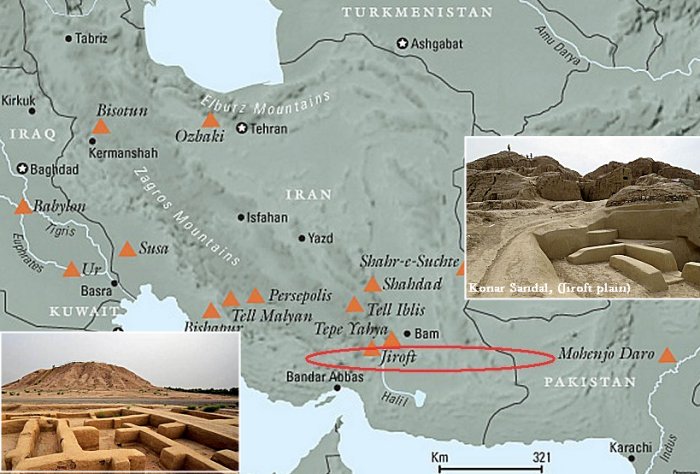
Among these places of a high cultural value, Konar Sandal is a Bronze Age archaeological site situated just south of Jiroft, Kermān Province, Iran. The Konar Sandal has many treasures, which we mention later in this article. First of all, the site has a ziggurat-like structure. It is today known as the Konar Sandal Ziggurat.
Before the discovery of the ziggurat in 2002, Chogha Zanbil, a significant leftover of the Elamite civilization near Susa, was the only surviving ziggurat in Iran. Built about 1250 BC during the Middle Elamite Period (c. 1500 – c. 1100 BC) by king Untash-Napirisha, to honor Sumerian god Inshushinak, Chogha Zanbil ziggurat has long remained the only still existing structure of this type
Yusef Majidzadeh, the director of the archaeological team working at the site, led excavations in the region for more than two decades. He said that the central part of the Konar Sandal Ziggurat is the lower part and is 200 years older than the upper section. Thus, the construction of the ziggurat was carried out in stages beginning in 2200 BC, and now, archaeologists have determined the original shape of the Konar Sandal Ziggurat. It will make the restoration of the ziggurat much easier.

Stone vessel, architectural decoration, Jiroft, Kerman, Iran. Image source
Two superimposed platforms are located on the mound of Konar Sandal North. The upper structure measures 150 x 150 m, and the lower 300 x 300 m. These measurements help us imagine that this gigantic ziggurat covered almost the whole mound and was constructed of more than four million mud bricks. There are still questions regarding the Konar Sandal Ziggurat, and particularly, the large platforms that form a stepped massif and resemble the ziggurats of Mesopotamia.
Also interesting, although not precisely explained, is a two-story citadel with a base covering approximately 13.5 hectares (33 acres) and surrounded by a fortress wall, which is 10.5 meters (34′) thick. While the ziggurat is a pyramid-like structure consisting of tiered platforms, a citadel, on the other hand, suggests a fortified building.
Jiroft - with more than a hundred historical sites - has ruins and artifacts dating back to the third millennium BC. Both Yusef Majidzadeh many other experts from Iran and abroad consider that the archaeological findings in Jiroft shed light on the so-called “Jiroft civilization” that existed between Mesopotamia and Indus valley and dated back to 3000 BC. They believe that Jiroft was the ancient city of Aratta, described as a great civilization in a Sumerian clay inscription.
Probably, it was an independent Bronze Age civilization with its own architecture and language, and the ruins may be the remains of the lost Aratta Kingdom.

Konar Sandal artifacts. source
However, the exact location of this civilization is unclear. Some scholars believe that Aratta was situated in Jiroft, but others suggest the kingdom was located in Azerbaijan, Baluchistan, or even the Gulf.
A New Writing System Discovered At The Site Of Konar Sandal
A few years ago, a new writing system probably dated to the second half of 3000 BC was unearthed at the site of Konar Sandal.
Three of them represent a Linear Elamite inscription and a second inscription with unknown signs dubbed as ‘Geometric.’ The fourth tablet remains enigmatic. However, according to scientists, the analyzed geometric signs dated to 3000 BC suggest that they may be musical scores.
In our article “Is Mysterious Prehistoric Jiroft The Legendary Land Of Aratta? we write that “many valuable objects, including two clay inscriptions carrying the oldest human scripts, have been unearthed during authorized excavations in the region.
Numerous fascinating artifacts unearthed at the site are of great value. There are two remarkable stone reliefs unearthed in the Konar Sandal. They are carved on soapstones and depict two men with human faces and snake bodies instead of legs.
Still, not much is known about this region of Iran. Excavations carried out from 2006 to 2009 revealed the remains of three settlements dated to 4000 BC. Even more, artworks were unearthed in 2014, and these finds attest that the ancient people of this region had not one but several writing systems.
Written by – A. Sutherland - AncientPages.com Senior Staff Writer
Copyright © AncientPages.com All rights reserved. This material may not be published, broadcast, rewritten or redistributed in whole or part without the express written permission of AncientPages.com
Expand for referencesReferences:
More From Ancient Pages
-
 Famous Viking Sigurd Snake-In-The-Eye, Son Of Ragnar Lodbrok And The Mark Of Fafnir Prophecy
-
 Hundreds Of Ancient Sealed Wine Jars Found In Mysterious Tomb Of Meret-Neith In Abydos
-
 Uplistsikhe Devastated By Genghis-Khan Hordes But Once City-Fortress Of Queen Tamar
-
 ‘Impossible’ Ancient Traces Of Humans – No, We Are Not The First
-
 South Africa ‘s Blombos Cave: Ochre Was A Tool For Stone Toolmaking During The Middle Stone Age
-
 How Human Ancestors Used Fire – New Methods Give Answers
-
 Sophisticated Lenses Of Minoans Discovered In The Sacred Idaion (Ideon) Cave
-
 Ancient Monuments The World Is Not Allowed To See – Forbidden Zone – Part 2
-
 Climate, Conflict, Collapse: How Drought Destabilized The Last Major Precolonial Mayan City
-
 Evidence Of Lost Advanced Ancient Technology In Babylon
-
 Nephthys – Egyptian Funerary Goddess Who Also Protected The Pharaohs While They Were Alive
-
 Ancestors Of The Irish And Scots Came From Biblical Lands And Ancient Egypt – Myths, History And DNA
-
 Was Spruce Hill In Ohio Home To An Ancient Lost Civilization? Traces Of Strong Fire Puzzle Scientists
-
 Italy’s Stunning Secret Temples Of Damanhur – City Of Light
-
 Has The Legendary Viking Stronghold Jomsborg Finally Been Found?
-
 Spectacular 6th Century Sword With Runes Found In Anglo-Saxon Grave Near Canterbury In Kent
-
 Riddle Of The Hanging Gardens Of Babylon – Ancient Place Still Shrouded In Mystery – Part 1
-
 Seven New Ancient Buddhist Caves – One With ‘A Harmika’ – Discovered In Mumbai
-
 Unexpected Substance Found In Ancient Maya City May Have Arrived Through Distant Trade
-
 The Faery Grail Of Hospitality And Accord- The Forgotten Story – Part 1

