
Hypnos: God Of Sleep Who Owns Much Of Our Lives In Greek Mythology
A. Sutherland - AncientPages.com - In "Theogony," a Greek poet Hesiod who likely lived around 700 BC, tells about Hypnos, the god of sleep, and his twin brother, Thanatos, the god of death, who the Greeks occasionally saw as a harbinger of a peaceful death. Their parents were Nyx, the goddess of the night, and Erebus, the god of darkness.
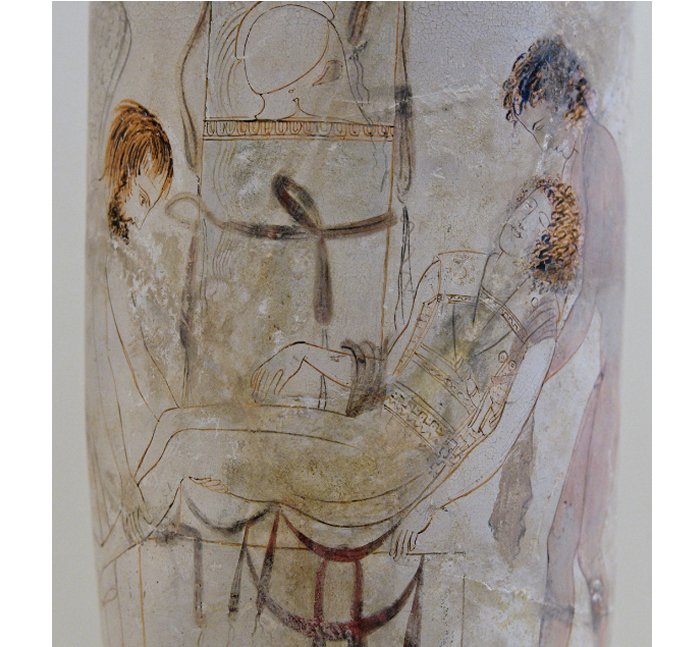 Hypnos and Thanatos carrying the body of Sarpedon from the battlefield of Troy; detail from an Attic white-ground lekythos, ca. 440 BC. source
The two divine brothers work in good cooperation, and together, they successfully help humans avoid unnecessary suffering and die peacefully during sleep. Hypnos masters people's dreams and owns half of their lives, watching over men's dreams and above all over the gods' dreaming.
Homeric sleep – pleasant but sometimes dangerous
In the "Iliad," Homeric sleep is a good, sweet, and pleasant thing. It brings rest to the exhausted body and brain and helps to forget sorrows.
But sometimes, sleep can also be dangerous when it occurs at the wrong time and place, especially when action is urgently needed. Patroclus, the friend of Achilles, puts on his armor and commands the Myrmidons in a battle against the Trojans. Sadly, he is slain by Hector, one of King Priam's sons. Then, the ghost of Patroclus reproaches Achilles for forgetting his duties towards his dead friend.
In "The Iliad," Homer (c. 800 -c. 701 BC) wrote that to prevent Zeus from joining the Trojan War, Hypnos put Zeus to sleep. Strongly influenced by the goddess Hera's power of persuasion, he did what she wanted. Hera and Thanatos could then bring the body of Sarpedon back to his native Lydia. Sarpedon was a Lycian prince and a hero in the Trojan War, killed before Troy's gates in the battle against the Greeks.
Hypnos successfully outmaneuvered Zeus, and it certainly was a desirable deed, but soon, the father of the gods woke up and knew that he was fooled. He could not even punish Hypnos because "the guilty" already arranged his escape to avoid Zeus' anger and hid in his mother's underworld cave.
Hypnos was usually depicted as a young winged man or boy holding poppy flowers in his hand (or in his hair) and an opium horn.
Among other elements related to Hypnos and his work is an opium horn, which allows him to induce sleep in people.

Hypnos was the God of sleep in Greek mythology. Credit: Adobe Stock - matiasdelcarmine
Tradition has it that he lives in a big cave palace in the underworld. Around his home entrance, grow beautiful poppies and other sleep-inducing plants. Around the cave flows the river Lethe ("Forgetfulness"), one of Hades' underworld's five rivers. Homer's version, the master of people's and gods' dreams, lives on Lemnos, his private dream-island.
He never sets his eyes on the sun, and the night is his kingdom.
The Greeks believed that the consequence of the Hypnos' appearance was the spreading of sleep-weariness, after which came the time of peaceful sleep. Everybody respected Hypnos, and none of the deities (much less human beings) could resist his great power.
Selene, Endymion and Hypnos
An important role plays Hypnos in the tale of Selene and Endymion.
In myth, Endymion is a shepherd who admires the night sky and the moon goddess Selene. Selene falls in love with a handsome boy and often watches over him while he sleeps.
Endymion wanted her love to stay that way forever, but there were problems because Zeus did not want to make Endymion immortal, so Hypnos gave him the power to sleep with his eyes open. From now on, Endymion could constantly watch Selene moving across the night sky.
There was also another reason why Hypnos agreed to give him eternal sleep. The god himself could forever look into Endymion's beautiful eyes and handsome face, and so could Selene.
Legend says that Hypnos travels far and wide across the land and sea with fantastic speed and touches the person's forehead in question with a branch or drops on the eyes, the liquid he carries in his horn of opium.
Three sons of Hypnos
It is believed that he had many sons (the Oneroi), but only three of them are considered as gods of dreams: the first is Morpheus, the assistant of his father Hypnos), delivers dreams to all, but with extreme caution applying the dreams of kings and heroes.
Phobetor appears in dreams "in the form of beast or bird or the long serpent" and delivers terrible dreams, can be a source of phobia), and Phantasos is responsible for surreal dreams or fantasy.
All of them still influence our dreams that can be frightening or pleasant, or good and bad. Humans dream, and so do animals because Hypnos and his sons own much of our lives and are with us forever.
Written by – A. Sutherland - AncientPages.com Senior Staff Writer
Copyright © AncientPages.com All rights reserved. This material may not be published, broadcast, rewritten or redistributed in whole or part without the express written permission of AncientPages.com
Expand for referencesReferences:
STAFFORD, EMMA J. "ASPECTS OF SLEEP IN HELLENISTIC SCULPTURE" Bulletin of the Institute of Classical Studies, no. 38 (1991): 105-20.
Cotterell, Arthur. A Dictionary of World
More From Ancient Pages
-
 Aboriginal Art And Knowledge Unlocks Mystery Of Fairy Circles
-
 Windover Pond – Remarkable 8,000-Year-Old Underwater Cemetery In North America
-
 Medieval Mystery Of The Booted Man Found In The Thames Mud
-
 Ekambareswarar Temple In Tamil Nadu, India Dedicated To Lord Shiva
-
 Archaeology Illuminates Chinese Businesses In Eugene
-
 Drought Was Not The Reason Cahokia, North America’s First City Was Suddenly Abandoned – New Study
-
 Cannabis Protected India’s Famous Ellora Caves From Decay For 1,500 Years
-
 On This Day In History: ‘Bloody Sunday’ In Northern Ireland – On Jan 30, 1972
-
 Unique 2,500-Year-Old Celtic Jewelry – Oldest Iron Age Gold Treasure Ever Found In Britain
-
 Eikthyrnir – Mythical Male Deer And Heidrun She-Goat Stand On The Top Of Valhalla
-
 War Between Romans And Persians Lasted 721 Years: One Of The World’s Longest Human Conflicts In History
-
 Ördög – Shapeshifting Demon Who Controls The Evil And Dark Forces In The World
-
 Prehistoric Humans Recycled Old Stone Tools To Preserve The Memory Of Their Ancestors
-
 Has The Viking Ship Burial Of King Bjørn Farmann Been Found At Jarlsberg Manor, Norway?
-
 Ancient Maya Drug Containers – Scientists Identified What’s Inside
-
 Ancient Manuscript In Museum Reveals Discovery Of Objects Unknown To Modern Science – Why Were The Ancient Time Capsules Hidden? – Part 3
-
 Ancient Health Center Discovered In Philadelphia, Central Anatolia, Turkey
-
 First Bathrooms Appeared Around 8,000 B.C In Scotland
-
 On This Day In History: Japanese Raid On The United States Navy At Pearl Harbor – On Dec 7, 1941
-
 Who Is Buried In The Giant Etruscan Tomb At San Giuliano Necropolis?

