
Phoenicians: Powerful Traders And Their Remarkable Seafaring Achievements
A. Sutherland - AncientPages.com - The Phoenicians remain one of the most enigmatic ancient civilizations. Our knowledge of these ancient people is based on scholars' speculations and educated guesses.
Although many Greek, Roman, and Egyptian writers mention the Phoenicians in trade records and military battles, only a few records were left by the original Phoenicians themselves, leaving modern scholars to fill in the blanks through these educated guesses and material culture.
With the material we possess, we can never obtain the whole picture of this civilization.
Today, their culture is associated with long-distance seafaring, trade and colonization, exploration, and language. However, in ancient times, the Phoenicians still needed to be protected from ground-based attacks. Therefore, over time, they developed a strong military and well-secured city fortifications that protected individual settlements.
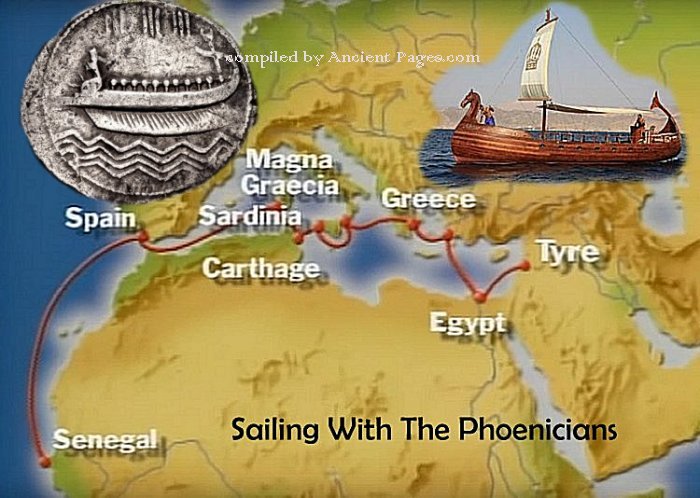
Interestingly, when they first appear in western records of the 8th and 7th century BC, the Phoenicians are described as those who possess many colonies, wide trade networks reaching as far as the Black Sea, from which they challenged the Greeks and later the Romans. Their ships were seen in harbors on the Atlantic coast of Africa.
According to Biblical accounts, already at an earlier period, the tenth century BC, their artisans, and artists were matchless, and they were sponsoring, together with King Solomon, ambitious naval accomplishments.
However, scholars continue to question when the Phoenicians became powerful, where they came from, and how they came to be such excellent navigators and successful merchants who managed to colonize much of the Mediterranean region.
The Canaanites' Origin Of The Phoenicians
The Phoenicians originated from the Canaanites' ancient culture in the region during the earlier Bronze Age (3000-1200 BC. It was concentrated along the coast of Lebanon and included some coastal areas of modern Syria and Galilee, reaching as far north as Arwad and as far south as Acre.
Phoenicia was not a single centrally administered state; it was more akin to ancient Greece, with its city-states, and one of the wealthiest and most developed state organisms of antiquity. Because the Phoenicians were spread out, they possessed numerous city-states that formed essential parts of their maritime trade networks. Archaeologists have discovered around eighty separate city-states scattered through a diverse region.
The most significant city-states were in the region of Lebanon, where the Phoenicians originated. Other settlements, also of great importance could be found in Algeria, Libya, Malta, Cyprus, Italy, Spain, Tunisia, Turkey, and Morocco.
The Phoenician Civilization With Many Contradictions
"The Phoenicians were a clever race, who prospered in war and peace," wrote around AD 43, the earliest Roman geographer, Pomponius Mela. Mela described the Phoenicians as the ones who "excelled in writing and literature, and other arts, in seamanship, and in ruling an empire."
He also wrote they were great writers, yet they left almost no documents.
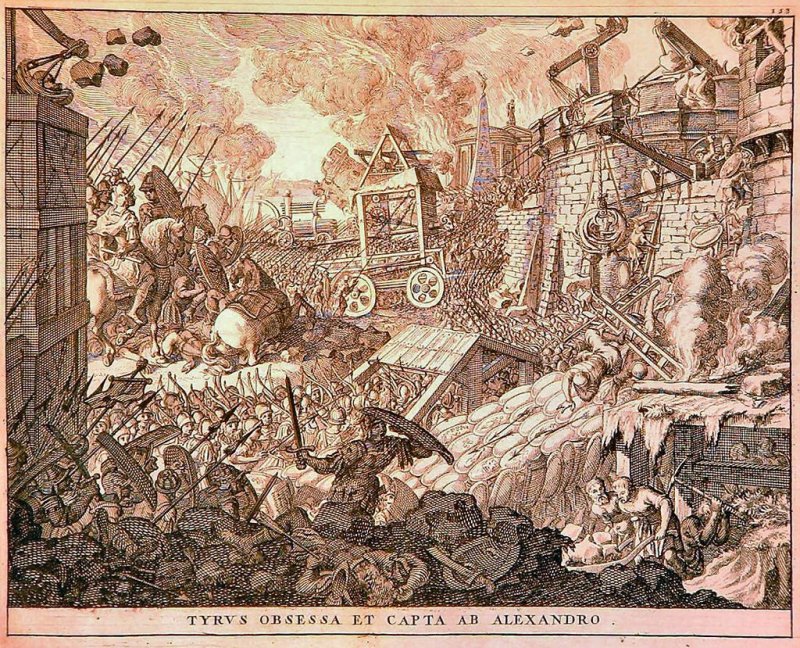
Siege of Tyre. Drawing of the end of the 17th century. Public Domain
They may have been excellent sailors and naval commanders, yet they built no territorial empire. They were stellar artists, yet their work contains few original elements. They may have been creative builders, yet their monuments crumbled. And the Phoenicians were a single civilization, yet they were split into city-states.
However, not all writers praised the Phoenicians. The ancient view of this civilization varied.
Some Interesting Questions About The Phoenicians
Some interesting and unanswered though valid questions are: How could a civilization exist with so many contradictions? How can modern historians utilize evidence that no longer seems to exist to uncover the truth about these people? And why did their civilization finally crumble?
As Canaanites, they had remarkable seafaring achievements. The Phoenicians were great maritime people, known for their mighty ships and a great experience as sea traders, traveling across the Mediterranean Sea and reaching as far north as Britain, Egypt, and Senegal.
The basis of their prosperity was long-distance trade that at that time was greatly influenced by the favorable location of colonies and cities on the main trade lines.
The Phoenicians' unique, perfectly organized commercial network flourished across the Mediterranean Sea in the 5th century BC. The ships in all sizes and all possible uses in different areas were included in the Phoenician trade network and reached very far.

A phoenician ship leaves the city of Carthage. Credit: Massimo Todaro - Adobe Stock
Their man-powered sailing vessels are mentioned in very early records confirming their arrival in Egypt from Byblos loaded with cedarwood in ca. 3000 BC. They were also used during the time of Carthage's defeat by the Roman forces in 146 BC.
Timber, spices, amber, gems, copper, and slaves had to be transported systematically from one country to another despite great distances.
The export goods were agricultural fruits and handicrafts, luxury metal products, the so-called Phoenician purple, greatly prized in antiquity and used as a fabric dye as early as 1200 BCE by the Phoenicians, and later continued by the Greeks and Roman. Above all, however, Lebanese cedars represented a precious and profitable material.
In exchange, Phoenician merchants imported gold, silver, tin, lead, copper, and slaves, which were traded on a large scale.
Phoenicians' Key Achievement - Alphabet And Writing
No doubt, the Phoenicians' outstanding achievement was the development of writing, with letters that were later taken over and expanded by the Greeks forming the Latin alphabet.
This alphabet originates from the Proto-Canaanite alphabet, during the 15th century BC, and earlier, the Phoenicians wrote with a cuneiform script. The earliest known inscriptions in the Phoenician alphabet come from Byblos and date back to 1000 BC. Many alphabetic writing systems like Greek, Etruscan, Latin, Arabic, and Hebrew and India and East Asia's scripts can be traced back to the Phoenician alphabet.
Phoenician Cities Under Foreign Rule
For most of their history, the Phoenicians remained under foreign rule or influence of political powers like Egypt, Assyria, Babylon, Persia, Macedonia, and Rome.
Gradually, the Phoenicia began to decline, and finally, Alexander the Great conquered Tyre and other Phoenician cities in 332 BC.
After him, the Phoenicians came under Ptolemy's Egypt's rule, and later the Syrian Seleucids. In 64 BC, the Phoenician cities were under the control of the Romans.
Written by – A. Sutherland - AncientPages.com Senior Staff Writer
Copyright © AncientPages.com All rights reserved. This material may not be published, broadcast, rewritten or redistributed in whole or part without the express written permission of AncientPages.com
Expand for referencesReferences:
Sabatino Moscati, The Phoenicians
Harden, D. The Phoenicians.
De Lafayette, Phoenicia, Ur, and Carthage: Artifacts, Inscriptions, Slabs, Sites
More From Ancient Pages
-
 Great Serpent Mound Of Ohio: Most Famous Ancient Earthwork Of North America
-
 Curly Hair Protected The Brain Of Early Humans And Helped It Grow
-
 A Ptolemaic Mummy Reveals Evidence Of Dental Filling Used In Ancient Egypt
-
 Rare Coins Found In A Dead Sea Cave Offer First Solid Evidence For The Maccabean Revolt 2,200 Years Ago
-
 Anne Askew: Woman Of Great Courage, Strong Beliefs And Principles Who Was Arrested For Heresy, Imprisoned, Tortured And Burnt At The Stake
-
 On This Day In History: Dr Martin Luther King Was Born – On Jan 15, 1929
-
 Ancient Greco-Roman Amphora Workshop Discovered In Alexandria, Egypt
-
 Spectacular 2,500 Years Old Shwedagon Pagoda In Myanmar – World’s Oldest Pagoda
-
 Ancient Egyptian Guide To Rostau – The Underworld Of God Osiris May Be World’s Oldest Illustrated Book
-
 New Study Questions Claims Homo Naledi Was Advanced
-
 Laocoon – A Trojan Priest Who Offended The Gods And Was Strangled By Sea Serpents
-
 Ancient Egyptian Papyrus Tells A Different Story About Biblical Isaac’s Fate
-
 Fascinating Virtual Avatar Of Mysterious Egtved Girl Created – What Is Her Story?
-
 Gunung Padang – Remarkable Megalithic Site In Indonesia
-
 One Of The Largest Anglo-Saxon Burial Grounds Ever Uncovered In Britain Reported By Archaeologists
-
 Pliska: Ancient City Ahead Of Its Time With Secret Underground Tunnels, Sewage And Heating Systems
-
 Does A Baffling Artifact Offer Evidence Of Ancient Extraterrestrial Visitation In New Zealand? – The Discovery – Part 1
-
 On This Day In History: First Battle Of Reading Took Place – On Jan 4, 871 AD
-
 13,000-Year-Old Engraving May Depict First Paleolithic Social Group Of Humans
-
 Engraved Trees Are Living Records Capturing The Rich History And Traditions Of The Sámi People


.jpg)