
Qanats: Ancient 3,000-Year-Old Underground Irrigation Canals Invented By People Of Persia
A. Sutherland - AncientPages.com - One of the ancient times' most amazing technologies is underground irrigation canals known as "qanats."
The qanats transported water from water wells to the surface for irrigation and drinking, and they could do it over long distances.
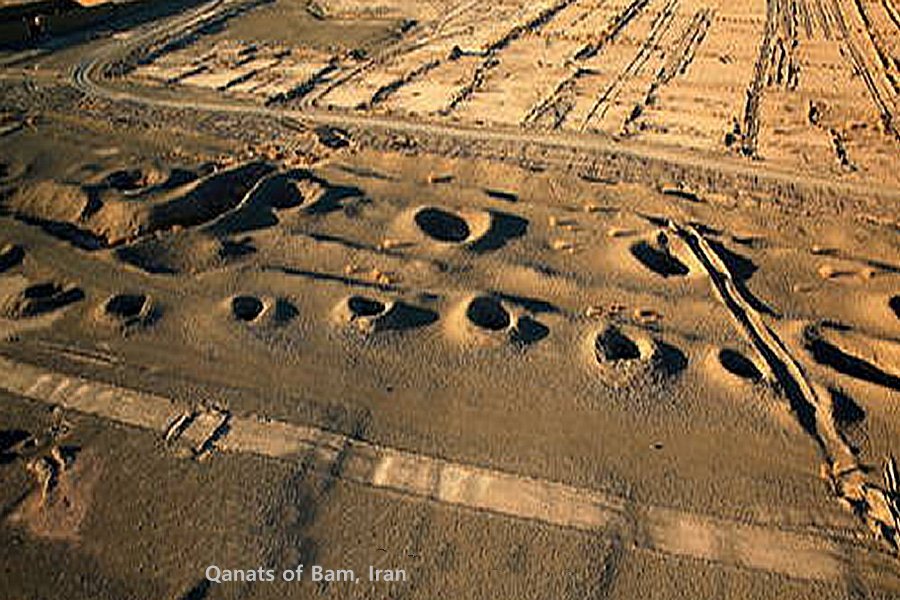
The technology- dated back more than 3000 years - was developed in ancient Persia. In the early part of the first millennium BC, Persians began to construct complex tunnel systems called 'qanats' for extracting groundwater in the dry mountain basins of present-day Iran. Later, the qanats gradually spread, and many of them are continuously in use stretching from China on the east to Morocco on the west, and even to both American continents. In fact, about 20,000 other qanats are still in use.
Qanat tunnels - often several kilometers long - were hand-dug, and their size was just large enough to fit the person doing the digging. Qanat builders sank vertical shafts along the tunnel at intervals of 20 to 30 meters. This space was needed to remove excavated material and to provide ventilation and access for future repairs.
The ancient Persian qanat water delivery system proved to have many apparent advantages. For example, it limited water loss from seepage and evaporation, and no pumps were necessary because the qanat system could function based entirely on gravity.

One of the longest known qanats in the world that is 70 km long is located in Iran. The qanat in the city of Gonabad ("Qanats of Gonabad"), which is the oldest and largest, is part of the Unesco World Heritage List since 2007. Built between 700 and 500 BC by the Achaemenid Empire in what is now Gonabad, Razavi Khorasan Province, Iran, the complex contains 427 water wells with a total length of 33,113 meters (20.575 mi).
Today, Gonabad's qanat provides water to more than 40,000 people.
With the conquests of the Persians, the qanats expanded from Egypt to Bactria (in modern times, certain parts of Tajikistan, northern Afghanistan, and southern Uzbekistan.
Many others can be found in the north of Africa, in the Middle East, China India, as well as in Sicily, in the southern parts of Spain and in the Canaries.

With this ancient technology, the Persians could build a set of vertical wells. It was important to dig them on a hill to reach a source of underground water. Then, the secondary wells connected the tunnel with the surface and finally, irrigation channels carried the water to respective areas.
The qanats significantly contributed to the prosperity and good life of the Persian people in regions exposed to bad weather conditions.
The vertical wells allowed access and help to ventilate the entire system. The wells are connected to a drainage gallery that is somewhat inclined, which helps water to descend in the form of waterfalls.
The qanats still create a reliable supply of water for human settlements and irrigation in hot, arid, and semi-arid climates.
Written by – A. Sutherland AncientPages.com Staff Writer
Updated on November 5, 2022
Copyright © AncientPages.com All rights reserved. This material may not be published, broadcast, rewritten or redistributed in whole or part without the express written permission of AncientPages.com
More From Ancient Pages
-
 Secrets Of The Jungle And Hidden Ancient Treasures Of The Serpent People
-
 Ancient Mysteries Of The Amazon Jungle – Survivors Of The Great Flood Or An Atlantean Race Hidden In The Forest? – Part 2
-
 Atlit Yam – Fate Of The 9,000-Year-Old Underwater Megalithic Site With A Huge Stone Circle
-
 Tarkhan Dress – The World’s Oldest Woven Garment
-
 Mysterious Shasu – Bandit Canaanites Or Israelites?
-
 Unexplained Historical Mass Disappearances – Lost Without Trace – Part 1
-
 There Is Evidence Humans Reached North America 130,000 Years Ago – Archaeologist Says
-
 Colossi Of Memnon: Gigantic Stone Statues Guarding The Temple Of Pharaoh Amenhotep III
-
 Researchers Study Human Mobility At The Bronze Age City Of Alalakh, Turkey
-
 Fossils, Fires And Focus On Early Human Activity In Southeast Asia Jungles
-
 First Genome-Wide Ancient Human DNA From Sudan Shines New Light On Nile Valley Past
-
 Rök Stone (Rök Runestone): Longest Runic Inscription Ever Discovered
-
 Ancient Sound Of Stones – Acoustics At Stonehenge Tested By Scientists
-
 Spectacular 6th Century Sword With Runes Found In Anglo-Saxon Grave Near Canterbury In Kent
-
 Unexplained Sightings Of An Unknown Parallel World – Did He Stumble Upon An Interdimensional Portal?
-
 Cooking, Roasting And Eating Of Root Plants Is 120,000-Year-Old Habit
-
 LIDAR Discovers Huge, Sophisticated Ancient Native American Farming System In The Sacred Anaem Omot Area In Michigan
-
 Why Were Viking Raids So Successful?
-
 Manuscripts And Art Support Evidence That Syphilis Was In Europe Long Before Explorers Could Have Brought It Home
-
 Evolution Puzzle – Broken Hill Skull And Homo Heidelbergensis Cast Doubt Over Modern Human Ancestry

