
God Dagda – A Powerful Leader Of The Tuatha De Danann In Celtic Mythology
Thalia Lightbringer - AncientPages.com - The Dagda was an ancient god of the earth, originally an agricultural god. When Christianity became dominant in Ireland, the Dagda became a comical figure, a brute giant with a huge gut. This was poor treatment of this respected god of many talents, called the "Good God" or "Shining" in old Celtic myths.
There are many stories of the Dagda showing he was originally one of the best of the gods and should be remembered as such.

Aspects of the Dagda, compiled by Thalia Lightbringer/ancientpages.com
Who Was The Dagda?
The Dagda had several titles, but apparently his original name was a mouthful. In the Cath Maige Tuired, he reveals that his true name is Fer Benn ("horned man"), like the horned god of the forest, Cernunnos. But Dagda continues, relating that his complete name is Fer Benn Bruach Brogaill Broumide Cerbad Caic Rolaig…and it goes on!
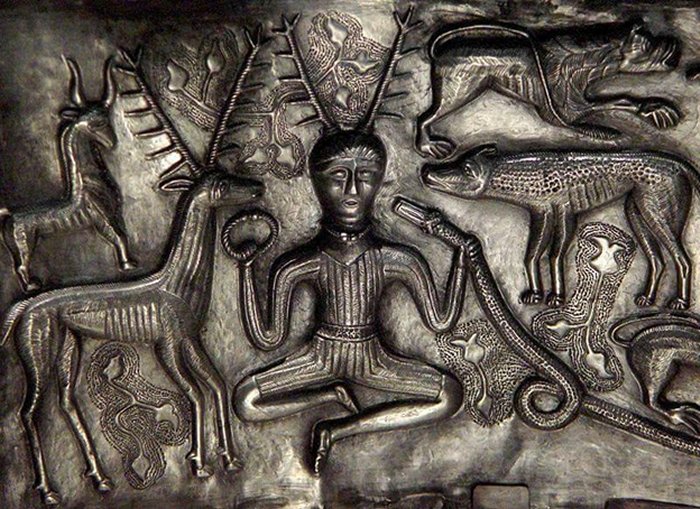
Gundestrup antlered figure, derivative work- Public Domain - CC BY-SA 3.0
The Dagda was called Eochaid Ollathair the "All-Father," not because he was the father of all the people, but rather because he acted as a father, a protector of all. This makes it tempting to compare him to the Norse god Odin, but the Dagda is more like warrior Thor, the Thunderer, with his mighty weapon. The Dagda's mother was the great goddess Dana, a sort of "All-Mother." His father was Elatha, king of the Fomorians. Among his brothers was Ogma, the god of poetry. Another is Ler or Lir, a personification of the sea.
One of Dagda’s titles is Ruad Rofhessa (mighty red one or noble lord of great knowledge), giving him an association with the druids. This also shows that far from being a figure to laugh at, he was considered extremely wise and powerful. Other important titles were Samildanach (meaning he had many skills or talents) and Cera (indicating he was a creator god).
The Dagda was one of the eldest of the Tuatha de Danann, the Children of Danu (or Dana). But the Dagda was not their first leader. Their first king in Ireland was Nuada, who wielded the Sword of Light, one of the four great treasures. When fighting for land with the Fir Bolg, Nuada lost an arm.
The physician Dian Cecht (sometimes said to be a son of the Dagda) fashioned him a working artificial hand out of silver and he became "Nuada Silverhand,” but could no longer be king. The tradition of those times was that the leader had to be physically perfect.
Conflict With The Fomorians
Despite the traditional rivalry against the Fomorians, an adopted half-Fomorian named Bres mac Elathan then became king of the Tuatha. It was a short rule. The Fomorians imposed difficult conditions, requiring great tribute, making the people resentful. Dian Cecht's son Miach found a way to regrow Nuada’s arm and his kingship was restored. He ruled for another twenty years.
Bres attempted to retake the kingship, teaming up with the Fomorian Balor of the Evil Eye. Before the great battle, Nuada asked his people what powers they would bring to his aid. After listening to them all, the Dagda claimed he would wield all of those powers at once himself. Then all exclaimed he was the "Good God" (Dagda), which is how he gained that name.
The Dagda helped to win the war by spying on the enemy camp before the battle. When returning at Samhain, he saw the Morrigan bathing in a river. They had a fling, conceiving Brigid, goddess of healing. Then the Morrigan gave Dagda a prophecy of the Fomorian battle plan, predicting victory over Balor.
Nuada put Lugh of the Long Arm in charge of leading the Tuatha and he triumphed using his great spear, another of the four treasures. The Dagda had a huge club which could kill nine men in one blow and could restore life with the other end. This great club of wrath (lorg mor or lorg anfaid) took out many enemies. However, in this battle, Nuada was beheaded and killed. Lugh then became the leader.
Magical Treasures
After Lugh, the Dagda reigned about seventy or eighty years. The Dagda possessed another of the great treasures, the Cauldron of Plenty, which is never dry or empty of food and could also be used to restore life to fallen warriors.

Dagda, o bom deus, by Jordan Brito - Public Domain - CC BY-SA 4.0
After Lugh, the Dagda reigned about seventy or eighty years. The Dagda possessed another of the great treasures, the Cauldron of Plenty (the coire ansic, or cauldron which is never dry), sometimes referred to as the Undry. It was never empty of food and could also be used to restore life to fallen warriors.
The Dagda was called a god of music because he played a magical harp called the Uaithne, also known as "the Four Angled Music," made of oak and richly ornamented with jewels. The Dagda was said to be able to control time and the seasons with Uaithne. This was how he stopped the sun when his lover Boann was pregnant with his son Angus Og. The harp’s music could command order in battles or play three types of music which caused the emotion, inspiring great sorrow, joy, or sleep and dreaming.
When Fomorians stole the harp, the Dagda discovered the keep where it hung upon a wall. The harp magically flew to his hand when he called it, killing nine men. Dagda then used Uaithne, causing his enemies to cry and laugh uncontrollably, then to fall asleep and dream.
The Dagda had other affairs and fathered Bodb Derg (who became king after him), Cermait who tried to steal Lugh's wife and was killed for it, possibly Aed, lord of the Underworld, and Midir of Bri Leith, who figures in the intriguing story of the Three Etains.
The Dagda was seen as a god of plenty due to his cauldron, as well as his fruit trees at Newgrange which always bore fruit and two pigs, one always growing and the other perpetually roasting. The Dagda is also linked with several other places. The Cerne Abbas Giant in Dorset, England is thought to depict him.
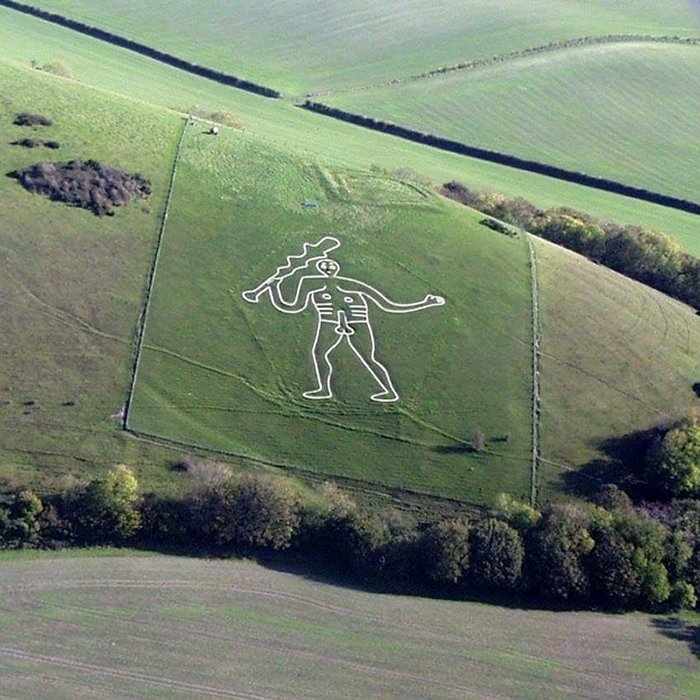
The Cerne Abbas Giant by PeteHarlow - Public Domain - CC BY-SA 3.0
Because of the magical harp with which the Dagda could control time and the seasons, he has been seen as a solar god of fertility and abundance, protecting the crops. Some sources link him with the harvest gods Crom Cruach and Crom Dubh.
Despite the crude picture painted of the Dagda in later times, it is clear from the stories that he was considered worthy by many women to have children with, a great warrior, and very knowledgeable. He was a god-like Lugh with an unbelievable number of skills and powers. He was one of the greatest of the Tuatha de Danann and deserves to be portrayed with respect.
Updated on March 16, 2024
Written by – Thalia Lightbringer – AncientPages.com Staff Writer
Copyright © AncientPages.com All rights reserved. This material may not be published, broadcast, rewritten or redistributed in whole or part without the express written permission of AncientPages.com
Expand for referencesReferences:
Celtic Myth and Legend: Poetry & Romance, by Charles Squire, 1905 (Original Title: The Mythology of the British Islands; and introduction to Celtic Myth, Legend, Poetry and Romance, published London, Blackie and Son Limited [1905])
Cath Maige Tuired: The Second Battle of Mag Tuired, Translated by Elizabeth A. Gray, 1982, Irish Texts Society, Kildare
Cuchulain of Muirthemne: The Story of the Men of the Red Branch of Ulster, arranged and put into English by Lady Augusta Gregory, with a preface by W. B. Yeats, London, J. Murray, 1902
Gods and Fighting Men: The Story of the Tuatha De Danaan and of the Fianna of Ireland, arranged and put into English by Lady Augusta Gregory, with a preface by W. B. Yeats, London, J. Murray, 1904
The Encyclopedia of Celtic Mythology and Folklore, by Patricia Monaghan, 2004, published by Facts On File, Inc., New York, NY
More From Ancient Pages
-
 Stonehenge May Have Aligned With The Moon As Well As The Sun
-
 Source Of Ancient Roman Silver Was The Iberian Peninsula
-
 World’s oldest bible -The Codex Sinaiticus – to be displayed at the British Museum
-
 Skulls and inscriptions on three rings found by archaeologists in Wales
-
 Unsolved Mysteries Of Cahokia – What Really Happened With The Large Metropolis?
-
 Stone Of Scone: Mysterious Stone Of Destiny Has Turbulent Ancient History
-
 Stonehenge’s Monumental Altar Stone Came From Scotland – Not Wales As Previously Thought
-
 India: Plastic Surgery And Genetic Science – Found In Ancient Vedas – Were Practiced Thousands Of Years Ago
-
 Impressive Complex Of 4,000-Year-Old Walled Oases Discovered In The Arabian Desert
-
 Large Underwater Site That Was Home To 500,000 People About 14,000 Years Ago Identified Northwest Of Australia
-
 Ancient Mystery From The Age Of Taurus And The Murdered Astronomer – Overlooked Secret In The North – Part 1
-
 On This Day In History: Ceres Discovered By Giuseppe Piazzi – On Jan 1, 1801
-
 First Chinese Murals Unearthed In Shimao Ruins Are Over 4,000 Years Old
-
 Mystery Of Pre-Adamic Didanum Race: Giants Who Were Ancestors Of The Nephilim and Rephaim
-
 Prince John’s Plot Against King Richard The Lionheart
-
 Ancient DNA Shows Neanderthals Used Plant-Based Medicine To Treat Pain And Illness
-
 Fascinating Accounts Of Incredible Vehicles, Cosmic Cities In Vedic Literature
-
 Lao Tzu: Legendary Thinker And Founder Of Taoism Who Advocated Modesty, Self-Restraint And Balance
-
 Archaeology Illuminates Chinese Businesses In Eugene
-
 Nicolas Bourbaki: The Greatest Mathematician Who Never Was

