
What Is The Meaning Of Ankh – Ancient Egyptian Symbol
A. Sutherland - AncientPages.com - Different people have different religions. Each religion has its symbols and characteristic signs.
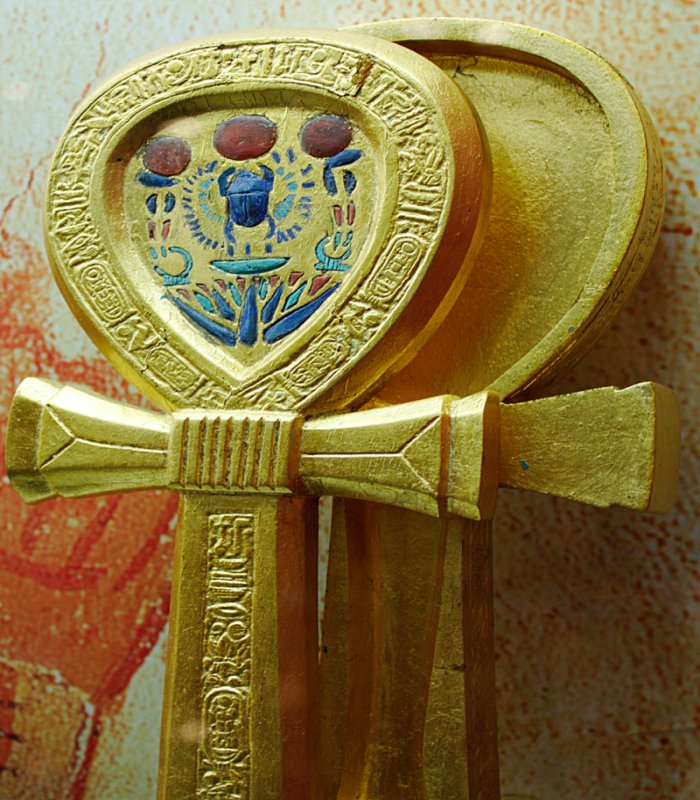
Egyptian Ankh. Image credit: Nachbarnebenan - Public Domain
Just as the symbol of Christianity has become the cross, known in several variants, and before it was a fish sign, so is the Ankh, a symbol of the ancient religion of Egypt.
Many Interpretations Of The Ankh
Some interpret this symbol according to its two parts – the oval shape symbolizes the eternity of living deities, and the cross that comes out of it is continuation and extension.
In Egyptian hieroglyphs since the Old Kingdom period, the Ankh symbolized life but not the 'life' (this everyday, ordinary life) we think of. The ancient Egyptians associated the Ankh with the soul's spiritual life, which most do not even think about daily.
But the Ankh is also the subject of other interpretations. It combines the two forces of life - the male and female symbols of Osiris and Isis.
It is the union between heaven and earth and unifying feminine and masculine principles.

First Dynasty stone dish in the shape of an ankh, embraced by a pair of hands representing ka.Image credit: Soutekh67 - CC BY-SA 4.0.
It also symbolized fertility as the sign's loop was associated with a woman's womb. Later, the Ankh was given a magical meaning as it was believed it possessed a mystic vital force.
Mystics and enthusiasts of secret knowledge in the 19th century and even the 20th century's New Age movements have considered the Ankh a powerful symbol of prosperity, health, good fortune, and protection against defeat, fall, and destruction.
Ankh Was Associated With Many Egyptian Deities
There are many depictions of Egyptian deities holding the Ankh. Maat, the goddess of truth, holds an ankh in her hand; however, the goddess Isis is most often seen carrying it. Also, Atum, the god of the sun from Heliopolis, and Sekhmet, a warrior goddess and a goddess of healing, were often depicted with the Ankh.
There are also representations of the pharaoh who stands between the gods and holds the Ankh in his palm. In this case, the sign emphasizes the pharaoh's divine nature.
Ankh Decorated Walls Of Egyptian Temples
In Egyptian tomb paintings and other art, the Ankh appears frequently. As a symbol of imperishable vital force, the Ankh was painted on the walls of the temples, stelae, and in friezes of objects, especially near the feet, to provide divine protection to the dead.
It often appears at the fingertips of a god or goddess in images representing the afterlife's deities conferring the gift of life on the dead person's mummy.
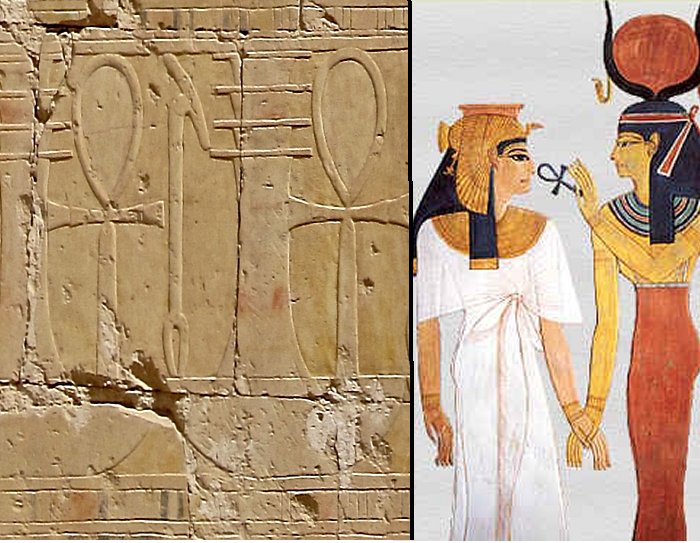
Left: Frieze of ankh, signs of djed and was at the top of the hieroglyph "all". Image credit: Ancient sculptor unknown; original photograph by Olaf Tausch. CC BY-SA 2.5; Right: Hathor presents the ankh to Queen Nefertari Merenmut. Scene from her tomb QV66, 13th century (19th) - Image upploader - Ramsis1978 - public domain
Numerous depictions show a symbolic combination of water and air in scenes when a god holds the Ankh before the king's nose, giving him the 'breath of life, or when a stream of water forming the Ankh runs over the king during ceremonial purification.
The Ankh is also known as the Egyptian Cross or crux ansata, which in Latin means "cross with a handle."
When Christianity came to Egypt, the ancient Egyptian symbol of Ankh was taken over by the fourth-century Coptic Christians, and their church adopted the Ankh as its unique form of the Christian cross because of its cruciform shape.
Interestingly, the Ankh, symbolizing life and accompanied by a two-winged sun and wings turned downward, was depicted on an impression of the royal seal of King Hezekiah (727–698 BC).
The artifact was unearthed during the Ophel excavations at the foot of the Temple Mount in 2015.
Ankh Is A Good Amulet – But Not For Everyone
The Ankh is a suitable amulet for those who wish to demonstrate their spiritual rather than religious beliefs.
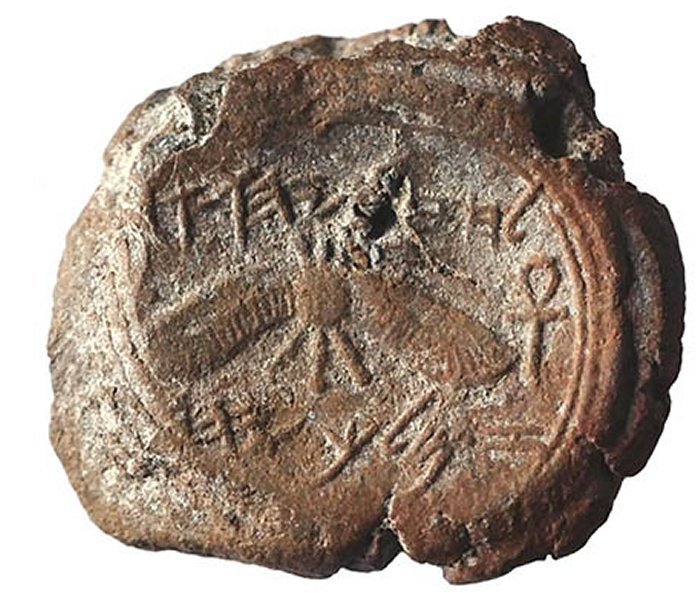
The royal seal of Hezekiah, king of Judah. The ankh is clearly visible. Photo: Courtesy of Dr. Eilat Mazar/ Ouria Tadmor
Otherwise, the Ankh is the attribute of the god Amun ('the hidden one'), King of the Gods, one of the most powerful gods in Egypt. Egyptians frequently carried it as an amulet, sometimes accompanied by two other hieroglyphs symbolizing 'strength' and 'health. Ancient Egyptian mirrors were often shaped as the Ankh.
This universal symbol has accompanied and influenced humanity in all ages and continues to influence modern people.
The Ankh is one of many important ancient Egyptian symbols.
Written by – A. Sutherland AncientPages.com Staff Writer
Updated on Sep 21, 2023
Copyright © AncientPages.com All rights reserved. This material may not be published, broadcast, rewritten or redistributed in whole or part without the express written permission of AncientPages.com
More From Ancient Pages
-
 Ancient DNA Reconstructs Rise Of Largest Empires In History Of Inner Asia
-
 Family Looking For Lost Gold Ring Finds Viking Age Artifacts In Their Garden On The Island Of Jomfruland
-
 Ancient Roman Shipwreck Marausa 2 With Intact Cargo Recovered Off The Coast Of Sicily
-
 Unsolved Ancient Mystery Of Hand Of Prêles – Unique Discovery Of Ancient Bronze Hand Puzzles Scientists
-
 ‘Face Of First European’ – Oldest Fossil Of European Human Ancestor Found At Spain’s Atapuerca Archaeological Site
-
 Unique Historical Discovery – Wreck Of Vasa’s Sister Ship Äpplet Found Off Swedish Coast!
-
 More Than 1, 300 Prehistoric Burial Mounds In Western Azerbaijan Have Been Systematically Surveyed For The First Time
-
 Swords And Spears Of The Yotvingians – A Long-Forgotten Ancient Warrior Culture Discovered In Poland
-
 Wars Of The Roses: Thirty Two Years Of Struggle To Claim English Throne
-
 Prehistoric Human Migration In Southeast Asia Driven By Sea-Level Rise – Study Reveals
-
 Amazing Ancient Underwater Treasures And Temples Discovered At Thonis-Heracleion
-
 Ancient Temple Dedicated To Aztec God Xipe Totec Discovered In Mexico Reveals A Gruesome Story
-
 City Of Sais: Prehistoric Prestigious Cult Center Of Northern Egypt
-
 Final Journey Of Ötzi Iceman: More Clues Found In Frozen Moss
-
 On This Day In History: Turco-Mongol Emperor Timur Sacks Damascus – On Mar 24, 1401
-
 Mesopotamians Worshipped An Unusual And Peculiar-Looking Creature – Archaeology And Sacred Texts Reveal – But What Was It?
-
 Morgan Le Fay – Heroine, Goddess, Witch, Fay, Or A Sorceress In Arthurian Traditions
-
 Where Were Herod The Great’s Royal Alabaster Bathtubs Quarried?
-
 Zagros Mountains: Home To Tribes, Kingdoms And Empires For Thousands Of Years
-
 Halicarnassus’ Monumental Tomb Built With Shining Stones Belonged To Carian Ruler Mausolus

