
Mysterious Sophisticated Gran Coclé Culture Reveals Its Ancient Secrets
Ellen Lloyd – AncientPages.com – The Gran Coclé culture emerged in what is now the Panamanian province of Coclé, near the Santa Marta River. There is extraordinary archaeological evidence the Coclé were a sophisticated Pre-Columbian people, and excavations have revealed some of this ancient culture's secrets.
The influence of Coclé ceramics extended throughout most of the Panamanian isthmus and took the form of spiral decorations and colors typical of this tradition.

Credit: Penn Museum
For more than a thousand years, a cemetery on the banks of the Rio Grande Coclé in Panama lay undisturbed, escaping the attention of gold seekers and looters.
Their gold artifacts reached as far as Chichen Itza and other parts of Central and South America.
Between 1515 and 1520, the Spanish fought with the chieftains of Panama over gold, destroying the social and political foundation of Coclé culture.
In 1940, a Penn Museum team led by archaeologist J. Alden Mason excavated at the cemetery, unearthing spectacular finds. The science team found large golden plaques and pendants with animal-human motifs, precious and semi-precious stone, ivory, animal bone ornaments, and tons of detail-rich painted ceramics.
The Coclé culture made alloys of copper and gold (tumbaga), sometimes adding a small amount of silver. They sometimes gilded the metal objects they made to increase their golden luster.

Amazing objects - intricate gold chest plaques, beaded necklaces, finely carved pendants, painted ceramic pots, bowls, and plates - excavated from the grave of a Coclé Paramount Chief.
This Pre-Columbian culture did not have access to any advanced tools, and they worked metals by hammering without heat, mainly making chest covers and helmets bearing a variety of decorations. They also practiced metal casting using the lost wax technique in order to make three-dimensional figures, and covered artifacts made of wood or bone with gold, silver, or copper leaf. Bone - mainly of deer or peccary was used to make figurines and flutes, and the decorations on these pieces depict other technologies they knew of, such as the atlatl or spear-thrower for hunting.
Astonished when they excavated one massive burial – named Burial 11 that was believed to belong to a Paramount Chief. Inside the huge burial were extraordinary materials together with 23 individuals in three distinct layers, accompanied by a vast array of grave objects.
"This ruler and his ancestors had subdued a majority of the natives in the vicinity. Graves of another type were of greater size and age. They contained two bodies, male and female, buried in an extended position, characteristically face downward, head to the northeast, and arms flexed. Jewelry of stone, bone copper, or gold had been placed with the dead, as well as 30 or 40 pottery vessels, tools, weapons, and fabrics.

This object was found among many other golden pendants, arm cuffs, and plaques, exquisitely crafted and worthy of a great warrior.
All evidence now available indicates that Coclé culture was of late date, that is to say, it flourished in the centuries just before the arrival of the Spaniards. "
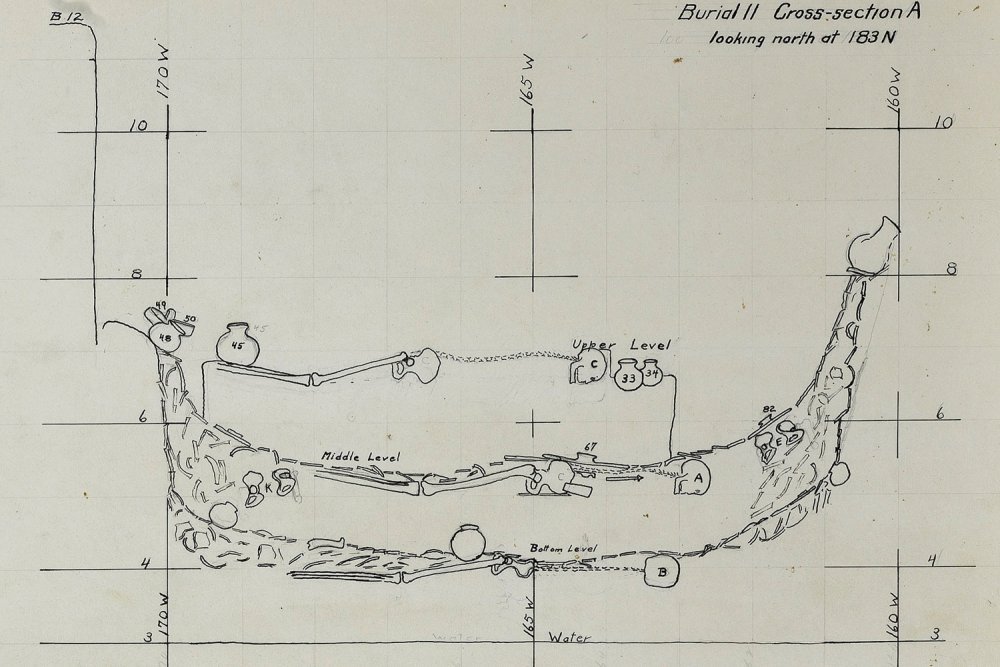
View the burial as never seen before: through a to-scale installation highlighting a vast array of grave goods as they were found.
The Coclé culture was artistic and produced beautiful designs that are "noteworthy for their balance and vigorous curved lines. Like most New World art, the patterns are largely derived from life forms, conventionalized at times recognition.
It is generally agreed that most aboriginal processes and alloys used in metalworking were invented in Peru and Bolivia and then spread north and south. Coclé metal objects are linked to Peru both in technique and design but are more closely connected with the Quimbaya and Sinú regions in Colombia whence many articles came in trade. While it is possible to point out connections between Coclé and other cultures, the quality of Coclé art must be regarded as purely local development, ranking among the foremost in indigenous America. 1
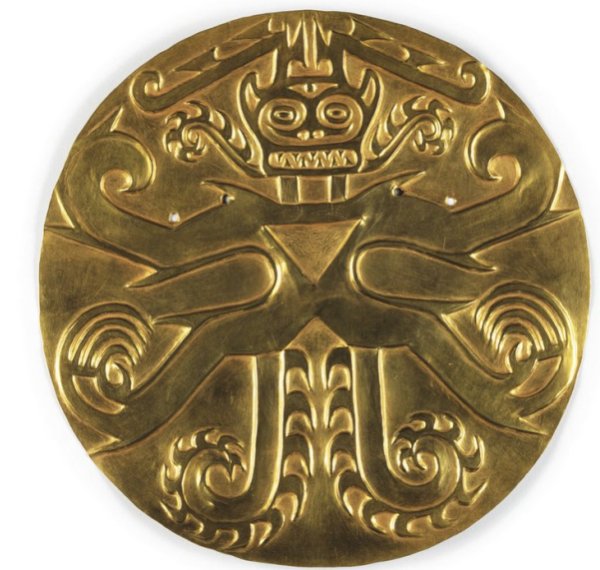
Gold Plaque, Sitio Conte, Panama, ca. 700-900 CE. Photo: Penn Museum
The Coclé culture still remains mysterious, but archaeologists, physical anthropologists, art historians, and other specialists are drawing on the materials they have excavated to tell more about this culture's ancient history, traditions and customs.
The rich iconography, sophisticated gold working technologies, and craftsmanship, exacting placement of bodies and materials in the burials offer clues about the world view, artistic style, and social hierarchy of the Coclé.
The art and artifacts uncovered from Burial 11 and throughout the Sitio Conte cemetery were rich in cultural meaning and practical value and provide us with valuable information about Pre-Columbian civilizations.
Updated on March 19, 2022
Written by Ellen Lloyd – AncientPages.com
Copyright © AncientPages.com All rights reserved. This material may not be published, broadcast, rewritten or redistributed in whole or part without the express written permission of AncientPages.com
Expand for references- Lothrop, S. K. "Archaeological Investigation in the Province of Coclé, Panamá." American Journal of Archaeology38, no. 2 (1934): 207-11. Accessed March 7, 2020. doi:10.2307/498075.
More From Ancient Pages
-
 Justinianic Plague: Modeling Study Challenges Death Rate And Severity Of Infectious Disease
-
 Sirrush – Powerful “Glamorous Snake” Guarded Marduk But Did This Hybrid Really Exist?
-
 Mystery Of Arthur’s Stone In UK – Solved?
-
 Mystery Of The Giants’ Grave of Coddu Vecchiu
-
 On This Day In History: Maltese Rebellion Took Place – On Sep 8, 1775
-
 Breakthrough – First Glimpse Into A 2,000-Year-Old Charred Herculaneum Scroll
-
 Surprising Time Capsule In Antarctica – Evidence Of Toxic Heavy Metal Pollution 800 Years Ago
-
 Curse Of The Dancer – Mysterious 1,500-Year-Old Tablet Finally Deciphered
-
 Ancient City Of Ipiutak Was Built By A Fair-Haired Race With Blue Eyes And Not Us – The Inuit Say
-
 Scottish Settler’s Ominous Encounter With A Mysterious Being In West Virginia
-
 New Study Questions Claims Homo Naledi Was Advanced
-
 Earliest Modern Human Fossil Outside Africa Unearthed At Misliya Cave, Israel
-
 Unknown Ancient Settlement Overlapping The Old City Of Nakhon Ratchasima Discovered
-
 Curious Golden Figurine Of Female Dwarf Is A Puzzle
-
 3,000-Year-Old Stela Challenges Assumptions Of Gender And Social Roles In Prehistoric Times
-
 There Is A Problem With The Footprints Claimed As Evidence Of Ice Age Humans In North America – Scientists Say
-
 Ancestor Of Italian Pizza Depicted On Fresco In Pompeii
-
 Almost 1000 Previously Undiscovered Prehistoric Barrows Identified In The Netherlands
-
 Mystery Of The Ancient Giant Wish Stone At Hattusa
-
 Famine And Disease Drove The Evolution Of Lactose Tolerance In Europe

