
Gonzalo Guerrero – The Renegade Who Joined The Maya Against His Own People
Ellen Lloyd - AncientPages.com - Gonzalo Guerrero dreamed about visiting foreign lands and meeting exotic people when he was a small boy. He had heard about Christopher Columbus's exciting journeys to distant lands and wanted to become famous and experience adventures. His dreams came true, but perhaps not as he imagined them.
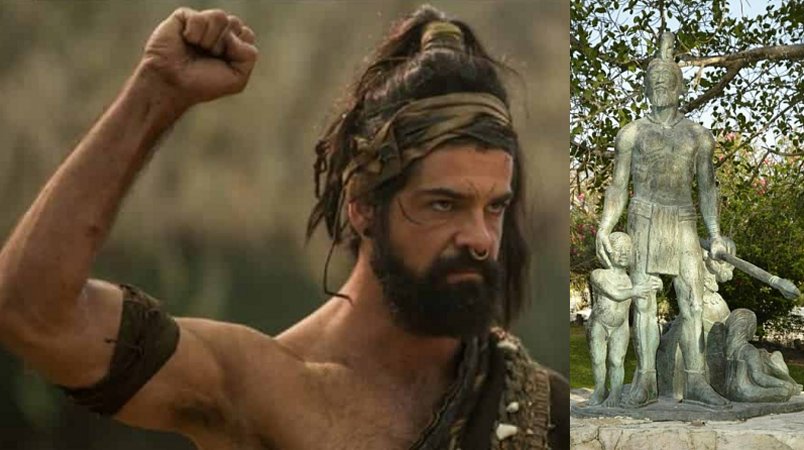
Left: A movie was made about the incredible life of Gonzalo Guerrero - Image source - Right: Statue by Raúl Ayala Arellano in Akumal, Quintana Roo commemorating Gonzalo Guerrero - Credit: Public Domain
Whether we call it fate or destiny, the fact remains that the Spanish soldier Gonzalo Guerrero (1470 – 1536) became one of the most hated men among the Conquistadors. He was a traitor, and the Spaniards wanted nothing less than to see him dead. How could Guerrero have known he would one day join and fight with an Indian civilization against his people?
So, how could Spanish man switch sides and fight with the Maya against his people?
A Young Gonzalo Guerrero Dreams About Adventures
When Guerrero was a young man, he understood his only option to see new lands was to get on board a Spanish ship, and so, one day, he decided to follow Columbus.
How he reached Haiti is not entirely clear. However, when Columbus' son Diego arrived in Haiti in 1509, Guerrero was already there.
Guerrero has sailed together with Gerónimo de Aguilar, a monk from Andalusia. Except for being both from Spain, the two men had nothing in common. Aguilar came to the New World to spread knowledge of Christianity and convert natives. On the other hand, Guerrero was only interested in adventures and fame.
We don't always choose our companions in life, and Guerrero and Aguilar shared events that forced them to depend on each other.
In 1510, the adventurer Vasco Núnez de Balboa asked Guerrero and Aguilar to join him on a famous and exciting expedition. They agreed, but instead of becoming colonists, they became enslaved people.
The Maya Captures Guerrero And Aguilar
In 1511, Guerrero and Aguilar sailed from the colony of Santa Maria to modern-day Haiti. The ship was heavily loaded with gold that Balboa had stolen from local Indians.
Not far from Jamaica, the Spanish ship was caught in a heavy storm, and there was nothing the captain or the crewmembers could do. The vessel sank rapidly along with Balboa's gold treasure. About 20 crew members jumped into a rescue boat, but half didn't survive. They battled against the ocean's waves for 13 days without food and water until they finally found a beach at today's Cabo Catoche, the northernmost point on the Yucatán Peninsula.

Gonzalo Guerrero's transformation. In time he looked just like one of the Maya. Credit: El Confidencial - CC
Barely alive, they cautiously stepped on the sand and realized the place was just as dangerous as the ocean. The Spaniards were surrounded by Indians carrying spears and shouting "Maya."
Guerrero had no idea what it meant, and he assumed this was the name of their land. The Maya Indians took the Spanish captives to the city of Ecab. When the Spaniards saw the Maya city, they were surprised by the advanced buildings' architecture, but they didn't have much time to admire the surroundings. The Spanish captain and four other captives were taken to a pyramid where they were brutally sacrificed to the Maya gods.
According to the Spanish chronicler Francisco Salazar, the Maya Indians ate the sacrificed Spaniards. However, Guerrero and Aguilar were much too thin to be offered as a gift to the god. They were locked up in a prison cell where they were meant to sit and wait until the next sacrificial ceremony occurred.
Being killed in honor of some foreign gods was unappealing, so Guerrero and Aguilar did what most of us would do – they escaped.
They didn't get far, though. After just some days, they were captured again by the Maya, only this time, the Indians had a different agenda. This Maya tribe, led by Chief Aquincuz, was at war with those who ruled Ecab. Instead of sacrificing Guerrero and Aguilar to the gods, the Spaniards became enslaved.
Guerrero and Aguilar looked and behaved just like the Maya. They worked, learned the Maya language, received military training, and changed their appearance. Now they had the same tattoos as the Maya Indians and holes in their nose and ears. The difference was that Aguilar hated every minute of it, while Guerrero felt like he was one of the Maya people even though he was a foreigner.
Guerrero Becomes A Great Maya Warrior
Years passed, and Guerrero explained to the Maya that his fellow citizens would soon come and conquer the Indians' land. He gave the Maya valuable advice on preparing to face the Conquistadors.

Guerrero wanted to stay with the Maya, but Aguilar was eager to return and join Cortés. Image source
The Maya appreciated Guerrero's loyalty, and he rose in rank. He became one of their greatest warriors. He married one of the Maya women with whom he had several children.
When Hérnan Cortés (1485 – 1547) and his Conquistadors reached Yucatan, they learned the story of Guerrero and Aguilar, who the Maya captured.
Cortés sent a message to the Maya asking them to return Guerrero and Aguilar. Cortés saw this as an excellent opportunity to get experienced guides who could make his conquest easier. He was even prepared to pay a ransom to return the two men.
Guerrero's Life Ends
When Aguilar learned Cortés was waiting, he didn't hesitate to join the Conquistadors. He had never been happy with the Maya, and becoming one with his people was like salvation to the Spanish monk.
Guerrero's decision to remain with the Maya didn't make Cortés happy. On the other hand, Guerrero refused and stayed with the Maya, who were now like his own family. From now on, Guerrero was nothing but a horrible traitor and the greatest enemy of the Conquistadors.
Guerrero was now a great Maya warrior who led several attacks against the Conquistadors. He fought by the side of the Maya and watched how the Spaniards brutally slaughtered the Indians with horror. He killed many of the Conquistadors but was not meant to survive. Guerrero tried to keep the Conquistadors away from Yucatan, but he was killed during a battle at the Ulúa River in western Honduras.
The adventures and colorful life of the Spaniard, who lived 25 years with the Maya and fought against his people, ended that day. Ten years later, the Conquistadors conquered the last remaining Maya cities.
Written by Ellen Lloyd – AncientPages.com
Updated on April 3, 2023
Copyright © AncientPages.com All rights reserved. This material may not be published, broadcast, rewritten or redistributed in whole or part without the express written permission of AncientPages.com
Expand for referencesMore From Ancient Pages
-
 Chilean Mummies Clad In Red Poison Dresses – Evidence Of A Unique Inca Ritual
-
 Why Do Old Norse Myths Endure In Popular Culture?
-
 Gigantic Asipatra: Terrifying Mythical Monster Bird In Hindu Beliefs
-
 Heyoka – Sacred Clown Who By Doing The Opposite Helps And Guides In Daily Life
-
 On This Day In History: Treaty Of Picquigny – Negotiations Between England And France – On Aug 29, 1475
-
 2,000-Year-Old Completely Preserved Shipwreck With Amphorae Found Near Šćedro Island
-
 Evidence Of An Advanced Ancient Civilization In Texas That Mysteriously Disappeared
-
 South Korea’s Silla-Era Tombs Reveal More Priceless Jewelry
-
 Remains Of An Ancient Seaport In Asini, Greece Discovered By Underwater Archaeologists
-
 Uniquely Well-Preserved Medieval Kitchen Unearthed North of Moravia
-
 Yenikapı Excavations Reveal 8,500-Year-Old Artifacts
-
 Arrival Of Nuuttipukki, Who Knocks On The Door And Demands Christmas Beer
-
 Has The Mystery Of The Lost Trading Ship Zuytdorp Been Solved?
-
 Ancient Greeks Built Sacred Temples On Earthquake Sites To Gain Spiritual Power
-
 Paleolithic Workshop Unearthed In The İnkaya Cave In The Turkish Western Province Of Çanakkale
-
 Number ‘Seven’: Mystical Number Of The Universe And One Of The Most Sacred Numbers
-
 Red Paint On 1,000-Year-Old Gold Mask From Peru Contains Human Blood Proteins
-
 Ajanta Caves: Incredible Accomplishment Of India’s Ancient Stonecutters
-
 Ancient People In The Tibetan Plateau Had More Cultural Exchanges Than Previously Thought
-
 Circe: Powerful Divine Sorceress Who Mastered Healing, Miracles And Transforming People Into Animals In Greek Mythology

