
Who Were The Sin Eaters?
Conny Waters - AncientPages.com - Not so long ago, a person could get employment as a sin eater and make some money in this unusual profession. As the name implies, sin eaters were those who consumed the sins of a deceased person.
Credit: Public Domain
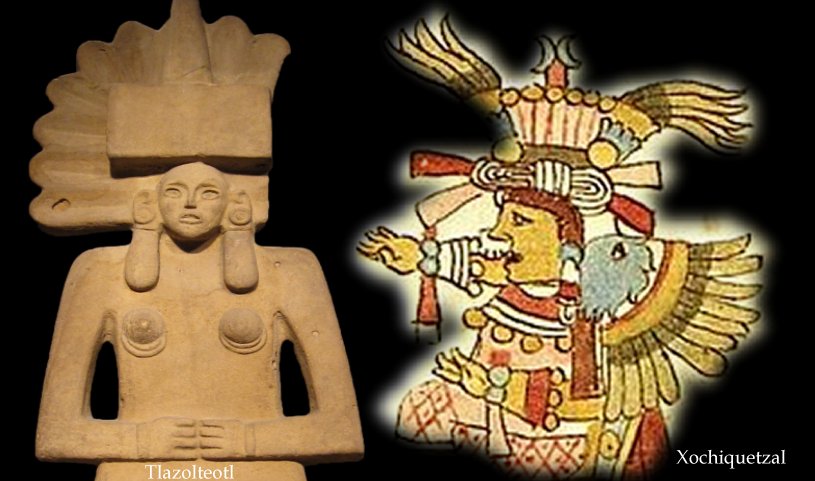
The Aztec religion offered a formal confession in case of sin or some serious crimes. According to tradition, the Aztecs had the possibility to confess their sins in front of their goddess Tlazolteotl.
The Aztec confession was an important ceremony that usually occurred during the Ochpaniztli Festival.
“After confessing, the person – dressed only in a paper skirt decorated with designs related to goddess Tlazolteotl - had to fast, and then go at night to one of the shrines built for women who died during childbirth. He had to leave its skirt behind, at the shrine - a symbol that they had left behind their sins.” 1
In European countries, the sin-eating ritual was much different. In most cases, a person had to eat something to swallow the deceased's sins.
There are several accounts of sin eaters in Wales. One of the earliest of these stories can be found in The Remaines of Gentilisme and Judaisme, a work of John Aubrey.
A letter from February 1, 1714, relates how sin eating was performed in Wales.
“Within the memory of our Fathers, in Shropshire, in those villages adjoying to Wales, when a person dyed, there was notice given to an old Sire, (for so they called him), who presently repaired to the place where the deceased lay, and stood before the door of the house, when some of the Family came out and furnished him with a Cricket, on which he sat down facing the door. Then they gave him a Groat, which he put in his pocket; a Crust of bread, which he eat; and a full bowle of Ale, which he drank off at a draught. After this, he got up from the Cricket and pronounced, with a composed gesture, the ease and rest of the Soul departed, for which he would pawn his own Soul. “ 2
In many European countries, it was also common to hire poor people to perform funeral services. Their job was to take upon themselves all the sins of the deceased person, which gave many poor people a chance to earn some money.
“The practice of sin-eating began during the Middle Ages and survived into the 19th century in some European countries. At one time it was also practiced by people living in the Appalachian region of the United States.
In many towns the same man was nearly always hired to serve as the sin-eater. This man often became a social outcast because other people believed that all the sins he'd absorbed must have turned him into a vile evil person.
Usually, only a very poor man was willing to play this role. Some of these men learned to recite special prayers or incantations over the bread after they arrived, claiming that this was necessary for the sins to be transferred from the dead body to the bread. They thought that this pretense would increase their chances of being hired when the next death occurred.
When a member of a very poor family died, the survivors often couldn't afford to pay the fee of a sin-eater. In this case, they would sometimes lay a piece of bread on the dead body, say some prayers over it, then carry the bread into the street and give it to a beggar without telling him that it had been on top of a corpse. By using this trick, they could get the sins removed from the body of their loved one for free.“3
One can conclude that how this curious ritual was performed varied between countries and cultures. The practice of eating sins was universal and was encountered among many ancient civilizations.
Updated on April 19, 2024
Written by Conny Waters – AncientPages.com Staff Writer
Copyright © AncientPages.com All rights reserved. This material may not be published, broadcast, rewritten or redistributed in whole or part without the express written permission of AncientPages.com
Expand for references- Sutherland - What Was An Aztec Confession? AncientPages.com
- Hartland, E. Sidney. "The Sin-Eater." Folklore3, no. 2 (1892): 145-57. Accessed January 21, 2020.
- Barry Wilson – Weird Beliefs
More From Ancient Pages
-
 Third-Century Sculpture Of Roman Emperor Aurelian Unearthed In Bulgaria
-
 Enigma Of Étienne Le Ray – Unusual Vagabond Prophet Nicknamed Nostradamus Of Brittany
-
 5 Fascinating Sacred And Lost Places In Myths And Legends
-
 Castro People: Intriguing Life Of The Female-Dominated Society In Ancient Iberia
-
 Ancient Bizarre Experiments Conducted In Mysterious Underground Temple
-
 Unfinished Roman Aqueduct Discovered In The Hellenistic Royal City Of Artashat-Artaxata In Ancient Armenia
-
 3,700-Year-Old Ceremonial Stone Circle Found In Derbyshire Forest
-
 What Is A Mural Of Tepoztēcatl, Aztec Rabbit God Of Alcohol Doing In A Mexican Church?
-
 Dragon’s Head – One Of The Most Famous Viking Symbols Discovered At Birka Ancient Excavation Site
-
 Unique 9,000-Year-Old Shrine With Symbols Discovered At Neolithic Ritual Site In Jordan Desert
-
 11 Reconstructions Of Ancient Cities, Monuments And Sacred Sites
-
 Beautiful Legends Of The Great Smoky Mountains: The Cherokee’s Little People Nunnehi And The Medicine Lake Ataga’hi
-
 India’s Mysterious Stonehenge: Prehistoric Complex Of Gigantic Standing Stones Of Willong Is An Enigma
-
 Unusual Discovery Of A Bronze Age Axe In Norway – Is An Unknown 3,000-Year-Old Shipwreck Nearby?
-
 Anomalous Ancient Structures In The South West Pacific Remain Unexplained
-
 Ancient Roman Laws Give Us A Window Into A World Of Abuse
-
 King Tut’s Cosmic Dagger Was Not Made In Egypt – New Study Reveals
-
 On This Day In History: Mysterious Death Of White Queen Anne Neville – On Mar 16, 1485
-
 Judas: A Famous Traitor Or A Hero?
-
 On This Day In History: Battle Of Fraustadt – One Of The Most One-Sided Swedish Victories – On Feb 3, 1706

