
Yokai Hone-Onna (‘Skeleton Woman’): Deceptive Succubus That Feeds On Man’s Soul And Vitality In Japanese Folklore
A. Sutherland - AncientPages.com –The belief in Yokai (Yōkai) was mentioned in “Shoku Nihongi” text dated to the eighth-century. This ancient belief is still alive in Japanese modern society.
Yokai monsters that can take many different forms are mostly associated with abandoned places, villages, deserted mountain regions, and even other unexpected places. There are numerous Yokai in folklore, legends, and Japanese mythology.
The whole Yokai concept is quite broad because it includes creatures depicted as plants, people with various body deformations, specters, ghosts, demons and other difficult to identify monsters. They usually have abnormal strength and supernatural powers.
In a way, they are nowadays even more popular than in ancient times, as we can find them in Japanese anime, video games, movies, and manga in form of comics, cartooning, and graphic novels.
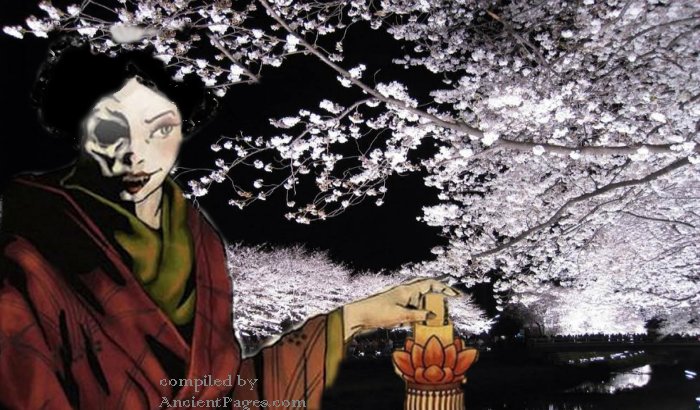
Today’s article is devoted to Hone-Onna (‘skeleton woman’), a Yokai, often depicted as an aged female that would carry a lantern decorated with beautiful peony (botan) flowers.
The main idea of many Japanese legends about Hone-Onna is always almost the same. She regularly visits the house of a man and they spend the night together, but her plan is simple. She dedicated herself to cheating, attacking and finally killing men. However, the legends have many versions.
One old Japanese version of the story tells about a widowed samurai, named Ogiwara Shinnojo who meets a beautiful woman named Yako.
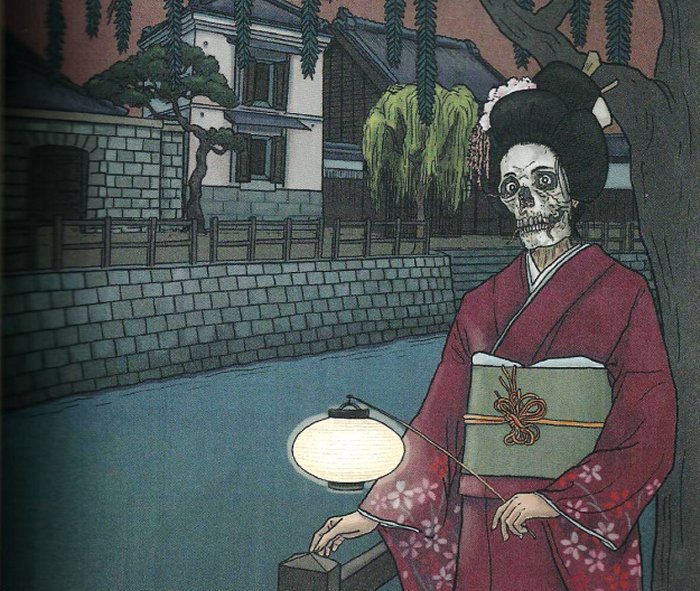 At the beginning of the night, Hone-Onna transforms into a woman of great beauty and tries to deceive the men she meets to take them home. Image source
They enjoy each other and meet every night, and the story seems very romantic, but there is a problem.
One night, Shinnojō’s next-door neighbor catches a glimpse of his partner and surprisingly sees the strange, shocking scene of Shinnojō embracing with a skeleton.
Could Yako be only a pretty-looking woman in the eyes of Shinnojō and for others around her, was she an ugly, aging woman?
See also:
Demon Oni: Cruel Harbinger Of Disease And Misfortune In Japanese Folklore
Nurikabe: Trickster That Manifests Itself As Invisible, Impassable Wall In Japanese Old Beliefs
Is The Legendary Tsuchinoko Real?
Yuki-Onna ‘Lady Of The Snow’: A Female Demon And Symbol Of Death In Japanese Mythology
Hone-Onna is a skeleton with an enormous appetite for sex and death. According to legends, she can take two quite different forms, the first, a beautiful woman of beautiful figure and, the second, a human skeleton.
Her charm and beauty help to seduce men. Usually, Hone-Onna takes revenge on her wrongdoers; she steals the men’s energy and vitality intentionally, and her choice of a night partner is rarely accidental. This bizarre relationship can continue for days or even weeks without being noticed. The men are so fascinated by Hone-Onna that they do not see the true appearance of this evil Yokai. Unaware that their health is in great danger and they become sicker and weaker and eventually die.
In another legend, Hone-Onna’s real name was Tsuyu. She was married to a young man, who sadly sold her to a brothel to pay off his debts.
After a while, Tsuyu and a friend, Kion, decided to escape from that brothel. It was then that her best friend, Kion, betrayed her and made her lover end Tsuyu’s life.
They threw her body into a lake (or river). Legend has it that Tsuyu’s corpse absorbed the souls of other women who had died in the same way and whose bodies were already at the bottom of that river.
As a result of this merger, she became a Yokai, Honne-Onna who dedicated herself to cheating men, attacking, and finally killing them.
Written by – A. Sutherland - AncientPages.com Senior Staff Writer
Copyright © AncientPages.com All rights reserved. This material may not be published, broadcast, rewritten or redistributed in whole or part without the express written permission of AncientPages.com
More From Ancient Pages
-
 Kindred Spirits: Why Did The Irish Build A Monument In Honor Of Native Americans?
-
 18,000-Year-Old Seashell Was Musical Wind Instrument Used By Magdalenian People
-
 Jason And The Argonauts – Hate, Sorcery, Love And Jealousy Reign In This Famous Greek Story
-
 Viking Treasures Discovered In Chamber Grave In Denmark
-
 Lake Mendota’s Submerged Canoes Predate The Egyptian Giza Pyramids – Why Are These Vessels Underwater?
-
 Strange Ancient Labyrinth City Under The Sands Of The Kara Kum Desert Reveals Its Secrets
-
 Ancient Secrets Of The Amazon Jungle – The Man Who Stepped Into The Unknown Searching For The Lost City Of The Gods – Part 2
-
 Why Was Louis XIV Called The Sun King?
-
 Discovery: Massive Gawro Wall Dated To The Antique Age: Was It A Symbolic Or Defensive Structure?
-
 Virtual Nubia: Sudan’s Medieval Monasteries Digitally Reconstructed By Polish Archaeologists
-
 Inchbrayock Stone: Pictish Samson Stone Carved With Biblical Symbols And Scenes
-
 Norse God Hermod’s Meeting With The Finnish Magician Rostioff Who Revealed The Prophecy Of Vali
-
 Maize-Based Diet Of Ancient Maya, Vulnerability To Drought And Collapse Of Society
-
 Afterlife Of Egyptian Religious Statues Intentionally Hidden In The Temple Of Ptah At Karnak
-
 Shell Trumpets In Neolithic Catalonia Were Used For Effective Long-Distance Communication
-
 Ritual Bath In Herod’s Fortress Found In Ruins Of Machaerus, East Of Jordan River
-
 Archaeologist Ludovic Slimak Wants To Rewrite The History Of Early Humans In Europe
-
 3,000-year-old knight discovered at the Palidli necropolis
-
 On This Day In History: Battle Of Rhyndacus – Oct 15, 1211
-
 DNA From 10,000-Year-Old Scandinavian Chewing Gum Reveals Stone Age Diet

