
Golden Secrets Of Lake Guatavita And The Muisca People Gave Rise To The El Dorado Myth
Ellen Lloyd - AncientPages.com - When the Conquistadors came to explore the New World in the early 16th century, they heard rumors about a magnificent wealthy city of gold ruled by a prince. Eager to get their hands on these golden treasures they searched for the golden city in many corners of South America. Gold was precious, and the Spaniards were greedy.

In a letter to King Ferdinand dated 7 July 1503, Christopher Columbus wrote:
“With gold we not only do whatever we please in this world, but we can even employ it to snatch souls from Purgatory, and to people Paradise.”
Golden Cities Hidden In The Andes
Indians told many stories about golden cities in the Andes. Most likely, the Natives thought it was a good method to lure away the Spaniards. One legendary golden city was Paititi.
According to a legend, Paititi was built by the Inca hero Inkarri, who founded the city of Cusco before retreating into the jungle after Spanish conquerors arrived.
When the Spaniards entered Cusco, they plundered gold and silver, but they only found a small portion of what existed in the Inca capital. The real gold treasure has never been found. The Inca hid it before the arrival of the conquistadors. Many have searched for Paititi, but the legendary golden city has never been located, but regular efforts to find this mysterious ancient place continue to this day.
The Spaniards were intrigued by all the stories about golden cities filled with magnificent treasures.

The Spaniards were determined to find El Dorado, the lost city of gold. Source
In La Historia General de las Indias (1535), Gonzalo Fernández de Oviedo y Valdés wrote: “When I asked why this prince or chief of king was called Dorado, the Spaniards who had been in Quito and had now come to San Domingo (of whom there were more than ten here) answered, that, according to what had been heard from the Indians concerning that great lord or prince, he went about constantly covered with fine powdered gold, because he considered that kind of covering more beautiful and noble than any ornaments of beaten or pressed gold . . .
[He] put his on fresh every morning and washed it off in the evening . . . The Indians further represent that this cacique, or king, is very rich and a great prince, and anoints himself every morning with a gum or fragrant liquid, on which the powdered gold is sprinkled and fixed, so that he resembles from sole to crown a brilliant piece of artfully shaped gold.”El Dorado, the lost city of gold was said to be located somewhere in Columbia. Its legend has been passed down through the generations, and many great explorers have tried to find this fabulous golden city.
Sacred Golden Lake Guatavita Of The Muisca People
Did the sacred Lake Guatavita of the Muisca people give birth to the legend of El Dorado?
The name El Dorado traces its origins to the mythical chief of the Muisca tribe that inhabited Colombia's Andes region. Between 800 and 500 B.C, the Muisca people were part of four tribes that occupied the Americas. The three others were the Aztecs, the Maya, and the Inca.
The legend of El Dorado emerged in 1638 when Juan Rodriguez Freyle wrote “El Carmero”, in which he described a sacred ceremony practiced by the Muisca people.

Laguna de Guatavita. Credit: José Ángel Morente Valero
Every time a new ruler was selected, he was first restricted to a cave where he had to spent some time without being able to leave. Later, he was taken to Lake Guatavita where a ceremony was held in his honor. As part of the celebrations, people showed respect and appreciation for their new tribe chief by making sacrifices and offerings.

The main leader of the Muisca on the Bogotá savanna at the time of the conquest was Tisquesusa. He led numerous efforts to resist the Spanish invasion but was eventually killed in battle. His nephew, Sagipa, succeeded him and soon submitted to the conquistadors. Credit: Public Domain
The new Muisca ruler was covered with gold and emeralds and set on on raft that was pushed off from the shore. All the precious golden offerings he carried were thrown into the lake and he was now officially declared the new ruler of the Muisca people.
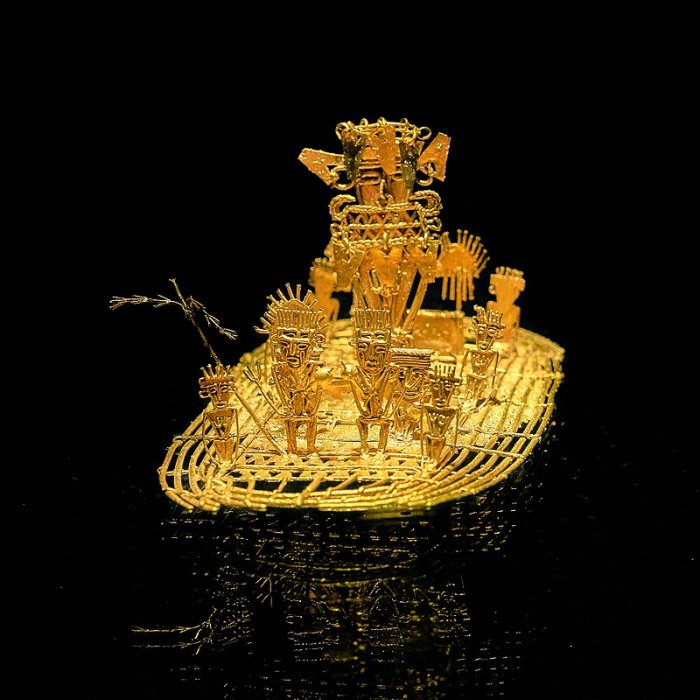
The zipa used to cover the chief's body in gold dust, and from his raft, he offered treasures to the Guatavita goddess in the middle of the sacred lake. This old Muisca tradition became the origin of the legend of El Dorado.
This Muisca raft figure is on display in the Gold Museum, Bogotá, Colombia. Credit: Pedro Szekely, CC BY-SA 2.0
The Conquistadors started calling this golden chief El Dorado, "the gilded one" and Lake Guatavita was said to contain large amounts of golden treasures. These stories inspired explorers to search for the legendary golden lake and it was eventually found in 1537 by Gonzalo Jiménez de Quesada.
The golden artifacts found in the lake confirmed the stories to be true and Lake Guatavita has been plundered on several occasions. In 1965, Lake Guatavita was declared a National Heritage site and gold searching, draining and exploring became illegal.
The lost city of gold El Dorado was never located, though the Spaniards spent years searching for it.
Written by Ellen Lloyd – AncientPages.com
Copyright © AncientPages.com All rights reserved. This material may not be published, broadcast, rewritten or redistributed in whole or part without the express written permission of AncientPages.com
More From Ancient Pages
-
 What Is Pax Sinica?
-
 Xiahou Dun ‘The One-Eyed’: Faithful Warrior, One Of Cao Cao’s Talented Officers
-
 Identity Of The Shining Ones – One Of The Greatest Secrets Ever Kept From Mankind
-
 Blood Of St. Januarius – One Of The Most Remarkable Christian Relics
-
 Kallikantzaroi: Naughty Nocturnal Goblins Emerge From Underground Only During Twelve Days Of Christmas
-
 The Strange Story Of The Grave Of Copernicus
-
 Secrets Of The Uruk Prophecy Found In The Ancient Library Of A Magician With Divine Powers
-
 Mysterious Magical Healing Gift Of The Whisperers – Meet The Enigmatic Szeptunka
-
 DNA Study Sheds Light On The Mysterious Picts Of Scotland
-
 Unexpected Danger Lurks Beneath Ancient Maya Cities – Mercury Pollution Discovered
-
 Ancient Mystery Of The Strange, Small Underground Being Who Secretly Emptied Casks
-
 Unexplained Dangerous Secret In The Great Smoky Mountains
-
 Star-Shaped Magnetic Anomaly At Hidden Stone Circle In The Outer Hebrides Gives New Insight Into Ancient Beliefs
-
 Secrets Of Legendary Viking Crystal Sunstones And The Mysterious Uunartoq Artifact Unraveled
-
 Herne The Hunter – The Horned God And Lord Of The Forest In British Mythology
-
 The Lost Prophecy Reveals Chilling Future Events – The Last Words To Mankind?
-
 Mystery Of The Hidden Shoes Discovered In Ancient European Houses – What Is Behind This Bizarre Tradition?
-
 Archaeological Discoveries At Fort San Juan Reveal Hidden History Of Conquistadors In American South
-
 Darabgerd: One Of The Oldest Cities Dated To Achaemenid Era
-
 Hagar Qim: “Standing/Worshipping Stones” – Megalithic Complex In Malta Dated To 3600 – 3200 BC

