
Butterfly: Powerful Ancient Symbol Of Beauty, Transformation, Hope, Rebirth And Happiness Featured In Myths And Legends
A. Sutherland - AncientPages.com - Insects have always accompanied humans; some of them have gained a special place in culture and mythology. A butterfly has deep roots in the early beliefs of ancient people around the world, and many myths and legends feature this fantastic insect.
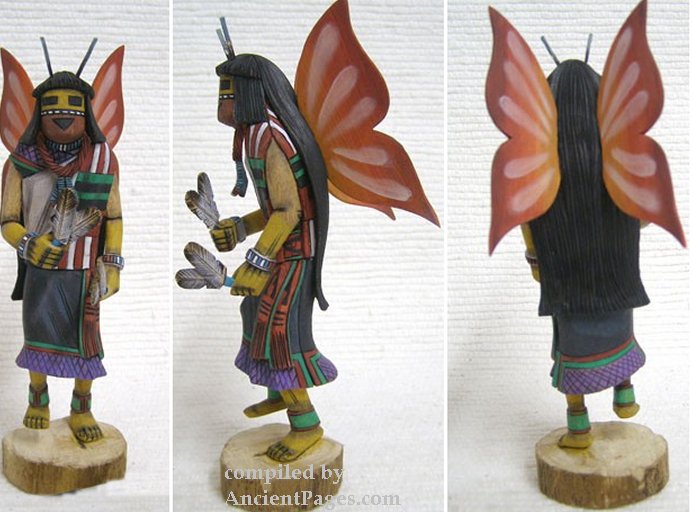 Native American Hopi Carved Butterfly Maiden Kachina Doll. Credit: kachinahouse
A good example can be the butterflies, one of the most beautiful insects that symbolize the day and female beauty.
The butterfly has been a symbol in almost every culture of transformation and rebirth. The butterfly experience many changes, starting its life in one form and ends in another. Ancient people (and perhaps also modern ones) have long believed that our souls transform. The ancient Romans believed that a butterfly symbolized the soul, and butterflies often adorned old tombstones.
Importance Of Butterfly Among Native Americans
For many Native American tribes, the appearance of a butterfly announces beautiful weather and good luck. However, butterflies play a variety of other roles in folktales of these people depending on the tribe. Sometimes, butterflies represent balance and change; other folktales emphasize their beauty, vanity, and playful behavior. Some Native America tribes had taboos against killing these insects. Likewise, among ancient Irish beliefs, there was one saying that in white butterflies dwelled the souls of young children.
The killing of such a butterfly had significant and very negative consequences.
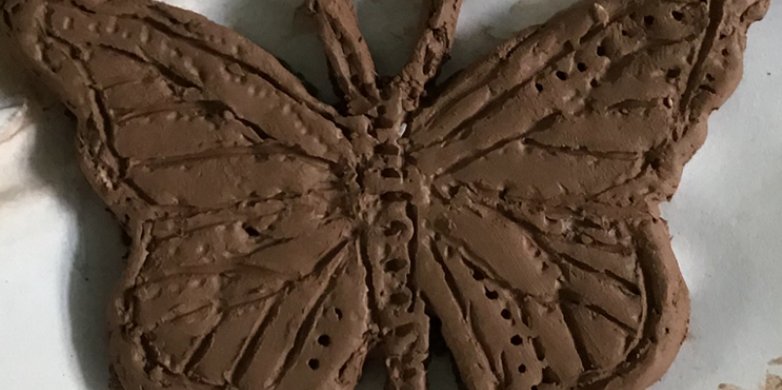 For the Greeks, the butterfly was the symbol of the soul or psyche. source
Blackfoot people of Saskatchewan, Alberta, and British Columbia, and the U.S. state of Montana, strongly associate butterflies with sleep and dreaming, and butterfly designs were used to decorate cradleboards and other children's objects to help them sleep and experience pleasant dreams.
For the Aztecs, the butterfly was associated with women who had died in childbirth. Such women were honored with the same praise as the Aztec warriors who lost their lives in combat. The monarch butterfly represented the souls of deceased children who return to earth. The Aztecs saw the image of a human face in the insect’s wing motif, and in times of Teotihuacan's greatness, seals and headdresses were adorned with it.
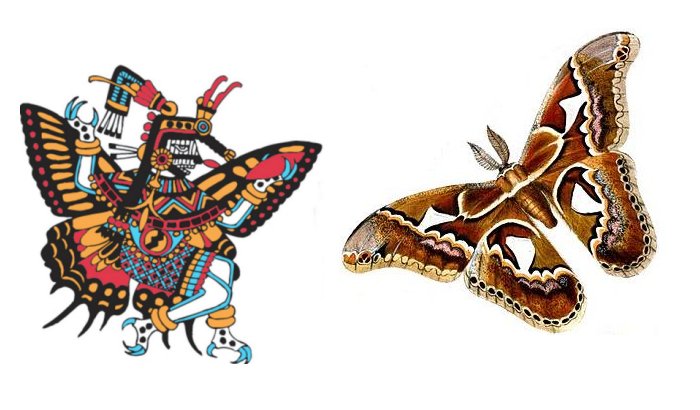 In Aztec mythology, Itzpapalotl ("Obsidian Butterfly") was a skeletal warrior goddess who ruled over the world of Tamoanchan, the paradise of victims of infant mortality and the place identified as where humans were created. source source2
Butterflies were also associated with fire; their swarming together resembles a dance giving associations with the flames of a bonfire.
Hopi And 'Butterfly Dance'
Irish folklore attributes butterflies the ability to penetrate between worlds, and the Indians of South America believed that if someone could count the spots on the wings of the most numerous variety of butterflies there, they would find out how much money they would make in their lives.
Among the Hopi in North America, the butterfly is one of the animals of the creator, and so they perform beautiful 'Butterfly Dance' in honor of the butterfly Kachina. The Butterfly Maiden, called Palhik Mana, appears in August when butterflies appear in Arizona. The ceremony is held as a thanksgiving for the corn harvest, and the maidens represent the butterflies that pollinate the corn, helping to bring the crop.
Butterflies Are The Returning Souls Of The Dead
For the Maori, however, the butterfly is a symbol of longevity and immortality while the aborigines of Australia believe that butterflies are the returning souls of the dead.
For the Greeks, the butterfly was the symbol of the soul or psyche. The story of the soul's transformation from human to immortal status is told in the tale of Eros and Psyche.
For the Chinese, the butterfly is the emblem of immortality, joy, and leisure. Its depictions with the plum mean longevity; when it is illustrated with the chrysanthemum plant (know in China since at least 500 BC) it portrays beauty in old age. The butterfly also means a young man in love; however, if the woman he loves dies, she may be represented coming out of her grave as a butterfly.
In Japan, ancient people had both positive and negative associations with the butterfly, which symbolized a dishonest lover, a vain woman, or a geisha who stays with no husband but is available to man after man. This insect was often viewed as a bad omen, but it also had a positive meaning: two butterflies dancing together was a sign of happy love and happiness in marriage.
Butterfly – Christian Symbol Of Resurrection Of All Men
In Christian iconography, the butterfly is sometimes shown in paintings of Christ Child and the Virgin, particularly in the Child's hand, and symbolizes not only Jesus' resurrection but also the resurrection of all men.
It has clear associations with the butterfly's three stages of life: the caterpillar, the chrysalis, and the butterfly. At the same time, these three stages mean human life, death, and resurrection.
Written by - A. Sutherland - AncientPages.com Senior Staff Writer
Copyright © AncientPages.com All rights reserved. This material may not be published, broadcast, rewritten or redistributed in whole or part without the express written permission of AncientPages.com
Expand for referencesReferences:
Ferguson G. Signs and Symbols in Christian Art
Matthews, Caitlin. The Element Encyclopedia of Magical Creatures
Lake-Thom B. Spirits of the Earth
More From Ancient Pages
-
 Artifacts From King Henry VIII’s Warship The Mary Rose – Analyzed
-
 Large Underwater Site That Was Home To 500,000 People About 14,000 Years Ago Identified Northwest Of Australia
-
 Book Of Kells: Illuminated Medieval Manuscript From Monastery On Iona, Scotland
-
 Vikings’ Legacy Is Still Alive In Ireland – DNA, Ancient Ruins And Modern Cites Reveal
-
 How Did Climate Change Impact European Ice Age Humans?
-
 Nygrotta: Species Migration Occurred Due To Climatic Shifts Millennia Ago – Ancient DNA And Bones Show
-
 Mysterious Sumerian Statues With Big Blue Eyes – A Sign From The Gods
-
 Ptolemaic Workshop For Repairing And Construction Of Boats Unearthed In Sinai
-
 First Genetic Map Of People Of Ireland Is Presented By Irish, British And American Researchers
-
 Mini Sphinxes, Huge Baboon Statue And Blocks From Khufu’s Reign Discovered In Heliopolis
-
 The Rise And Fall Of The Sasanian Empire
-
 Incredible Ancient Machines Invented By Hero Of Alexandria – An Engineer Far Ahead Of His Time
-
 How Did Vikings Celebrate Yule – The Winter Solstice?
-
 Travel Back To Ancient Greece In Virtual Reality
-
 Mysterious Skeletons Of A Tall Unknown Race Discovered In California – Who Were These Beings?
-
 Nephthys – Egyptian Funerary Goddess Who Also Protected The Pharaohs While They Were Alive
-
 Ancient Mosaics Dated To The First Century Discovered In Southern Turkey
-
 Incredible Ancient Roman ‘Service Station’ With Hundreds Of Artifacts And Dozens Bodies Found In Hertfordshire, UK
-
 Denisovan DNA May Explain Why Tibetan Women Thrive In Low Oxygen At High Altitudes For Over 10,000 Years
-
 42,000-Year-Old Shell Jewelry Workshop Unearthed At The Paleolithic Site In France

