
Ancient Children Played Marbles Thousands Of Years Ago
Conny Waters - AncientPages.com - Kids will be kids, no matter what country, place or time. Some things are ageless and never go out of fashion.
Many modern children play with computer games, but some of the simplest toys are still as popular as they were thousands of years ago. It seems today’s children enjoy the same things as ancient kids did.
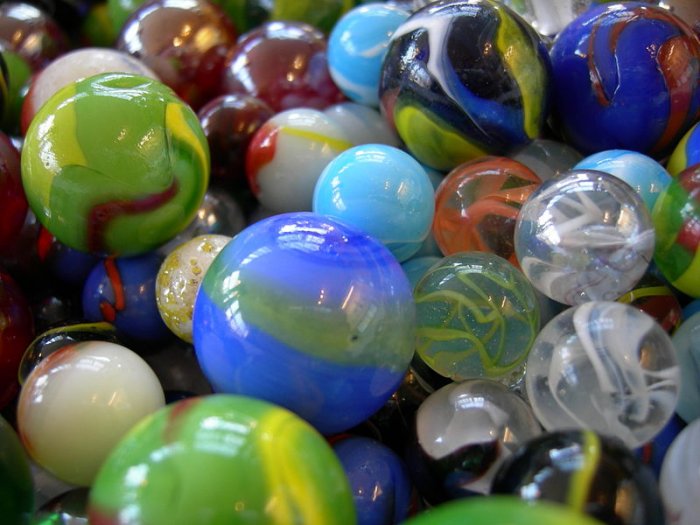
Marbles. Credit: Joe Mabel. CC BY-SA 3.0
Marble is a small spherical toy often made from glass, clay, steel, plastic. These balls are of different size and type. It’s fair to say it’s one of the simplest toys ever produced, but historical records show playing marbles can be fun.
It is unknown where marbles were first manufactured, but there is archaeological evidence that many games played today were enjoyed by children thousands of years ago. The first original marbles, the ones we are today familiar with were produced by a German glassblower in 1846.
Scientists have discovered small, colorful balls in pyramid tombs, and it seems marbles were part of the daily play of Egyptian children a long time ago. The oldest marble set was unearthed buried with an Egyptian child around 3,000 B.C. in a gravesite at Nagada.
Marbles made of clay have been discovered in prehistoric pueblo ruins in the southwestern United States, and in ancient Mexican ruins. Historians think the Aztecs enjoyed playing with marbles.
See also:
Ancient Egyptian Toys And Games In Focus
World’s Oldest Toy Car – Could This 7500-Year-Old Discovery Be The Earliest Evidence Of The Wheel?
What Was Life Like For Children In Ancient Athens?
It is thought that the Aztecs played a form of marbles. Clay marbles have been found in prehistoric pueblo ruins in the southwestern United States, in the classic periods Valley of Mexico ruins, and in the northern plains.
Small, ancient stone balls, identified by archaeologists as marbles have been unearthed near Mohenjo Daro, India and similar artifact have been discovered at prehistoric sites associated with Chaldeans of Mesopotamia.
In ancient Greece and Rome, children loved to play marbles. “On the Greek island of Crete, Minoan youths played with highly polished marbles of jasper and agate as early as 1435 B.C. And it is the Greeks, from their term for a polished white agate, marmaros, who gave us the word “marble.”
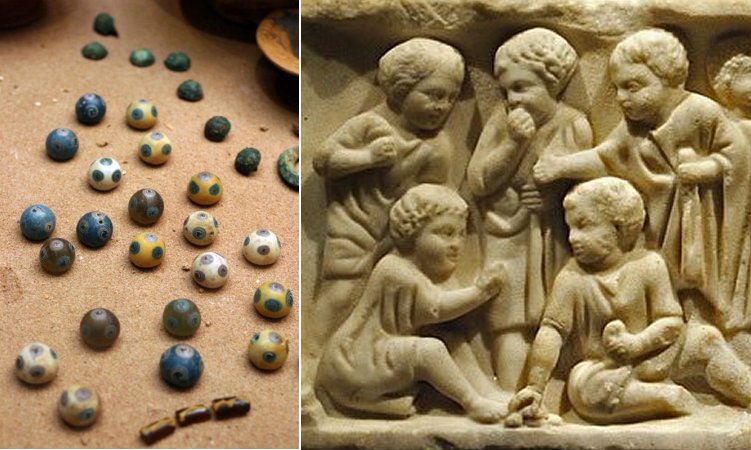
Left: Roman marbles. Credit: grandvoyageitaly.com - Right: Ancient Roman children. Credit: Public Domain
Marbles was a popular game among Roman children. The first Roman emperor, Caesar Augustus, would descend from his litter in order to join street children shooting marble pebbles and galls. Even clear glass marbles, fused from silica and ash, were manufactured in ancient Rome.
Despite the numerous marble artifacts obtained from ruins and the many references to the sport in extant texts, rules on how the game was played do not exist.” (Panati, Charles. Extraordinary Origins of Everyday Things)
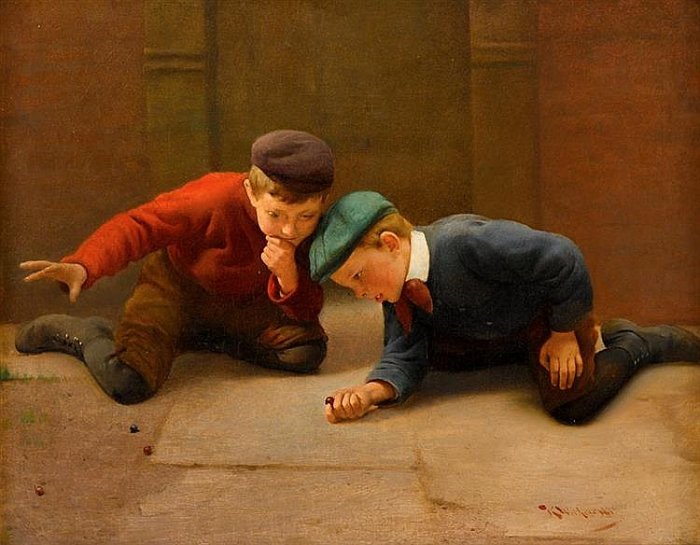
Game of Marbles, Karol D. Witkowski. Credit: Public Domain
Celtic, Saxon and African children did not have such beautiful glass balls, but they used nuts and olives to play marbles.
We can add that marbles are mentioned in ancient literature and depicted on historical paintings.
It’s fascinating to see how this game developed independently in virtually every ancient culture, and it’s still popular in modern times.
Written by Conny Waters – AncientPages.com Staff Writer
Copyright © AncientPages.com All rights reserved. This material may not be published, broadcast, rewritten or redistributed in whole or part without the express written permission of AncientPages.com
More From Ancient Pages
-
 Is There An Over-Looked Ancient Secret In Sahara?- Intriguing Theory Examined
-
 Czech Neolithic Well Is Oldest Wooden Structure In The World
-
 Abydos: One Of The Most Important Cities Of Ancient Egypt
-
 Sami People: Facts And History About The Only Indigenous People Of Most Northern Europe
-
 Bartolomeo Colleoni: Most Respected Mercenary General Of The 15th Century Italy
-
 Runic Inscription On The Viking-Age Galloway Hoard Deciphered
-
 Early Christian Landmark – Re-Evaluation Of Its Architecture And Practices
-
 Helmet Of Meskalamdug – Sumerian King Of The First Dynasty Of Ur
-
 DNA Confirms 2,000-Year-Old Sustainable Fishing Practices Of Tsleil-Waututh Nation
-
 Neolithic Farmers Invented Methods To Fight Pests 8,000 Years Ago
-
 Rare 2,000-Year-Old Roman Hoard Discovered In Suffolk
-
 Octopus Lures From The Mariana Islands Are The Oldest Known Artifacts Of Their Kind In The World.
-
 A 5,000-Year-Old Anatolian Sword Identified In Armenian Monastery In Venice
-
 Hesperides – Greek Nymphs Who Guarded Fabled Garden With Divine Apples Of Immortality
-
 Two-Million-Year-Old DNA Opens A ‘Game-Changing’ New Chapter In The History Of Evolution
-
 Mystery Of The Minoan Blue Monkeys Depicted In Frescoes
-
 Puzzling Biological Event 7,000 Years Ago – Something Weird Happened To Men
-
 Ancient Roman Coins Thought To Be Fakes Are Authentic – Experts Say
-
 Mystery Of Panxian Cave: How Could Gigantic Animals Reach A Mountain Cave Located Over 1600m Above Sea Level?
-
 Unknown Ancient History Of Antarctica And It’s Lost Civilization – Secrets Beneath The Ice

