
Ancient City Of Ipiutak Was Built By A Fair-Haired Race With Blue Eyes And Not Us – The Inuit Say
Ellen Lloyd - AncientPages.com - Located at Point Hope, Alaska, Ipiutak was once a flourishing city where people lived, traded, and practiced unusual rituals. Only ancient ruins and artifacts are left today, but the site is of great archaeological and historical importance.
Unraveling the mystery of Ipiutak could help us gain vital knowledge about a vanished culture and the early inhabitants of North America.

Fossil ivory figurine. Okvik. Punuk Islands. Credit: Froelich Rainey, Penn Museum
Unfortunately, this is easier said than done because there is conflicting information about the ancient city of Ipiutak. The site is estimated to be at least 2,000 years old. The community collapsed around 800 C.E., and archaeologists are trying to piece together who built the ancient city and when.
The builders of Ipiutak were sophisticated people and more advanced than the Eskimos. Who were they? Where did they come from? What happened to them?
Ipiutak was discovered during archaeological excavations in 1939 and 1940. It has been labeled as the largest site of its kind in the Eskimo region.
The sea destroyed some of the houses, but there are still enough ruins left to investigate. The ancient city was designed on a grid pattern. Its architecture reminds us of the ancient cities of the Indus Valley.
Scientists have discovered about 600 abandoned houses, one thousand unusual artifacts, and a huge cemetery that raises many interesting questions about the true inhabitants of Ipiutak.
Ipiutak Was Built By A Fair-Haired and Blue Eyed Race – The Eskimos Say
The Ipiutak are famous for producing sophisticated and decorative carvings in ivory, wood, bone, and stone artifacts, but their work is different.
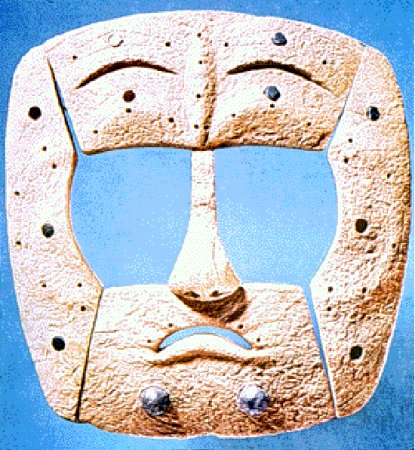
Burial mask from Ipiutak grave, Larsen and Rainey collections, in Danish National Museum, Copenhagen. Phil Mcgillivary, Researchgate
According to Phil Mcgillivray of the U.S. Coast Guard, "the complex and unusual nature of the carved ivory material found at Ipiutak immediately confirms the material as unique. Ipiutak specimens show artistic patterns distinct from those of related cultures."
The is a disagreement regarding the original builders of Ipiutak. Some archaeologists say the Eskimos constructed the ancient city, but they deny this. According to the legends of the Eskimos, the ancient city of Ipiutak was built by a fair-haired and blue-eyed race. Their legends also inform that white giants lived in Ipiutak until the War of the Gods.
Who could the legends of the Inuit refer to? Was Ipiutak once a Viking settlement, perhaps?
Inhabitants Of Ipiutak Were Not Primitive
Some archaeologists like Rainey Froelich, who excavated there, think people from Asia built Ipiutak. "Although this culture precedes known types of Eskimo culture on the Arctic coast, it is not primitive, and it diverges so widely from familiar Eskimo patterns that I am led to believe its origin will be found outside the Arctic regions, probably in eastern Asia," Froelich said.
At Ipiutak, scientists discovered more than 5,000 graves, some of which revealed this culture practiced unusual customs, but they also possessed knowledge of more advanced science. Ipiutak grave specimens date mainly around 350A.D., ranging from @100A.D.-1000 A.D.

Ivory cub walrus. Ipiutak, Point Hope. Credit: Froelich Rainey, Penn Museum
Researchers found ancient skulls with artificial eyeballs of ivory inlaid with jet inside the graves. Some bodies had ivory nose plugs shaped like bird's heads, and others had ivory death masks. Many graves contained small mummified animals, also with eyes inlaid with obsidian. Based on the findings, it seems inhabitants of Ipiutak practiced shamanism, and some archaeologists suggest their works remind Scthyo-Siberian cultures of Ukraine.
Ipiutak was not a small settlement. According to Froelich, this was once "a settlement with a population of several thousand, which must have been larger than the modern city of Fairbanks of Alaska."
The ancient inhabitants of Ipiutak left valuable clues, but we still do not know who the original builders were. Perhaps this enigmatic ancient city was built by a fair-haired race with blue eyes, as the Inuit say, or maybe these people did originate from Asia or Siberia. Some think they could be related to the Dorset culture, but these are only speculations, and we must confess that Ipiutak still remains shrouded in mystery.
Updated on July 23, 2022
Written by Ellen Lloyd – AncientPages.com
Copyright © AncientPages.com All rights reserved. This material may not be published, broadcast, rewritten or redistributed in whole or part without the express written permission of AncientPages.com
Expand for referencesRainey, Froelich. "The Ipiutak Culture at Point Hope, Alaska." American Anthropologist, New Series, 43, no. 3 (1941): 364-75. http://www.jstor.org/stable/663137.
Mcgillivary, Phil. (2005). Recovering the lost treasures of Ipiutak (Pt. Hope), Alaska. Proceedings of MTS/IEEE OCEANS, 2005. 2005. 1122 - 1129 Vol. 2. 10.1109/OCEANS.2005.1639907.
National Service PArk - Ipiutak National Historic Landmark
Larsen, Helge. "The Position of Ipiutak in Eskimo Culture." American Antiquity 20, no. 1 (1954): 74-79. doi:10.2307/276726.
More From Ancient Pages
-
 On This Day In History: ‘Sue’ Largest Tyrannosaurus Rex Skeleton Discovered In South Dakota – On August 12, 1990
-
 DNA Study Sheds New Light On The Mysterious 9,000-Year-Old Shaman Burial In Bad Dürrenberg
-
 Knowledge Of Secret Ancient Underground Civilization Revealed By Maya Priests
-
 Evidence Humans Used Fire 1 Million Years Ago In Israel Discovered By Artificial Intelligence
-
 Statue Of Apollo Discovered in Ancient City Of Prusias ad Hypium, Turkey
-
 Hieroglyphs Discovered In Sudan’s Old Dongola – Once Important City Of Nubia
-
 What Is The Link Between Drought And The ‘Barbarian Conspiracy’ In Roman Britain?
-
 The Dove And The Pomegranate: Who Was The High-Ranking Lady Who Owned This Unique Artifact In The First Temple Period?
-
 Earliest Evidence Of Humans Using Fire To Shape The Landscape Of Tasmania
-
 Eshu The Trickster: Mischievous Mediator Between Heaven And Earth In Beliefs Of Yoruba People
-
 Unusual Find – Headless Skeletons Discovered In A 7000-Year-Old Mass Grave In Slovakia
-
 Evidence Of Europe’s Earliest Human Presence, Dating Back 1. 3 Million Years Found At Venta Micena, Iberian Peninsula
-
 Bonobos And Chimps: What Our Closest Relatives Tell Us About Humans
-
 Home Of The Gods – Arrival Of Golden Ships – Part 1
-
 200 Tons Of Silver Hidden From The Romans On The Shores Of The River Lahn
-
 Treasures From Ancient City Of Hippos-Sussita Displayed In Exhibition For The First Time
-
 On This Day In History: Gottfried Wilhelm von Leibniz – Famous Philosopher, Scientist And Mathematician Died – On Nov 14, 1716
-
 A 5,000-Year-Old Anatolian Sword Identified In Armenian Monastery In Venice
-
 Rare And Well-Preserved Inka Tunic Discovered In Chile
-
 Mystery Of The Ancient Giant Wish Stone At Hattusa

