
Nammu: Sumerian Goddess Who Got The Idea To Create Mankind In The Image Of Gods
A. Sutherland - AncientPages.com - In Sumerian mythology, Nammu (Namma) was the "primeval sea" - the ultimate origin of everything.
The goddess Nammu gave birth to the heavens and the earth and life to the first couple of gods.
More exactly, she gave birth to the male sky god, An, and the female earth goddess, Ki, whose union, in turn, produced the god Enlil (Air), source of the ordered universe, responsible for cattle, agriculture tools, vegetation, and the arts of civilization. Man was created to serve the gods and provide them with nourishment.
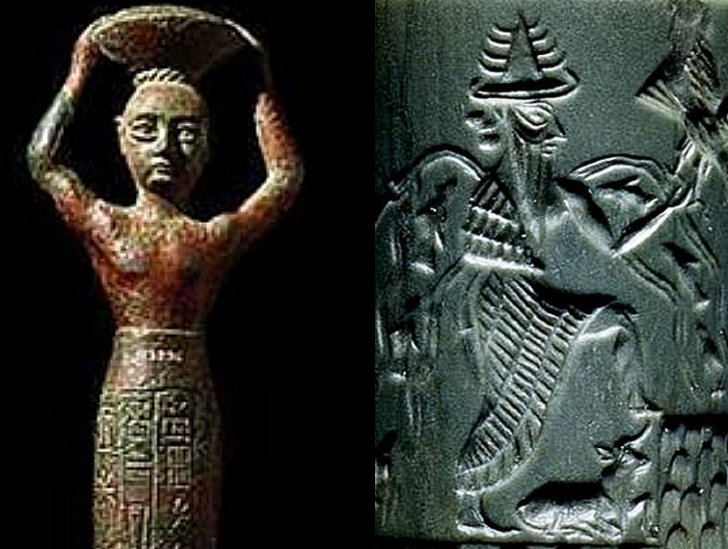
Nammu /Namma), a primeval goddess, who gave birth to An (heaven) and Ki (earth) and the first gods; Right: Enki god of the god of wisdom, creator, protector of humanity and the patron of craftsmen and artisans.
Nammu represented the oldest generation of Mesopotamia’s deities and was the mother of the god Enki (Ea), the Sumerian water god of Eridu, located in the southern wetlands of what is today Iraq. Enki was also the god of wisdom, creator, protector of humanity, and patron of craftsmen and artisans.
Not much is known about the Eridu goddess, Nammu, but she may have been a much more important prehistoric deity in the times before her son Enki took over most of her tasks.
Enki’s birth as the son of the goddess Nammu is attested in the Neo-Sumerian mythological text entitled “Enki and Ninmah.” It is said that Nammu got the idea to create mankind in the image of gods; however, to do this, she had to consult her son Enki, who gave his mother instructions on how to fashion man.
Samuel Noah Kramer, Assyriologist and a world-renowned expert in Sumerian history, writes that the poem begins with what may be a description of the difficulties of the gods in procuring their bread, especially after the female deities had come into being.
The gods complain, but Enki, the water god— as the Sumerian god of wisdom who is expected to come to their aid—is lying asleep in the deep and fails to hear them.
Enki gives the matter thought, leads forth the host of "good and princely fashioners," and says to his mother, Nammu, the primeval sea:
"O my mother, the creature whose name you uttered, it exists,
Bind upon it the image of the gods;
Mix the heart of the clay that is over the abyss,
The good and princely fashioners will thicken the clay..."
In the Sumerian poem “Enki and Ninmah,” Nammu’s role in Mesopotamian cosmology is particularly emphasized. Still later, however, in other texts such as the Akkadian ones, Nammu lost her importance, being only mentioned infrequently. In a later myth of Sumer, she became known as Tiamat.
The Mesopotamian scribes depicted and described Nammu as a goddess without a husband, the self-procreating womb of the universe. No male divine deity in connection with Nammu was ever mentioned in ancient Mesopotamian sources.
This led to the belief that the first cosmic production was asexual, according to the Sumerian creation myth.
Very little historical information can attest to cult places for the goddess Nammu, representing the oldest generation of Mesopotamian deities.
Her latest reference dates to the Neo-Babylonian period, when King Nabonidus (556 until 539 BC), the last king of Babylonia, mentioned Nammu’s shrine as part of the Esagil, known as the temple constructed to honor Marduk, the protector god of Babylon and located south of the ziggurat Etemenanki.
Updated on January 26, 2024
Written by – A. Sutherland - AncientPages.com Senior Staff Writer
Copyright © AncientPages.com All rights reserved. This material may not be published, broadcast, rewritten or redistributed in whole or part without the express written permission of AncientPages.com
Expand for referencesReferences:
Kramer N. Samuel, History Begins At Sumer
Leick G. A dictionary of ancient Near Eastern mythology
More From Ancient Pages
-
 On This Day In History: Captain James Cook Spotted The East Coast Of Australia – On Apr 19, 1770
-
 Rare 2,500-Year-Old Saw Discovered At The Ancient Hittite City Hattusa
-
 Earliest Version Of Our Alphabet Possibly Discovered
-
 Stunning Colorful Ancient Roman Mosaic With Found Under Aldi Supermarket Site In UK
-
 Handshaking Is An Ancient Tradition – When, Where And Why Did We Start To Clasp Hands?
-
 Modern Humans Have Their Homeland In Botswana – New Study
-
 Isaiah: Prophet Who Predicted The Coming Of Jesus Christ To Salvage Mankind From Sin
-
 Hasankeyf – 12,000-Year-Old Mesopotamian City Will Be Destroyed – Decision Sparks Outrage And Controversy
-
 Pharaoh Ramses II’s Sarcophagus On Display For The First Time In 50 Years
-
 Meenakshi Temple Of Madurai Is Among Most Powerful Sacred Sites For Hindu People
-
 Roman Britain Executions Revealed – New Evidence
-
 Shaka Zulu: African Hero And One Of Greatest Military Leaders Of All Time
-
 Brochs: Ingeniously Engineered Windowless Iron Age Structures Of Atlantic Scotland
-
 8,000-Year-Old Petroglyphs Discovered In Oldest Impact Crater In South Africa
-
 Last Of The Giant Camels And Archaic Humans Lived Together In Mongolia Until 27,000 Years Ago
-
 Ancient Mystery Of Pharaohs And Gods With Two Left Or Two Right Hands – A Deeper Investigation
-
 DNA Study Of Ancient Humans Sheds Light On Human Evolution On The Tibetan Plateau
-
 2,000-Year-Old Huge Terracotta Jar Discovered In Turkey
-
 Kelpie – Supernatural Horse-Liked Creature Lures Humans To Death In Scottish Lore
-
 2,600-Year-Old Blocks Of White Cheese Discovered At Giza’s Saqqara Necropolis, Egypt

