
Ancient People Dressed Baby Boys In Blue To Ward Off Evil Spirits
Conny Waters - AncientPages.com - The colors pink and blue have been used as gender signifiers for quite some time now. We are so used today to baby boys dressed in blue that we rarely think about why this color was chosen for newborn males. We also tend to forget that boys were dressed in pink not so long ago.
Some modern parents who dislike stereotypes disregard this unwritten rule and dress their kids in any color they want, but many try to follow old customs.
As a matter of fact, just before the 1920s, pink was considered the best color for boys.
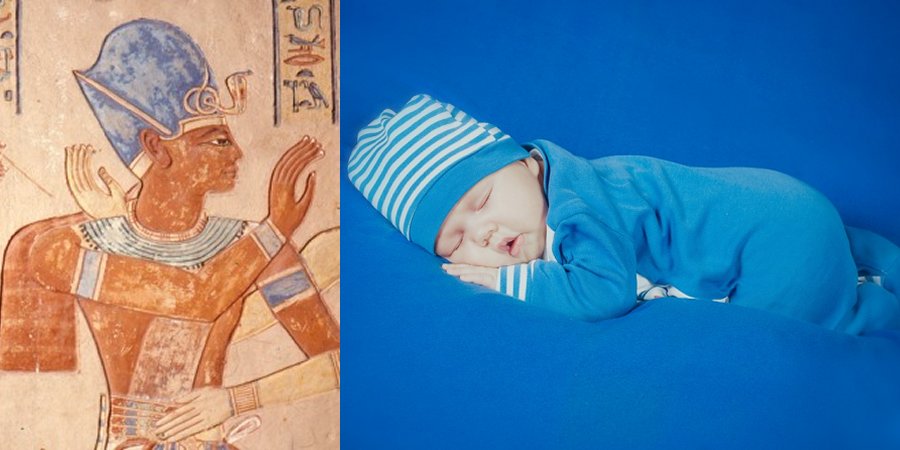
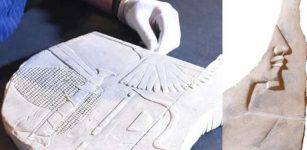
Left: Egyptian blue crown symbolizes military power held by the pharaoh during military battles. Credit: globalegyptianmuseum.org Right: Baby boy dressed in blue. Credit: Public Domain
According to a June 1918 article from the trade publication Earnshaw's Infants' Department, “the generally accepted rule is pink for the boys, and blue for the girls. The reason is that pink, being a more decided and stronger color, is more suitable for the boy, while blue, which is more delicate and dainty, is prettier for the girl.”
This changed later, and people started dressing their baby boys in blue, something our ancestors did thousands of years ago.
Ancient People Used Blue Color To Ward Off Evil Spirits
In ancient Egypt and Greece, blue color was used to protect a person or a place from evil spirits. Pharaohs were often dressed in blue. Egyptians and many other ancient civilizations considered blue color to be of divine origin.
It’s therefore not surprising that the blue color was specifically chosen by our ancestors who wanted to protect their newborn from evil spirits that might be lurking about.
This ancient tradition is still alive and there are many places in the Mideast where people still paint their doorways to ward off evil spirits.
“Centuries ago, it was commonly believed that satanic spirits hovered about nurseries waiting for a chance to enter the bodies of young children. It was also believed that these evil spirits could be repelled by the color blue, the color of the heavens.” (Smith, Douglas B.. Ever Wonder Why?)
To many of us, it may seem odd that newborn girls were not dressed in blue too, but back then, baby boys were more precious than baby girls. Parents considered girls to be inferior, and it was assumed that evil spirits would not bother with them. Ancient people could dress baby girls in any color, but small boys must be dressed in blue to protect them from these harmful evil powers.
Blue Color Is Still Believed To Protect From Evil Powers
Today, many people still fear the Evil Eye, a harmful power that comes from emotions such as envy or greed.
In many countries, one can easily buy various amulets that shield its bearer from the curse of the Evil Eye. One of the most famous symbols protecting against the Evil Eye is called Hamsa, a universal symbol is that especially popular among Jews and Muslims.
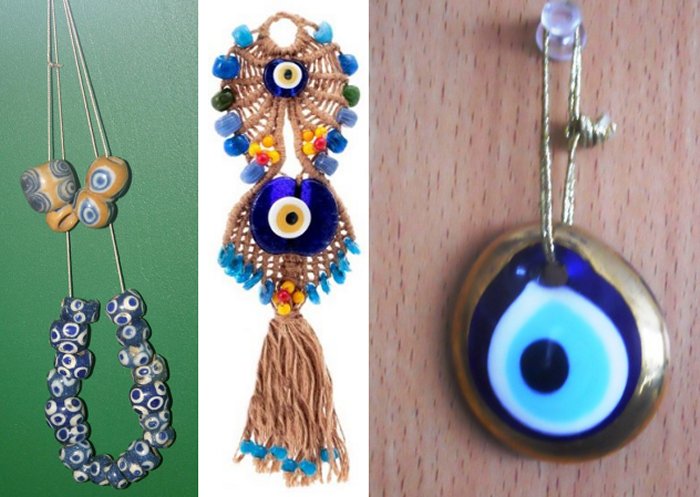
Nazar symbol. Credit: Public Domain
Nazar amulets that offer protection against the Evil Eye are especially popular in Turkey, but they can also be found in other countries.
“In Macedonia, Albania, Bosnia and Herzegovina, Bulgaria, Greece, Cyprus, Syria, Lebanon, Israel, Egypt, Armenia, Iran, India, Afghanistan, Pakistan, Iraq, and Azerbaijan, Nazar is often hung in homes, offices, cars, children's clothing, or incorporated in jewelry and ornaments.“
The blue color in these protective amulets is still of special importance because it is widely regarded as warding off evil powers.
Updated on September 3, 2023
Written by Conny Waters – AncientPages.com Staff Writer
Copyright © AncientPages.com All rights reserved. This material may not be published, broadcast, rewritten or redistributed in whole or part without the express written permission of AncientPages.com
Expand for referencesBarbara Berliner, Melinda Corey, George - Book of Answers
Smith, Douglas B. - Ever Wonder Why?
More From Ancient Pages
-
 Two Inca Measurement Systems Calculated By Polish Architect
-
 Extraordinary Find: Monumental Relief Of King Ashurbanipal And Deities Unearthed In Ancient City Of Nineveh
-
 10,000 Years Ago Cattle Was Domesticated In The Central Nile Region – New Study
-
 When Did Humans First Start To Speak?
-
 Does A Baffling Artifact Offer Evidence Of Ancient Extraterrestrial Visitation In New Zealand? – Experts Investigate – Part 2
-
 Radiocarbon Dating Method Needs Adjustments – Researchers Say
-
 Patara Lighthouse Built By Emperor Nero In 64 AD Will Shine Again
-
 Englishmen Jailed For Stealing Rare Viking Hoard Worth Millions
-
 Scathach – The Shadowy One – Legendary Martial Arts Teacher Who Trained Cuchulainn And Other Warriors
-
 Family Looking For Lost Gold Ring Finds Viking Age Artifacts In Their Garden On The Island Of Jomfruland
-
 New Attempt To Solve The Easter Island Mystery – What Did Rapa Nui Look Like Before Europeans Arrived?
-
 8 Billion People: How Different The World Would Look If Neanderthals Had Prevailed
-
 Ancient Warfare And Continuous Rise In Global Population – Is There A Connection?
-
 On This Day In History: Vädersol Painting Depicting ‘Sun Dog’ Phenomenon Observed Over Stockholm – On Apr 20, 1535
-
 Bronze Age Finding Offer New Clues On The Beginnings Of Cardiff
-
 Humans Were Living Around Fort McMurray, Alberta 13,000 Years Ago – Scientists Reveal
-
 Among Ancient Maya Cacao Was Used In Celebrations And Was Common To All People
-
 Does The Shigir Idol Depict Demons And Evil Spirits?
-
 Mysterious Depiction Of Pharaoh Hatshepsut
-
 LIDAR Discovers Circular Iron Age Village At Cap d’Erquy, France

