
Ninkasi – Sumerian Goddess Of Beer And Alcohol – The Hymn To Ninkasi Is An Ancient Recipe For Brewing Beer
Ellen Lloyd - AncientPages.com - Ninkasi was a Sumerian goddess of beer and alcohol worshiped in Mesopotamia, an area between the large rivers known as Tigris and Euphrates, that is today known as modern Iraq, but the region also included parts of southwestern Iran, southeastern Turkey, and northeastern Syria.

This Babylonian cylinder seal from Ur (c. 2600 B.C.E.) shows two people drinking beer out of a jar using straws. Credit: Biblical Archaeology Review
Considering how much people have always enjoyed alcoholic beverages, one can safely assume that Ninkasi was a beloved deity in the Mesopotamian pantheon.
Beer Was A Gift From A Goddess
In Mesopotamia, beer was considered a sacred drink and like most ancient civilizations, Sumerians considered beer to be a gift from a goddess and not a male god. Why humans received this particular gift is uncertain. According to Christine P. Rhodes, editor of Encyclopedia of Beer, it is likely “this divine generosity was thought to have been prompted by pity for the plight of human beings — the only animals doomed to a life plagued by the knowledge that one day we must die.”
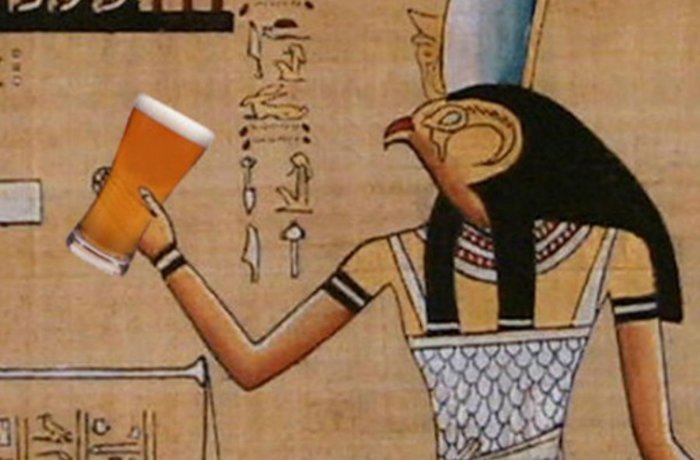
In ancient Egypt, beer was used as medicine and payment. Credit: Cairo Scene
Ninkasi was not the only beer goddess worshiped by our ancestors. In ancient Egypt goddess Hathor was associated with beer and so was goddess Menquet. From Encyclopedia of Beer, we learn that “the goddesses of brewing survive to this day among isolated tribal groups in Africa and India. All brewing is accompanied by prayers and offerings to the earth goddesses Mama Sara and Pauchua Mama, both of whom date back long before the rise of Incan civilization.
Just as goddesses are universally believed to have given humans the gift of beer, women historically have been the brewers of beer. It is obvious that women used their brewing skills to maintain power and status in male-dominated hunter-gatherer societies. In remote corners of the modern world, women continue their domination of beer making.“
Beer Goddess Ninkasi And The Hymn To Ninkasi - An Ancient Recipe For Brewing Beer
Ninkasi was the daughter of a king from Uruk and a priestess of the temple of the Mesopotamian goddess Inanna, known as Ishtar to the Assyrians. Ninkasi had several responsibilities. She was one of eight children who had to heal one of god Enki’s eight wounds and she prepared beer daily.
An ancient poem, known as “A hymn to Ninkasi” was discovered by archaeologists excavating in Iraq. Written on a clay tablet, this poem is a recipe for brewing beer. It is also the oldest record revealing the connection between brewing and the responsibility that women had with regard to supplying both bread and beer to the household.
Clay tablets were one of the earliest systems of writing invented by the Sumerians.
Hymn to Ninkasi
Borne of the flowing water,
Tenderly cared for by the Ninhursag,
Borne of the flowing water,
Tenderly cared for by the Ninhursag,
Having founded your town by the sacred lake,
She finished its great walls for you,
Ninkasi, having founded your town by the sacred lake,
She finished its walls for you,
Your father is Enki, Lord Nidimmud,
Your mother is Ninti, the queen of the sacred lake.
Ninkasi, your father is Enki, Lord Nidimmud,
Your mother is Ninti, the queen of the sacred lake.
You are the one who handles the dough [and] with a big shovel,
Mixing in a pit, the bappir with sweet aromatics,
Ninkasi, you are the one who handles the dough [and] with a big shovel,
Mixing in a pit, the bappir with [date] - honey,
You are the one who bakes the bappir in the big oven,
Puts in order the piles of hulled grains,
Ninkasi, you are the one who bakes the bappir in the big oven,
Puts in order the piles of hulled grains,
You are the one who waters the malt set on the ground,
The noble dogs keep away even the potentates,
Ninkasi, you are the one who waters the malt set on the ground,
The noble dogs keep away even the potentates,
You are the one who soaks the malt in a jar,
The waves rise, the waves fall.
Ninkasi, you are the one who soaks the malt in a jar,
The waves rise, the waves fall.
You are the one who spreads the cooked mash on large reed mats,
Coolness overcomes,
Ninkasi, you are the one who spreads the cooked mash on large reed mats,
Coolness overcomes,
You are the one who holds with both hands the great sweet wort,
Brewing [it] with honey [and] wine
(You the sweet wort to the vessel)
Ninkasi, (...)(You the sweet wort to the vessel)
The filtering vat, which makes a pleasant sound,
You place appropriately on a large collector vat.
Ninkasi, the filtering vat, which makes a pleasant sound,
You place appropriately on a large collector vat.
When you pour out the filtered beer of the collector vat,
It is [like] the onrush of Tigris and Euphrates.
Ninkasi, you are the one who pours out the filtered beer of the collector vat,
It is [like] the onrush of Tigris and Euphrates.
Beer Was Important And Valued In The Sumerian Society
In “Brewing An Ancient Beer”, an article published by Archaeological Institute of America, authors explain that “ancient texts preserved on clay tablets indicate that the earliest beer was Sumerian, From all that we can determine, beer played an important role in Sumerian society and was consumed by men and women from all social classes.
In Sumerian and Akkadian dictionaries, being compiled by scholars today, the word for beer crops up in contexts relating to medicine, ritual, and myth. Beer parlor receive special mention in the laws codified by Hammurabi in the eighteenth century B.C.
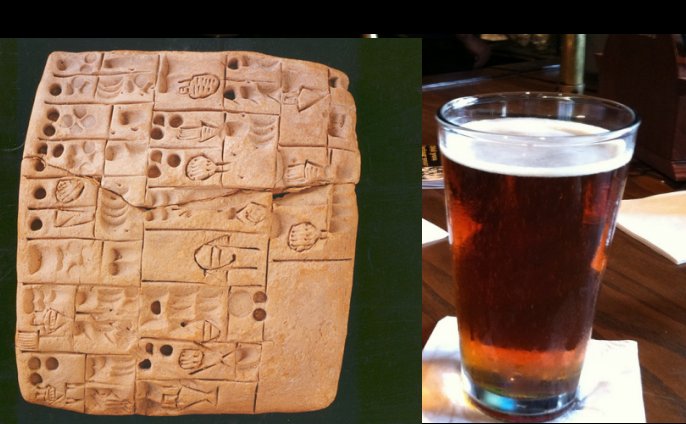
Archaeologists have unearthed ceramic vessels from 3400 B.C. still sticky with beer residue, and 1800 B.C.’s “Hymn to Ninkasi”—an ode to the Sumerian goddess of beer—describes a recipe for a beloved ancient brew made by female priestesses.
Apparently stiff penalties were dealt out to owners who overcharged customers (death by drowning) or who failed to notify authorities of the presence of criminals in their establishments (execution) Hight priestesses who were caught in such places were condemned to death by burning.”
The drink was apparently so popular that ancient Sumerian workers were paid for their labor in beer and this practice was widely known in the ancient world.
Receiving wages in form of alcohol has happened on several occasions throughout history. Ancient Egyptians also valued beer and used it not only to get drunk but as medicine and payment. Beer was of great importance in ancient Egyptian society and its existence gave women an opportunity to earn extra money.
Although beer was most likely born in the Middle East, one mustn’t forget that around 7,000 BC. ancient Chinese consumed a beverage similar to beer known as kui, which was made from rice, honey, and fruit.
Other alcoholic beverages can be even older. Researchers think ancient civilizations invented alcohol about 10,000 years ago.
Written by Ellen Lloyd – AncientPages.com
Copyright © AncientPages.com All rights reserved. This material may not be published, broadcast, rewritten or redistributed in whole or part without the express written permission of AncientPages.com
Expand for referencesChristine P. Rhodes - The Encyclopedia of Beer
Katz, Solomon H., Fritz Maytag, and Miguel Civil. "BREWING AN ANCIENT BEER." Archaeology 44, no. 4 (1991): 24-33. Jstor.org
More From Ancient Pages
-
 Thousands Of Petroglyphs And Inscriptions In Wadi Rum, Jordan – 12,000 Years Of Human Occupation
-
 Land of Israel: A 5,000-Year-Old Settlement And A Pottery Kiln Unearthed Near Beit Shemesh At The Site Of Hurvat Husham
-
 On This Day In History: ‘Battle On The Ice’ – Army Of Prince Nevsky Against Teutonic Knights Was Fought – On Apr 5, 1242
-
 Unique Roman Oil Lamp Decorated With A Crafted Mask Discovered In The Netherlands
-
 Priceless Artifacts From The Bactrian Hoard Are Missing – Where Are They?
-
 Long-Standing Mystery Of What May Have Triggered Ice Age Solved – New Study
-
 On This Day In History: Tsar Peter The Great Opens New Chapter in Russia’s History – On Mar 19, 1697
-
 Ancient ‘Yahweh And His Asherah’ Inscriptions At Kuntillet ‘Ajrud Remain An Unsolved Biblical Mystery
-
 Beautiful Ancient Irish Legend Of The Blessing Of The Bees – Ancient Tradition Revived In Ireland Again
-
 Tragic Reign Of Caterina Cornaro – The Last Queen Of Cyprus And Patron Of The Arts
-
 Tarascan Indians: Intriguing Pre-Columbian Civilization Of Artists, Warriors And Skilled Metallurgists
-
 Extremely Rare Roman Glass Vase Adorned With A Message Found In France
-
 Unexplained Disappearance Of East Balkan Civilizations – Scientific Disagreement – Part 2
-
 ‘Exceptionally’ Rare Iron Age Axle Found In Suffolk
-
 Mysterious Crypt Points To A Rosicrucian Secret That Was Never Meant To Be Revealed
-
 Submerged Ancient Bridge Found In Genovesa Cave Reveals Humans Settled In Mediterranean Much Earlier Than Previously Thought
-
 Acheulian Culture Of Ethiopian Highlands And Their Prehistoric Tool Selection To Make Society’s Life Easier
-
 Mysterious Unknown Caves And Tunnels Discovered Beneath The Olsztyn Castle
-
 Mysterious Ancient People Who Mastered Thought-Transmission Through Space And Spoke At Distance
-
 St. Simeon’s Monastery And History Of Its Founder Shed Light On Christian Past In Anatolia

