
Mysterious Prehistoric Statues In Bada Valley, Indonesia Surrounded With Countless Legends
A. Sutherland - AncientPages.com - There are hundreds of prehistoric megaliths and several impressive ancient stone statues located in the Bada Valley, Central Sulawesi just south of the Lore Lindu National Park, Indonesia.
They vary in shape and size and according to sources, the number of megalithic rocks is 1,451. No doubt, the megaliths represent a prehistoric heritage, older than Borobudur Temple, but no one knows exactly their purpose and use of these rocks in ancient times.

Two Dutch ladies standing by a statue in Bada Valley in the 1930s. Image credit: Tropenmuseum - CC BY-SA 3.0
Located in a distant, isolated village that only a small number of Indonesians have heard about, mysterious statues of Bada Valley, Indonesia have no inscriptions to explain what or who they actually symbolize, who their builders were, or why they were built.
The tallest and best-known carved standing stone statue in the valley is a statue known as 'Palindo' which translates as 'The Entertainer' and measures over 4 meters.
The "Entertainer" has round eyes and a large nose that extends down and a deeply carved mouth makes him Watu Palindo looking cheerful and friendly. Besides Watu Palindo, there is another famous stone - Langka Bulawa ("Queen with a golden leg"), which depicts a woman's figure.
There are 13 other finely carved statues in the Bada Valley, with others in the nearby Besoa and Napu valleys inside the Lore Lidu National Park.
Hundreds of megaliths in this region of the country that goes back to the 14th century are called watu ("stone") in the local Badaic language and arca ("statue") in Indonesian.
Some people suggest that the stones were carved around 5,000 years ago, while others say the megaliths were made about 1,000 years ago. Meanwhile, other people say that the stones are related to megalithic culture in Laos, Cambodia, and other regions in Indonesia in the past 2,000 years.
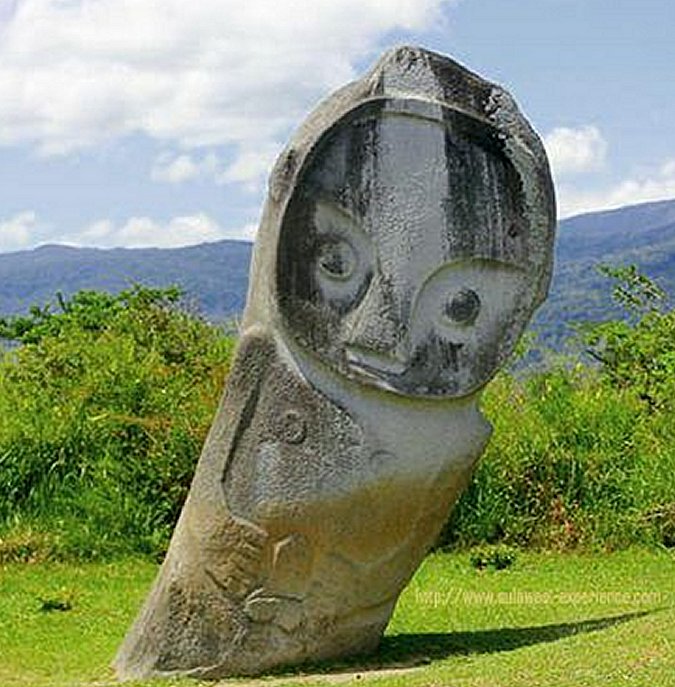
'Palindo' ('The Entertainer') measures over 4 meters. source
As we see, the dating of these impressive megaliths is uncertain, and for now, the bizarre statues are dated to be from 5000 to 1000 years old.
Archaeologists claim they haven’t found enough clues to explain their history yet, because at the time of their discovery, local people scraped the statues out of thick moss and dirt in order to clean them.
Other sources say, farmers grow rice around them and simply ignore them all, probably unaware of their historical value and mysteries behind them.
Many have long wondered who were these rock sculptors because it is commonly known that granite rocks are very hard, which makes working with them - very difficult.
Were The Megaliths Used To Worship Ancestors?
Local people Of Bada Valley and neighboring areas believe that the stone was used
to worship ancestors. They also have their own story about the origin of these very ancient megaliths.
Not only that, the residents also have stories about the origin of the formation
of these megaliths. According to local folklore, there was once a dangerous rapist who was finally condemned to be a piece of stone.
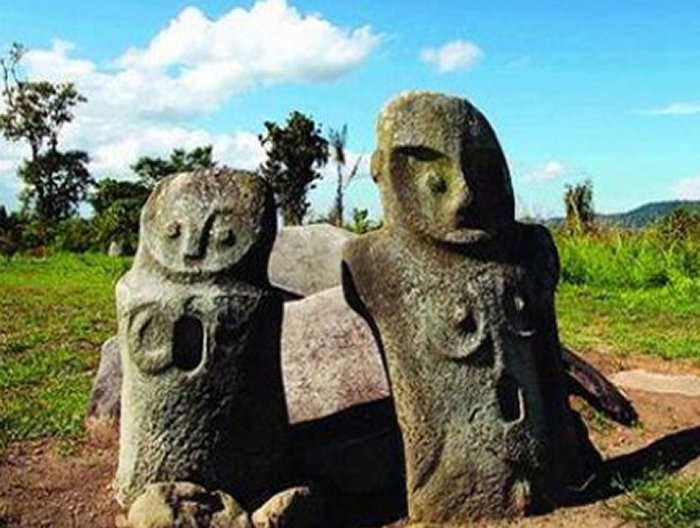
Bada Valley gigantic statues, Indonesia. source
Another story says about another large megalith named Tadulako. The community said that Tadulako was known as a village guard, but after stealing rice he was changed to stone.
Bada Valley's megaliths are also linked with human sacrifice or supernatural powers and some other ancient beliefs suggest they were intended to ward off evil spirits.
The elders in the village of Sepe believe that the statue of Palindo which means the entertainer in the local language is a representation of their predecessor population, the Tosaloge tribe. These people believe that the largest and the most celebrated statue in the area, which is that of Palindo ('The Entertainer') may represent Sepe's first mythological inhabitant, Tosaloge.
Yet another legend tells of the Raja of Luwu from the oldest kingdom in South Sulawesi, who once ordered 1800 statues to move from Sepe to Palopo. It was not an easy task for the workers because the distance between these two places is large.
Anyway, King Luwu wanted to prove his dominance over Bada, but his effort failed. One statue was ordered to originally face the south, but the Bada people turned it to face the west.
The Raja's followers tried to turn it back, but an accident happened and the statue fell onto its side, killing 200 people.
In the past, there was a tradition to give offerings to this statue before doing great work, such as opening new land for agriculture.
Written by – A. Sutherland - AncientPages.com Senior Staff Writer
Copyright © AncientPages.com All rights reserved. This material may not be published, broadcast, rewritten or redistributed in whole or part without the express written permission of AncientPages.com
Expand for referencesReferences:
Bellwood P. First Islanders: Prehistory and Human Migration in Island Southeast Asia
More From Ancient Pages
-
 On This Day In History: Albertus Magnus – Medieval Person Of Great Historical Importance Died – On Nov 15, 1280
-
 Stele Of Tell al-Rimah And Deeds Of Assyrian King Adad-nirari Against Rebellious Kings
-
 Discovery At Fujiwarakyu Palace Complex Offers Better Glimpse Of 7th-Century Japan
-
 A New William Shakespeare First Folio discovered on Isle of Bute, Scotland
-
 Brown Hares And Chickens Were Seen As Gods Not Food In Iron Age Britain
-
 Castor And Pollux: Dioscuri Brothers Immortalized In The Night Sky In Greek Beliefs
-
 Earliest Evidence Of A 260-Day Maya Calendar Found Inside Guatemalan Pyramid
-
 Teutonic Knights – Facts And History About The Christian Military Order
-
 Rare Iron Age Crouch Burial Discovered At The Margate Caves Site In Kent, UK
-
 The Lycurgus Cup: Fascinating Artifact That Reveals Prehistoric Knowledge Of Nanotechnology
-
 Extraordinary 6,500-Year-Old “Noah” Skeleton Re-Discovered – A Survivor Of The Great Flood Hidden In Museum
-
 Homo Longi: Extinct Human Species That May Replace Neanderthals As Our Closest Relatives
-
 Ancient Papyrus Of Merer Reveals How The Great Pyramid Of Giza Was Built
-
 Mycenae Kingdom: Home To King Agamemnon And Tholos Tomb ‘Treasure of Atreus’
-
 Carbon-12 – A Critical Gateway To The Birth Of Life Is Produced In Stars – Did Life Come From Cosmos?
-
 Ancient Health Center Discovered In Philadelphia, Central Anatolia, Turkey
-
 DNA Evidence For Early Contact Between Farmers And Pastoralists In Black Sea Region
-
 Rare 4,500-Year-Old Stone Sculpture Of Canaanite Goddess Anat Found By Farmer In Gaza Strip
-
 Beautiful Legends Of The Great Smoky Mountains: The Cherokee’s Little People Nunnehi And The Medicine Lake Ataga’hi
-
 Bees – Embodiment Of Human Soul, Divine Messengers Symbolizing Invisible Bridge Connecting Life And Death

