
Mount Nemrut: ‘Throne Of The Gods’ – Mysterious Royal Tomb Surrounded By Gigantic Sculptures
A. Sutherland - AncientPages.com - Mount Nemrut is an awe-inspiring and enigmatic place located on one of the highest peaks of the Eastern Taurus mountain range, at an altitude of over 2,000 m above sea level, in south-east Turkey.
We know this ancient place as Nemrut Dagi - the Hierotheseion (temple-tomb and the house of the gods) built by the late Hellenistic King Antiochos I of Commagene (69-34 B.C.), who dedicated it to himself.

Western terrace of the Nemrut Dagi, Turkey: Antiochos (left); Herakles (right). Credit: Bernard Gagnon/ Wikipedia
The unique mountain top shrine was completely unknown to all until its discovery in 1881 by German engineer Karl Sester. At the time of the discovery, the megalithic statues were said to be intact. Archaeological excavations began for the first time in 1953 when the American School of Oriental Research conducted precise surveys of the site.
With a diameter of 145 m, the 50 m high funerary mound of stone chips is surrounded on three sides by terraces to the east, west, and north directions. Two separate antique processional routes radiate from the east and west terraces.
Antiochus I's sanctuary is flanked by huge statues 8-9 m (26-30 ft) high of himself, two lions, two eagles, and various Greek, Armenian, and Iranian gods, such as Vahagn-Hercules, Aramazd-Zeus, or Oromasdes (associated with the Iranian god Ahura Mazda), Bakht-Tyche, and Mihr-Apollo-Mithras.

Mount Nemrut - East Terrace Nemrut. Image credit: Klearchos Kapoutsis, Santorini, Greece via wikipedia
These statues were once seated, with names of each god inscribed on them. Later, the heads of the statues have been removed from their bodies and most likely deliberately damaged (especially their noses). Today they are found scattered throughout the site but they have never been restored to their original locations. Additionally, after numerous earthquakes and devastation, the stone heads look as if they have been cut off from the trunk.
The site also preserves stone slabs with bas-relief figures that are thought to have formed a large frieze. These slabs display the ancestors of Antiochus, who included Armenians, Greeks, and Persians. The Hierotheseion of Antiochos I is one of the most ambitious constructions of the Hellenistic period.
A highly developed technology was used to build the colossal statues and stelae, the equal of which has not been found anywhere else for this period. The syncretism of its pantheon and the lineage of its kings, which can be traced back through two sets of legends, Greek and Persian, is evidence of the dual origin of this kingdom's culture.
Is There A Treasure Hidden On The Top Of Mount Nemrut?
Are ancient secrets hidden inside the mountain? Archaeologists believe that the mound hides the tomb of King Antioch, but they are not entirely convinced. In addition, there are numerous legends about the treasure hidden on the top of the mountain.
However, the truth regarding both the tomb and possible treasures has not been revealed during archaeological studies lasting for more than half a century. Even the use of dynamite, which only lowered the mound by 5 m, did not reveal anything of value.
Archaeologists have found an ancient glass shaft, which according to experts indicates a unique knowledge of advanced astronomy of people of that period. It runs towards the slope at an angle of 35 degrees and is about 150 meters long. Computer analysis has shown that two days of the year, the sun’s rays would illuminate the bottom of the shaft - once when in line with the constellation of Leo and another time when in line with Orion.
The ancient kingdom of Kommagene (Commagene) - a small mountain kingdom located in what was Asia Minor, in Eastern Anatolia - was relatively short-lived but it survived as an independent kingdom until 72 AD when it was incorporated into the Roman Empire.
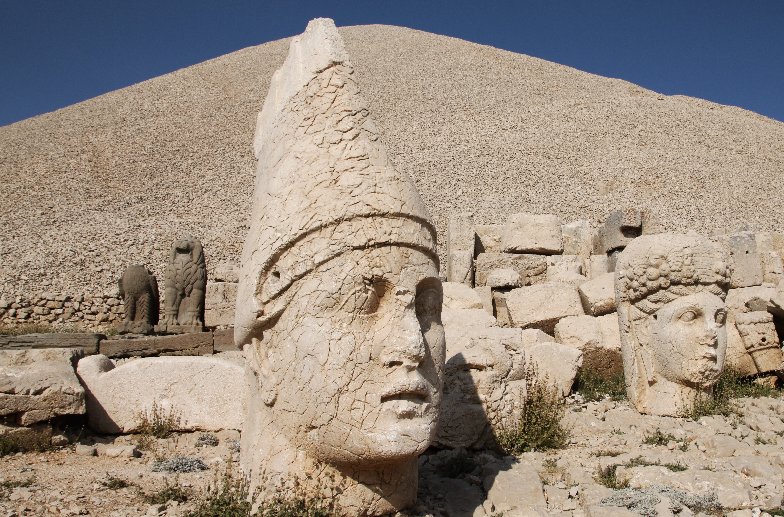
Mount Nemrut - West Terrace. Left: the head of Apollo/Mithra/Helios/Hermes. Klearchos Kapoutsis, Santorini, Greece/Wikipedia
The magnificent Nemrut statues are located within a first-degree earthquake zone very close to the East Anatolian Fault, which is seismically active. Therefore, the tumulus, statues, and stelae are vulnerable to earthquakes. The height of the tumulus has been reduced from its estimated original 60 m due to weathering, previous uncontrolled research investigations, and climbing by visitors.
The first version of this article was originally published on August 6, 2015
Written by – A. Sutherland - AncientPages.com Senior Staff Writer
Copyright © AncientPages.com All rights reserved. This material may not be published, broadcast, rewritten or redistributed in whole or part without the express written permission of AncientPages.com
More From Ancient Pages
-
 Baffling Encounters With Mysterious Underground Humanoids Guarding A “Giant Hand”
-
 Ancient Ruins Of Hovenweep: Impressive Puebloan Masonry
-
 Unusual Secret May Be Hidden In A Mysterious Valley In The American Southwest
-
 Over 2,000 Clay Figurines Discovered In The Ancient City Of Kythnos
-
 Strange Medieval Figurine With A Crown On The Head And A Falcon On The Arm – Is It A King Or A Queen?
-
 Scotland’s Mysterious Ballachulish Figure Could Be Cailleach Bheithir – Ancient Hag Goddess Of Winds And Storms
-
 Mysterious Biblical Canaanites – What Ancient DNA Reveals About Their Fate
-
 Yak Milk Consumption Among Mongol Empire Elites – New Study
-
 Aboriginals Inhabited South Australia 29,000 Years Ago – New Study
-
 Possible Viking Boat Burials Discovered On The Isle Of Mull
-
 On This Day In History: Admiral Richard E. Byrd Made His First Flight Over The South Pole – On Nov 29, 1929
-
 Secrets Of Namibia’s Fairy Circles Solved – Self-Organizing Plants Are The Creators – New Theory
-
 Men And Women Had Equal Access To Resources 6,000 Years Ago
-
 Mystery Of The Ancient Foggaras: Sahara’s Incredible Masterwork Of Antiquity
-
 Oldest Living Culture: Research Reveals Indigenous Ritual Spanning 500 Generations
-
 Frigg: Chief Norse Goddess Who Knew Secrets Of Humans’ Fates
-
 New Clues Why Neanderthals Visited La Cotte de St Brelade In Jersey 250,000 Years Ago
-
 Controversial Tartaria Tablets: The First Writing System In The World?
-
 Evidence Americas’ Oldest Mine In Wyoming Was Used By Paleoindians 13,000 Years Ago Has Been Found!
-
 Daily Life Of Priests And Priestesses In Ancient Egypt

