
Celtic Knot Decorated Bible, Gospels, Celtic Crosses And Symbolized Strength, Love And Continuity Of Life
A. Sutherland - AncientPages.com - The Celts reached a high level of civilization, yet this civilization ceased to exist long ago.
Its rich culture and art survived until modern times, for example, in the form of mysterious and complex patterns and symbols expressed by the Celtic knotwork, which appear almost everywhere in contemporary society.
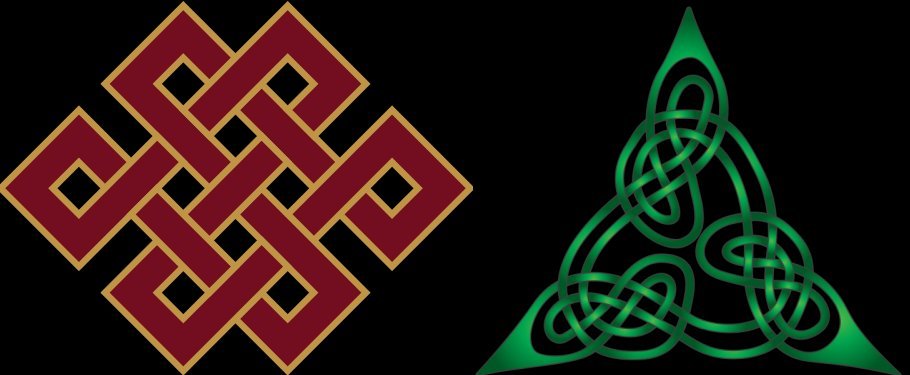
Left: Tibetan Endless Knot (common form). credit: Dogcow on de.Wikipedia; Right: Design influenced by the illustration in the Lindisfarne Gospels. Credit: User Melian/Wikipedia
Celtic knots are complete loops without any beginning or end; this never-ending style is called pure knots. By using only one thread in their artistic designs, the Celts wanted to express their fundamental belief in the continuity of life and the inseparable connection between life and eternity.
Celtic art was vibrant and colorful, and artists decorated objects of everyday use with various motifs. Based on the Celts' strong belief in symbolism, old legends, and myths, they inspired the culture's artists and their countless knotworks.
The knots vary from simple to very complicated ones, and undoubtedly, they have a deep but not particularly well-known meaning. In addition, there is little written history documenting the purpose of the Celtic knots.
Much later, people began to understand better the true meaning of the Celtic knots displaying the constant intertwining of the spiritual and the physical paths.

Left: Romanesque cross atop the church of St. Susanna, Santiago de Compostela, Galicia. Credit: Froaringus - CC BY-SA 4.0; Right: Cahir Abbey, c. 15th century, credit: Andreas F. Borchert - CC BY-SA 4.0
Modern researchers try to learn more about the symbolism and spirituality behind the Celtic knots based on preserved material evidence and the culture of Ireland, Wales, where Celtic culture has survived.
Old And Modern Use Of Celtic Knots
In earlier times, elaborate designs were predominantly used for decorative purposes. Since the Post-Roman times in Ireland and Britain, the techniques we used as the ornamentation of Christian monuments, Celtic crosses, and manuscripts, such as the 8th-century St. Teilo Gospels, the Book of Kells, and the Lindisfarne Gospels date back before the Christian period.
Additionally, the knots can be found on plates, mugs, garments, and tableware.
How Was It From The Beginning?
Knot patterns first appeared in the third and fourth centuries AD and can be seen in Roman floor mosaics and later as beautiful decorations of Byzantine architecture and Coptic art, Celtic art, Islamic art, Russian book illumination in the Medieval times, Celtic crosses, and to decorate Bible manuscripts.
Before the Christian influence, spirals, step patterns, and other patterns were the most recognizable symbols used by Celtic artists on various objects. The patterns were beautiful and complicated plaits (interwoven cords), which predated knotwork designs in many cultures worldwide.

Example of the plaited knot. Source1; Source2
Gradually the Celtic masters began to use beautiful flowing forms and lines instead of strict symmetry. As a result, unique patterns were created.
True knotwork (the term describing broken and reconnected plait work) appeared in northern Italy and southern Gaul in the 7th century before it spread to Ireland, where it was prevalent among the Picts, Northumbrians, and others.
A British archaeologist, Romilly Allen(1847 - 1907), has identified eight elementary knots, which form the basis of nearly all the interlaced patterns in Celtic decorative art.
In modern times Celtic art is popularly thought of in terms of national identity, specifically Irish, Scottish, or Welsh.
Endless Knot – An Important Cultural Marker
One of the most important of the Celtic knot designs, there is especially one - 'endless knot,' which has many different interpretations in different cultures, including Celtic, Chinese, and Tibetan Buddhism.
The 'endless knot,' an important cultural marker, can be drawn without the pen leaving the paper. It symbolizes an uninterrupted life cycle, compassion, and wisdom combined, male and female, night and day. It also represents the need to unite material matters with spiritual ones. Since the knot has no beginning and no end, comparisons can be drawn with the circle.
In later times in Ireland, where Celtic culture survived the longest, the scribes used the endless knot frequently, as it was considered an ideal symbol of divine infinity and diversity.
Written by – A. Sutherland - AncientPages.com Senior Staff Writer
Updated on February 26, 2023
Copyright © AncientPages.com All rights reserved. This material may not be published, broadcast, rewritten or redistributed in whole or part without the express written permission of AncientPages.com
Expand for referencesReferences:
Romilly Allen, Celtic Art In Pagan and Christian Times
Sandison, D. The Art of the Celts
More From Ancient Pages
-
 Cuneiform Tablets: One Of The Earliest Systems Of Writing Invented By The Sumerians
-
 New Theory On “Dry Moat” At The Pyramid Of Pharaoh Djoser
-
 Biblical Lydia ‘Woman Of Purple’ Who Run Her Own Business
-
 Mysterious Death Of Cambyses II – Natural, Suicide Or Assassination By Darius I The Great?
-
 Amazing ‘Guennol Lioness’ – One Of The Greatest Ancient Works Of Art Of All Time
-
 Did Ancient Romans Use Four-Meter Deep Shafts As Refrigerators During Summer?
-
 Ptolemaic Granite Sarcophagus Found In Alexandria, Egypt
-
 Unique, Well-Preserved 4,000-Year-Old Boat Discovered Near The Ancient City Of Uruk
-
 Adorable Village Of The Little People In Connecticut
-
 Neolithic Cow Tooth And Evidence Linking Cattle Remains From Stonehenge To Wales
-
 Enoch – The Initiator – Pre-Flood Messenger Of God
-
 Mysterious Kaali Crater And The Holy Lake – Sacred Ancient Places In Estonia
-
 Sirens: The Secret Of The Power In Their Captivating Song That Heralded Death
-
 Oldest Evidence Of Mysterious Humans On ‘Hobbit’s’ Island Neighbor – Found
-
 Rare Ancient Boomerang Collection Sheds New Light On Australia’s Past
-
 Human-Driven Mass Extinction Is Eliminating Entire Branches Of The Tree Of Life – New Study
-
 11,000-Year-Old Human Remains Found At Heaning Wood Bone Cave In Britain
-
 Unique Medieval Spindle Whorl With Cyrillic Inscription Discovered In Poland
-
 Mystery Of The Mandala: The Circle Of Life
-
 A 900-Year-Old Crusader Sword Discovered Off The HaCarmel Coast, Israel

