
Secrets Of The Japanese Shirasaya Sword Mounting
Rafael - AncientPages.com - The samurai warriors considered the sword as part of their soul. In this case, we can assume that the sword blade is the heart of a classic nihonto. All the other parts that make up the sword are secondary to the blade; yet on a finely-mounted sword, the sword’s fittings complement, enhance, and allows the blade to be functional.

Left: A fully functional Japanese Shirasaya Wakizashi Ninjato. Credit: Katanas For Sale - Right: Samurai warrior. Credit: Public Domain
There are two mounts that are well known as the Koshirae and Shirasaya, Koshirae refers to a traditional mount with fitting and proper to wrap with samegawa, while the Shirasaya is known as a plain scabbard which is used to store a blade that is not being used for a long period of time.
The Shirasaya
The shirasaya is an extremely popular mount that generally translates to the white scabbard. It is often made up of a hilt and is commonly crafted using a special kind of wood called the nurizaya however can be made from different wood types. The handle is also made of the same wood as the Saya, making it an unsuitable choice when it comes to battle-oriented blades. A sword with Shirasaya mount should not be used for battle or cutting as it lacks handguard and proper non-slippery grip.
This piece features a simple and rather designless exterior, save for its mekugi ana which helps secure the nakago. There were times when the sayagaki existed on the shirasaya.
You’re probably wondering why specialized storage is necessary for the blade despite having a saya. Thing is, this type of storage is vital for prolonged koshirae mounting since it could harm the blade. The reason for this is that lacquered wood retains moisture, thus, encourages corrosion. The shirasaya is also necessary since it is usually tightly fitted to prevent dirt, air, and dust from coming in contact with the sword’s blade. While the shirasaya’s exterior remained unadorned, there were instances when it featured text describing the type of blade within the saya.
Purpose Of The Shirasaya
Japanese swordsmiths commonly used a shirasaya mount when the sword is not expected to be used on the battlefield or for practice. And especially when it was going to be stored for a long period of time.
The shirasaya was a sword mounting that was not designed for combat. This was because it lacked a tsuba and because of this, shirasaya was never used on the battlefield. However, there have been similar mountings to the shirasaya. One of these included the shikomizue.
Although the shirasaya and the shikomizue may seem similar in appearance, these do not have the same purpose. These are both unadorned, but unlike the shirasaya, the shikomizue is designed to conceal the blade. It usually resembles a cane that can be used as a walking stick. Its mounting can also be used to conceal other types of weapons including hooks that are often used by the ninja.
The shirasaya can be used with any form of blade, it has become highly popular for various types of swords like Tanto and Wakizashi.
First Invention Of The Shirasaya
Experts believe that the first creation of the shirasaya was during the Edo period (1603-1868 AD). This can be true since this was the period when the government first imposed laws that prohibited the carrying of weapons in public. During this time, the government was aiming to establish peace throughout Japan by imposing laws on the samurai class. However, they believed that this would bring rise to the conflict between the different clans. This resulted in the restriction of carrying swords in public, which is why individuals who owned swords needed storage that would still keep their weapons protected from damages.
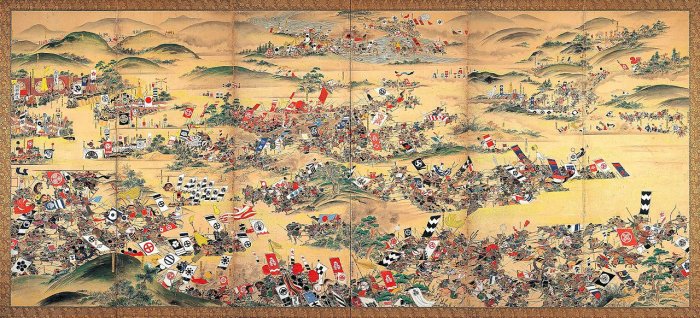
Edo-period screen depicting the Battle of Sekigahara. It began on 21 October 1600 with a total of 160,000 men facing each other. Credit: Public Domain
Since the swords did not see any use during this period, the samurai had to store these in sheaths that would keep their weapons protected from the country's harsh climate which may cause the swords to acquire rust and corrosion.
Honoki For The Shirasaya
Honoki is the type of traditional Japanese wood used for making tsuka and saya. Since this wood belongs to the magnolia family, it is considered as hardwood.
There are a few reasons why Japanese craftsmen opted for the honoki as the ideal wood for a saya. First, it doesn't contain acid or resin which can cause oxidation of the blade. Second, it was easy to carve and file this into shape. Third, the type of material also does not easily scratch blades. Most importantly, it was a stable and water-resistant type of wood. Even when exposed to humidity, the honoki does not warp over time.
Aside from not containing acid or resin, honoki is also the ideal type of wood for the shirasaya since this does not retain moisture, unlike lacquered wood. Moisture can eventually cause the blade’s corrosion when stored for a long period of time.
The Modern Shirasaya
As mentioned earlier, the shirasaya can be used with any type of blade. This is why a lot of collectibles can be found today and these come as sets with two or three differently sized swords. Other manufacturers also craft different sizes.
When it comes to modern shirasaya, some of these are made from bamboo while others are made from various types of visually appealing wood. Compared to the traditional shirasaya that is plain, modern replicas are elaborately designed. This is to make it a beautiful and attractive display piece.
The Shirasaya In Popular Culture
Popular culture most likely contributed to the growing popularity of the shirasaya. Just like a lot of Japanese weapons, this was featured in various TV series and films. The shirasaya was featured in the Japanese movie called Zatoichi which became a hit in the United States. Other movies also featured characters wielding the shirasaya, and these have most probably been inspired by the film.
In these movies, the battling style used when wielding the shirasaya was similar to fencing. The shirasaya was held in one hand and some modern popular shows have demonstrated the use of this weapon. A couple of these well-known shows include the Lady Snowblood and its sequel, as well as the anime series Naruto and D. Gray-Man.
Written by – Rafael - AncientPages.com Contributor
Copyright © AncientPages.com All rights reserved. This material may not be published, broadcast, rewritten or redistributed in whole or part without the express written permission of AncientPages.com
More From Ancient Pages
-
 Unique Glass Bead From The Time Of Jesus Discovered In Fire Pit In Sweden
-
 Cave Hidden Under Pembroke Castle in Wales Could Hold Secrets Dating Back 10,000 Years
-
 Slaves In The Aztec Empire Had Much Better Rights Than In Any Other Ancient Society
-
 Why Didn’t Alexander The Great’s Body Show Signs Of Decomposition For Several Days? A Never-Before Suggested Explanation – From Scientists
-
 Aboriginal Australians Were World’s First Astronomers Who Discovered Variable Stars – Astrophysicist Says
-
 Has The Legendary Viking Stronghold Jomsborg Finally Been Found?
-
 X-Ray Of Skulls Reveals Vikings Suffered From Several Diseases
-
 Largest Figurine Workshop Yet Discovered In The Maya World
-
 Underwater City: Unveiling The Secrets At The Bottom Of Fuxian Lake
-
 Bayeux Tapestry May Have Served As Monks’ Mealtime Reading, New Study Suggests
-
 The ‘Stonehenge Calendar’ Is Much More Modern Than Previously Thought – Scientists Say
-
 Wolstenholme Towne: Lost Virginia Settlement – Destroyed, Abandoned And Forgotten
-
 Ireland, Wales And The Scholar Who Helped Unravel Their Celtic Connections
-
 Battle Of Visby – Death Came With King Atterdag’s Ships
-
 Riddle Of Two Undeciphered Elamite Scripts
-
 51,000-Year-Old Bone Carving Shows Neanderthals Were Artistic Long Before Humans Arrived
-
 Trajan’s Market Was The World’s First Known Shopping Mall
-
 Largest And Most Complete Ancient Egyptian Workshops Found In Saqqara
-
 Mysterious MUC19 Gene – DNA From Denisovans Helped Ancient People Survive In The Americas
-
 Ancient Ingapirca: Largest And Best Preserved Inca Ruins In Ecuador

