
Ancient Stela Of Piankhi – King Of Napata, Rightful Ruler And Maintainer Of Maat
A. Sutherland - AncientPages.com - The Victory Stela of King Piankhi is an important surviving artifact related to the historical period when the Nubian King Piye (formerly called Piankhi) invaded and conquered Egypt, that at the time, had no central power.
He came into possession of Upper Egypt and established the 25th Egyptian Dynasty, named also Kushite or Napata Dynasty.

Known as Piankhi the Great, he was proclaimed King of the old kingdom of Kush and ruled ca. 743-712 BC. It is believed Piankhi was a son of Kashta of the Kushite Dynasty and his mother was Pebatjma, a Nubian queen dated to the 25th Dynasty of Egypt.
In his book "World's Great Men of Color", J. A. Rogers wrote about Piankhi:
"During his reign of approximately thirty-two years (c. 744 -712 B.C.), Piankhi expanded greatly the boundaries of his ancestral domain through the force of arms; but he never engaged in military activity if it could be gracefully avoided, and the national interests and imperial honor otherwise preserved. In short, Piankhi was primarily a patron of the pursuits of peace…"
Stela Tells About The King’s Deeds
The stela, with a 159-line inscription, recounts Piankhi’s accomplishments and justifies his kingship over all of Egypt.
It describes Piankhi’s military campaign northward and how he achieved his success.
It is said that Piankhi, the Nubian king and pharaoh of Egypt, fought against a coalition organized by the princes (Nimlot from Hermopolis and princes Osorkon IV, Iupet II, and Sheshonq V) of the Delta under the leadership of Tefnakht.

After receiving the surrender of Hermopolis in Middle Egypt, and conquering Memphis, Piankhi received oaths of fealty and tribute from all his conquered adversaries.
The inscription also says that Piankhi had certain and rather unusual personality traits. As a conqueror, he favored treaties and alliances instead of bloodshed, forgave his enemies and made special devotions to the gods of the northern towns fallen to his armies.
Despite his victory, Piankhi did not expand his rule over the north of Egypt and focused his reign over Thebaid (a region of southernmost nomes of Upper Egypt, from Abydos to Aswan) and the western desert oases.
His next step was to withdraw to Napata, in the Kingdom of Kush, located along the Nile River just south of Egypt, in an area between modern-day Aswan and Meroë, Sudan.
See also:
Ancient Great City Of Napata In The Kingdom Of Kush
Sistrum: A Magical And Sacred Ancient Egyptian Musical Object
Maat – Ancient Egypt’s Most Important Religious Concept
On the walls of his new temple, Piankhi memorialized his success on the stela and remained in his capital until he died and was buried in the royal cemetery at el-Kurru, just outside the capital of Napata, in 714 BC.
He was considered by many a holy king who ruled by the will of Amun. He was also a rightful ruler who deeply respected and maintained Maat principles.

What Does The Stela Depict?
The large and impressive stela of pink granite, with a rounded top that measures 180 cm by 180 cm (about 6ft) high and 43 cm thick, is now stored in the Museum of Cairo.
It was discovered (almost intact) in the temple of the god Amun-Re at Gebel Barkal (Napata) by a native Egyptian officer of the Sudanese government in 1862 and the artifact dates back to the 21st year of Piankhi’s reign.
As described by Breasted, J. H. in “Ancient Records of Egypt”, the Victory Stela depicts the god Amun of Napata enthroned and accompanied by the goddess Nut, standing behind him. Piankhi, standing behind these two divine figures, is approached by Namlot, the ruler of Hermopolis, who is shown leading a horse and shaking a sistrum. Above him, there is a short inscription: "King Namlot."
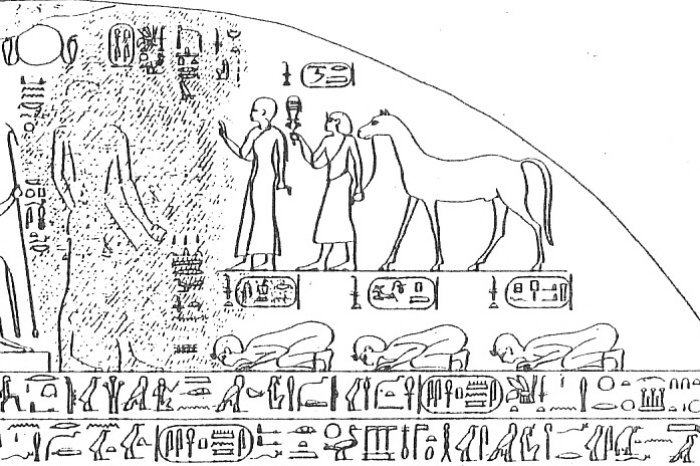
Drawing of the upper-right part of the victory stele of pharaoh Piankhi (Piye), depicting Piye being tributed by four conquered Nile Delta rulers: Nimlot (holding a horse) and his queen (before him), Osorkon IV, Iuput II, and Peftjauawybast. Image credit: Wikipedia
A woman, standing with an uplifted right hand, preceding Namlot, represents "the king's-wives," the women of Namlot, who appeared before Piankhi in the palace at Hernopolis. The three defeated Libyan kings (Osorkon, Yewepet, and Pefnefdibast ) bow themselves down at Piankhi’s feet, recognizing his total supremacy. Behind Nut, there are five other princes approaching the king Piankhi and all of them are showed kissing the earth at Piankhi’s feet.
The Piankhi Stela does not give any hint of the development of the Nubian Kingdom, instead, it discloses its existence as a fully-developed power and strongly suggests that King Piankhi must have come to the throne in Napata about 741 BC.
Written by – A. Sutherland AncientPages.com Staff Writer
Copyright © AncientPages.com All rights reserved. This material may not be published, broadcast, rewritten or redistributed in whole or part without the express written permission of AncientPages.com
Expand for referencesReferences:
David Bourke O'Connor, David P. Silverman, Ancient Egyptian Kingship
A. Lobban Jr. Historical Dictionary of Ancient and Medieval Nubia
Academia.edu/S. Schellinger
http://www.academia.edu/7757030/The_Victory_Stela_of_Piankhi_ca._725_BCE_
Breasted, J. H. Ancient Records of Egypt
More From Ancient Pages
-
 Viking Law And Order Was Based On The Thing System
-
 Tricksters: Mischievous Troublemakers Making Attempts To Help And Hinder In Mythologies Of Ancient Cultures
-
 On This Day In History: Storming Of The Paris Fortress – Prison Bastille – On July 14, 1789
-
 Rare Ancient Human Footprints Found On Gower Peninsula, Wales Are 7,000 Years Old
-
 Animal Tracks And Human Footprints In Prehistoric Hunter-Gatherer Rock Art In Namibia
-
 Arachne – Spider Woman Who Challenged Goddess Athena And Was Punished
-
 Rare Discovery Of More Than 18,000 Inscribed Pot Sherds Document Life In Ancient Egypt
-
 Evidence Europeans Started Using Milk 7,400 Years Ago – New Study
-
 Stone Slab c. 9,000-Year-Old Used In Making Fire Discovered Not Far From Jerusalem, Israel
-
 6,000 Years Ago, Europe’s Oldest Cities Relied On Fertilizer And Plant Protein, Isotope – Analysis Shows
-
 Infamous End Of Lugalzagesi – Ambitious King Who United Sumer
-
 Gunung Padang – Remarkable Megalithic Site In Indonesia
-
 Remains Of Graeco-Roman Temple Discovered Near Egypt’s Siwa Oasis
-
 Was Mysterious 2,000-Year-Old Miniature Clay Token Used By Pilgrims Arriving To The Temple In Jerusalem?
-
 Mystery Of The Bar Hill Comb Solved
-
 Discovered Inscription On Ancient Stone Vessel Reveals Location Of Legendary Tomb Of Chinese Emperor
-
 Life And Legacy Of Queen Tiye, Mother Of Akhenaten – Was She Egyptian Or Nubian?
-
 William Marshal Earl Of Pembroke: Master Of Tournaments And Best Example Of Medieval Chivalry And Knighthood
-
 Amazing 2,000-Year-Old Engraved Roman Gems Discovered Near Hadrian’s Wall
-
 DNA Reveals Unique Ancestry Of Inhabitants Of The Angolan Namib Desert

