
Vikings’ Unicorn Bluff Fooled Europeans For Hundreds Of Years
Ellen Lloyd - AncientPages.com - Vikings were famous for their raids and conquests of new lands, but they also had other ‘talents.’ The Norse warriors were cunning businessmen who were not always completely honest.
Actually, Vikings managed to fool Europeans with their unicorn bluff for hundreds of years.
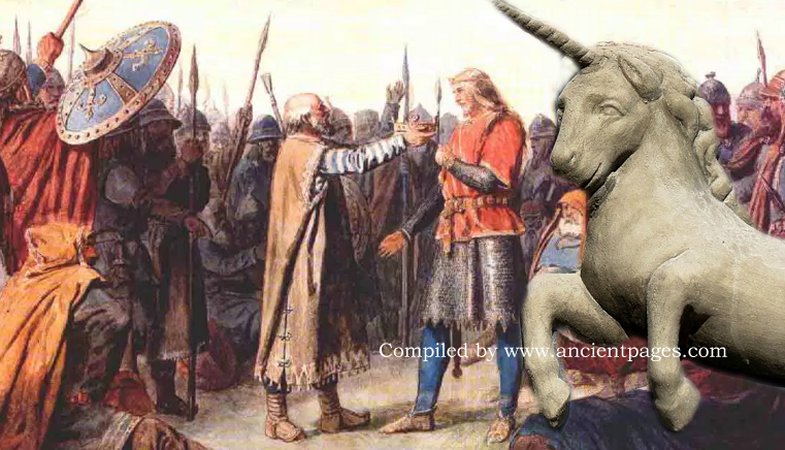
When famous Viking Erik the Red and his men colonized Greenland, they encountered the narwhal, a medium-sized toothed whale that possesses a large "tusk" from a protruding canine tooth.
The tooth reminded of an alicorn, a horn of a unicorn, a mythical animal described in myths, and legends and mentioned in the Hebrew Bible as a re'em or ox. During the Middle Ages, most people believed in the unicorn's existence in Western Europe. People were convinced that the unicorn's horn possessed many healing properties and could be used as medicine to treat poison.
How the Vikings came up with the idea to start selling a narwhal’s tooth as a unicorn horn, is unknown, but they sold it at very high prices to many merchants and princes throughout Europe.
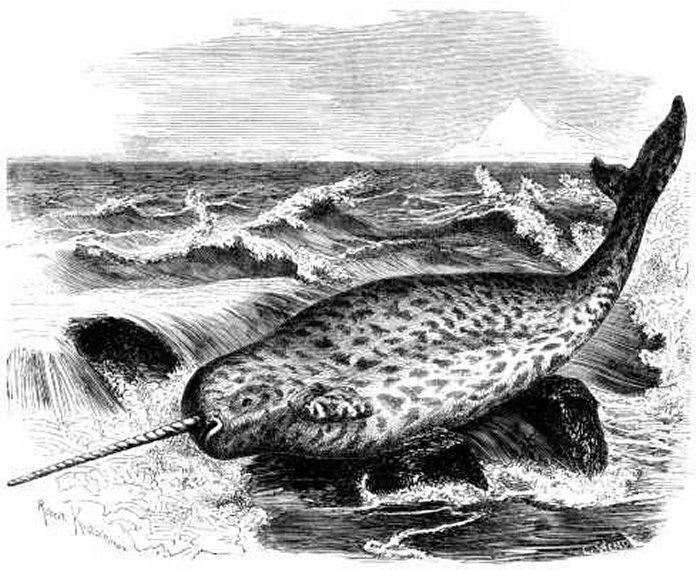
Image of narwhal from Brehms Tierleben (1864–1869). Credit: Wikipedia
It was a bluff, and the Vikings knew it, of course, but this didn’t prevent them from earning money. They had the advantage that their secret was safe because no one, except the Vikings themselves, had seen a narwhal on Greenland.
For 500 years, no travelers reached Greenland, and the Vikings could keep their secret and continue selling their faked unicorn horn”.
In 1577, British seaman and privateer Sir Martin Frobisher (1535-1594) reached Christopher Hall Island, a Baffin Island located in the Canadian Arctic Archipelago in the territory of Nunavut. There, he and his men discovered a dead narwhal on the beach. They had never seen this kind of animal before, but its horn looked familiar, and they gave the animal the name sea-unicorn.

One of these is real. From Pierre Pomet's Historie Generale Des Drouges, Traitant Des Plantes, Des Animaux & Des Minearuc. Paris, 1694. Credit: New York Academy of Medicine
In his journal, Sir Frobisher wrote, “Upon another small island here, was also found a great dead fish, which, as it would seem, had been embayed with ice, and was in proportion round like to a porpoise, being about twelve foot long, and in bigness answerable, having a horn of two yards long growing out of the snout or nostrils. This horn is wreathed and straight, like in fashion to a taper made of wax, and may truly thought to be the sea-unicorn.”
Sir Frobisher was familiar with stories about the unicorn from the Bible, and he was convinced he had found something truly precious. When Sir Frobisher returned back to England, he gave the horn of the sea-unicorn to Queen Elizabeth I of England (1533-1603), who kept the treasure together with her crown jewels. In those days, there was nothing more valuable than a unicorn horn, and Elizabeth I was said to have paid 10,000 pounds for a unicorn horn, the price of a castle.
Sir Frobisher hoped this gift could convince the queen to finance more of his expeditions.
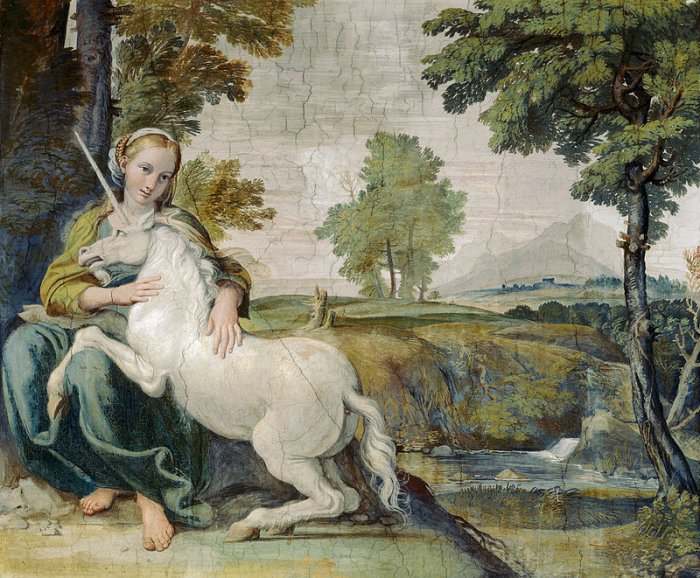
The gentle and pensive maiden has the power to tame the unicorn, fresco, probably by Domenico Zampieri, c. 1602 (Palazzo Farnese, Rome)
In Europe, Scandinavian merchants continued to sell faked unicorns, but what had turned into a lucrative business ended in 1638 when Danish scientist Ole Worm studied the alleged unicorn horn in detail and exposed the bluff.
Worm who was a respected scientist, revealed the so-called unicorn horn people bought was, in fact the tooth of a narwhal.
News about Worm’s research spread across Europe, and the interest in the faked unicorn horn faded.
So, as we have seen, Vikings were not only sarcastic jokers, but they could also be dishonest businessmen.
What many people also didn't know at the time was that the unicorn in the Bible was an oryx. It was all an ancient translation mistake.
Written by Ellen Lloyd – AncientPages.com
Updated on January 16, 2023
Copyright © AncientPages.com All rights reserved. This material may not be published, broadcast, rewritten or redistributed in whole or part without the express written permission of AncientPages.com
More From Ancient Pages
-
 Namoratunga: ‘People Of Stone’ And Ancient Astronomical Observatory
-
 Should Scientists Open An 830-Million-Year-Old Rock Salt Crystal With Ancient Microorganisms That May Still Be Alive?
-
 Mystery Of The Bar Hill Comb Solved
-
 How Did Mesopotamia Change The World?
-
 Myth Of The Pale Sun Followed By A Catastrophe Confirmed By Archaeologists
-
 Exceptional 1,700-Year-Old Roman Mosaics Have Returned Home To Israel
-
 Aaru – Field Of Reeds: Kingdom Of Osiris Was The Ancient Egyptian Paradise
-
 Undeciphered Ancient Symbols On Boulders In Pennsylvania And New England Could Be An Ancient Diary Of Forgotten Civilizations And Events
-
 Oldest Carving Of A Penis Discovered On Ancient Mongolian Pendant
-
 Ancient DNA Confirms Picuris Pueblo Tribe’s Ancestral Ties To Chaco Canyon
-
 Maya Site With At Least 300 Buildings Some Of Which Are Over 8 Meters High – Discovered
-
 On This Day In History: The Battle Of The Nile Concludes In A British Victory – On August 2, 1798
-
 Hidden Structure Detected In Monte Albán, Ancient Metropolis Of Mexican Zapotec Culture
-
 120,000-Year-Old Human Footprints Discovered In Saudi Arabia
-
 Two Discoveries Reported From Komombo Temple And Elephantine Island, Aswan
-
 Fulani: Africa’s Pastoralists Traced To Green Sahara Period,12,000 – 5,000 Years Ago
-
 Bora People Of The Northwest Amazon Use Drums To Speak Over Large Distances
-
 ‘The Battle Of The Tooth Worm’ – Strange Ivory Carving
-
 Golden Secrets Of Lake Guatavita And The Muisca People Gave Rise To The El Dorado Myth
-
 Indian Black Earth And Biodiversity Of The Amazon – New Study

