
The Unicorn In The Bible Was An Oryx – Ancient Translation Mistake
Ellen Lloyd - AncientPages.com - The unicorn is a legendary animal that has fascinated people for ages. Depictions of this magical and beautiful animal have been found on ancient seals, and early Greek writers believed the unicorn originated from India.
During the Middle Ages and Renaissance, people were incredibly interested in this mysterious creature no one had seen. As discussed in our previous article on Ancient Pages, Vikings used the opportunity and started selling faked unicorn horns and fooled Europeans with their bluff for hundreds of years.
Being in possession of a unicorn horn was everyone’s desire, but hardly possible due to the high price. It was believed that the alicorn, the horn itself, and the substance it was made of held magical and medicinal properties. Even the great painter Leonardo da Vinci was fascinated by the unicorn and wrote about it in his notebooks.
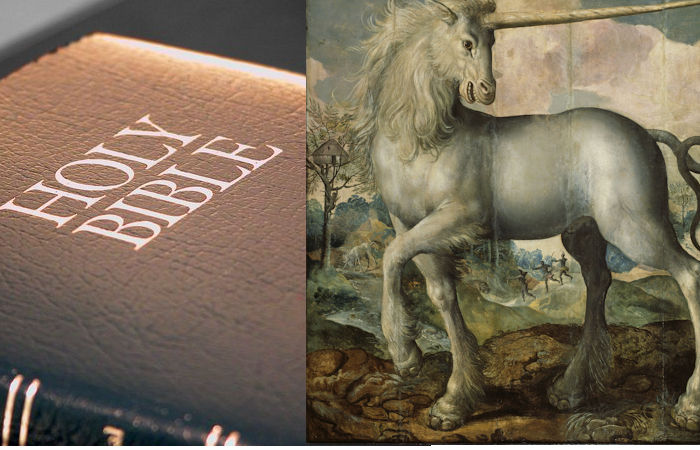
The Holy Bible. Credit: Kevin Probst - Public Domain - Unicorn by Maerten de Vos (1532–1603). Credit: Public Domain
Knowledge of the unicorn came from ancient Greek authors and the Bible, but no one knew the magical animal had been misidentified.
The Bible mentions the unicorn seven times, but only by mistake.
The mistake happened long before the birth of Christianity. The Old Testament was originally composed in Hebrew.
In 250 B.C., Ptolemy II Philadelphus, the second King of Egypt's Greek period, ordered 72 elders to translate the sacred Hebrew texts into Greek. That Greek translation is called the Septuagint. During the translation, the Jews encountered a problem. Their texts contained several references to an animal called "Re'em".
Re’em is the Hebrew name for oryx leucoryx or oryx, but the Jewish ancient scholars were confused by the descriptions in the Old Testament.

Left: Virgin Mary holding the unicorn (c. 1480), detail of the Annunciation with the Unicorn Polyptych, National Museum, Warsaw. Credit: Public Domain - Right: Maiden with Unicorn, tapestry, 15th century (Musée de Cluny, Paris). Credit: Public Domain
Modern Bible scholars believe that the Jewish texts are likely to refer to the two-horned oryx. Oryx leucoryx was once a lord of the entire Middle East. Its domain embraced most of the Land of Israel, but during the reign of King Ptolemy II Philadelphus, it had already been extinct in North Africa and the Middle East.
The original Jewish texts mention nothing about the animal having a horn, but the King's scribe chose, despite this, to call the animal monoceros, which can be translated into "a horn". The translation was continued when the Jewish texts became the Old Testament.
Unicorns still captivate modern people, and scientists have tried to find proof of their existence. Some years ago, a unicorn fossil was discovered in Siberia. The discovery caused a sensation. Scientists said unicorns were in fact real, but they looked slightly different from what we imagine today.
Written by Ellen Lloyd – AncientPages.com
Copyright © AncientPages.com All rights reserved. This material may not be published, broadcast, rewritten or redistributed in whole or part without the express written permission of AncientPages.com
More From Ancient Pages
-
 Garden Of Eden And Its Four Rivers – Possible Locations Of Biblical Paradise Suggested By Archaeologists, Historians And Biblical Scholars
-
 Mysterious Ancient “Fish People” – Who Were They And How Did They ‘Change’ Civilizations Worldwide?
-
 Unique 3,300-Year-Old Hittite Bracelet With Symbols Discovered By Farmer
-
 Mysteries Of Old Europe – Intriguing Gradeshnitsa Tablets Might Hold Secrets Older Than Egyptian Hieroglyphs
-
 Millennia Old Extremely Complex Object Of Unknown Origin
-
 Ancient Wooden ‘Coptic Dolls’ May Have Been The Ancestors Of Today’s Barbie Dolls
-
 Sacred Number Four – Perfect Number And Deep Meaning Behind It
-
 Chagyrskaya Female Neandertal That Lived 60,000-80,000 Years Ago – Studied
-
 The Lycurgus Cup: Fascinating Artifact That Reveals Prehistoric Knowledge Of Nanotechnology
-
 Myth Of The Pale Sun Followed By A Catastrophe Confirmed By Archaeologists
-
 Ancient Monastery In The Middle Of ‘Syria’s Stonehenge’ – Underground Caves, Tombs, Stone Circles Older Than Pyramids
-
 The Ancient ‘Flying Machines’ Of Icarus and Daedalus
-
 Tanana Valley, Alaska: Study On Ancient Hunter-Gatherer Sites Dating Back To 14,500 Years Ago
-
 Secrets Of Mica Chambers Of Teotihuacan
-
 Death And Afterlife In Sumerian Beliefs
-
 Mysterious Ancient Figure Depicted On A Jade Cong May Re-Write History Of China
-
 Story About Cahokia’s Lost Civilization Is Wrong – Archaeologist Says
-
 ‘Tonina Chiapas’ Mayan Pyramid In Southern Mexico Is Among The Largest Yet Found
-
 Spectacular Olduvai Gorge And Early Hominid Fossils Found In East Africa
-
 Researchers Will Search For “Fingerprints” Of Thera/Santorini Eruption In Tree Rings

