
Mysterious Ichthys – Ancient Secret Christian Symbol With A Deep Meaning
Ellen Lloyd - AncientPages.com - Early Christians used many secret symbols and one of them was known as the Ichthys. Named for the Koine Greek term for fish, this ancient symbol consists of two intersecting arcs, the ends of the right side extending beyond the meeting point. The symbol was simply made in the image of a fish.
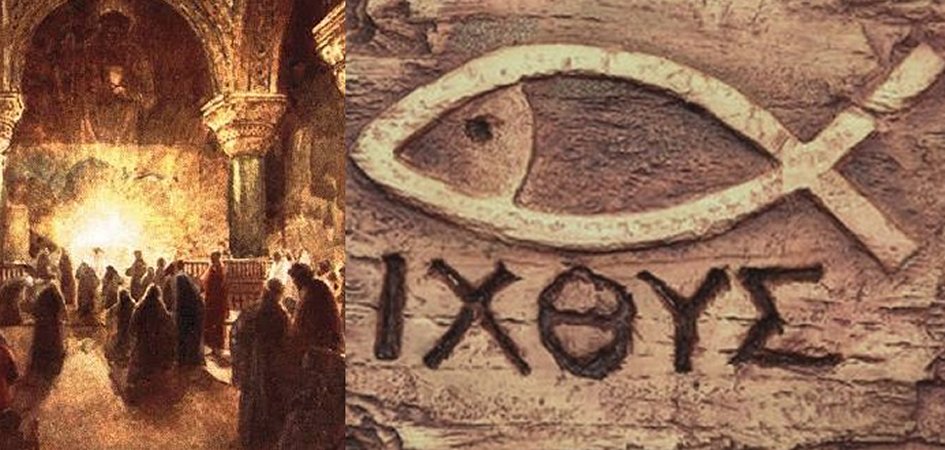
So, why would early Christians use secret symbols in the first place and why was one of them resembling a fish?
Secret Symbols Protected Persecuted Christians
The answer to the first part of the question is not difficult to answer, but the true meaning of the fish symbols is still a question of debate.
The first 300 years after Jesus’ death Christians were persecuted in the Roman Empire. To avoid being killed for their faith, early Christians used secret codes that showed the way to a Church and many secret symbols protected believers of Christianity.
See also:
Ancient Symbol Fleur-de-lis: It’s Meaning And History Explained
The Sistine Chapel Cypher – Secret Messages In The Art Of Michelangelo
10 Types Of Ancient Crosses In Different Cultures Explained
Ancient Symbol Hamsa: It’s Meaning And History Explained
For example, if a Christian met a stranger, he could draw an arc on the ground. If the stranger completed the image with another arc so it formed a fish, they would both know they were Christians. This was a clever way to distinguish friends from foes. The Ichthys symbol also used to mark meeting places, tombs and reveal the road to secret churches. On June 13, 313 AD, Edict of Milan was signed by Roman Emperor Constantine and the persecution of Christians ended.
The Fish Is A Sacred Christian Symbol
The Ichthys symbol became of great in importance and started to appear in Christian art during the late 2nd century, and its use spread widely in the 3rd and 4th centuries.
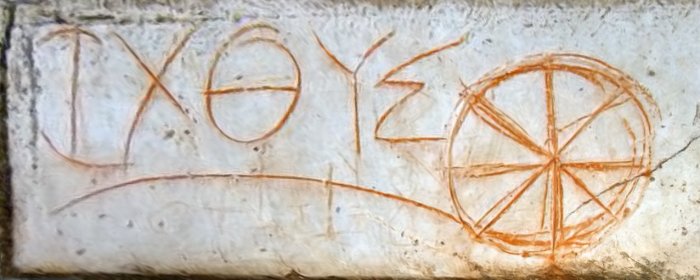
An early circular ichthys symbol, created by combining the Greek letters ΙΧΘΥΣ, Ephesus. Credit: Wikipedia
There are many reasons why Christians considered the fish sacred. The fish appears in many Biblical stories and the animal has different symbolic associations. For example, the fish that swallowed Jonah is believed to symbolize Christ’s incarceration in the tomb. The story of Tobias, who survives an attack by a large fish and then uses the gall of the fish to restore his blind father’s sight, symbolizes God’s blessings.
The story “Feeding of the 5,000”, also known as the "miracle of the five loaves and two fish" told in the Gospel of John describes how five barley loaves and two small fish supplied by a boy were used by Jesus to feed a multitude.

Funerary stele with the inscription ΙΧΘΥϹ ΖΩΝΤΩΝ ("fish of the living"), early 3rd century, National Roman Museum. Credit: Wikipedia
Some Biblical scholars maintain that the meanings ascribed to the fish symbol are so numerous and varied that it is impossible to identify a central explanation. The biggest uncertainty is whether the symbol of the fish is meant to denote faith in Christ or Christ himself.
Returning back to the subject of how people took advantage of signs and symbols to protect themselves, we should not forget that secret Christian symbols were not only used in ancient Rome. Many Samurai had swords with secret crucifixes and hidden Christian symbols to avoid persecution.
Written by Ellen Lloyd – AncientPages.com
Copyright © AncientPages.com & Ellen Lloyd All rights reserved. This material may not be published, broadcast, rewritten or redistributed in whole or part without the express written permission of AncientPages.com and Ellen Lloyd
About the author:
Ellen Lloyd – is the owner of AncientPages.com and an author who has spent decades researching ancient mysteries, myths, legends and sacred texts, but she is also very interested in astronomy, astrobiology and science in general
More From Ancient Pages
-
 The Use Of Surnames Started During The Middle Ages In England
-
 On This Day In History: Roman Emperor Caligula Was Born – On August 31, 12 AD
-
 11th-Century Pratihara-Era Temple Accidentally Found By A Farmer In Uttar Pradesh, India
-
 Stone Artifacts Reveal Long-Distance Voyaging Among Pacific Islands During The Last Millennium – New Study
-
 Archaeologists Refute Claims That A Comet Destroyed Hopewell Culture
-
 History Mystery: Gold Tool Found In Jerusalem Cemetery Baffles
-
 12,000-Year-Old Crater Dipsiz (‘Bottomless’) Lake, Searched For Gold, And Destroyed In Legal But Controversial Excavation
-
 Madagascar Hippos Were Forest Dwellers – New Study
-
 Hidden Text Of Medical Book By Doctor Galen Read For The First Time In 1000 Years
-
 Surprising Discoveries In Mysterious Giant Viking-Era Cave In Iceland Can Confirm Norse Sagas
-
 ‘Umeda Graves’ Dated To Edo Period Discovered At Osaka, Japan
-
 Evidence Of Hallucinogenic Drug Use During Bronze Age Ceremonies Found
-
 Viking Women Were More Prominent Than Previously Thought – Archaeological Discoveries Reveal
-
 2,000-Year-Old Lavatory In Turkey’s Denizli Province Will Be Restored
-
 Aglaonice (Aganice): Female Greek Astronomer From Thessaly Was Believed To Be A Witch
-
 Neanderthal Intelligence Revealed By Their Use Of Fire For Cooking
-
 First Roman Military Amphitheater Unearthed Near Megiddo
-
 What Was The Medieval ‘Two Sleeps’ Habit?
-
 Mictlan – Underworld Realm Of The Dead In Ancient Aztec Beliefs
-
 Colossus Of Standing Falcon-Headed God Horus Unearthed In Egypt’s Luxor

