
Napta Playa – Egypt’s Stonehenge And Its Ancient Astronomical Alignments
Thalia Lightbringer – AncientPages.com - Many people gather every year to celebrate the spring equinox at Stonehenge, but did you know there is something similar, but older, in Egypt?
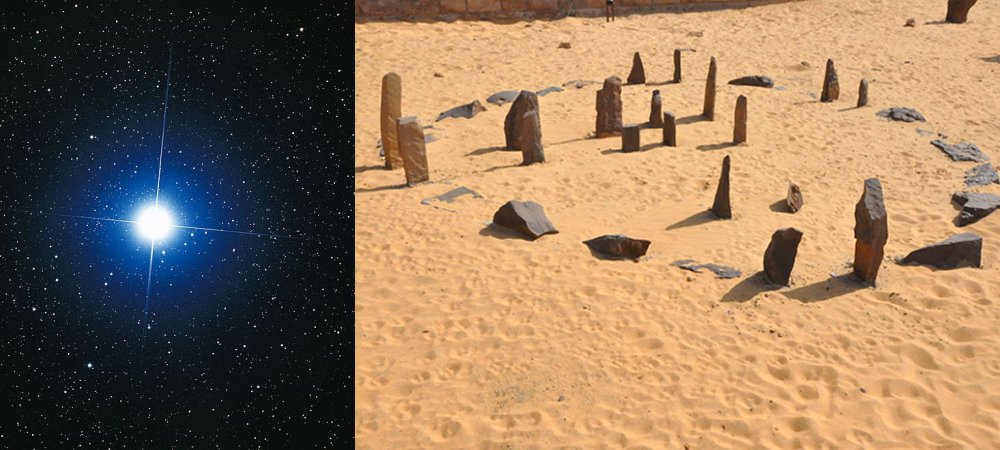
One hundred kilometers west of Abu Simbel in southern Egypt, there are some standing stones with astronomical alignments similar to the famous Stonehenge and other megalithic structures scattered across Europé.
Nabta Playa was constructed approximately 2,000 years before the stone circles of Europe by nomadic peoples of the late Neolithic (Stone Age) period.
These people were probably cattle herders, perhaps some of those who may have contributed to the formation of the Sahara Desert, as noted in another article here.
Ancient Astronomers At Napta Playa
Observation of the stars was essential to ancient people because it helped them navigate, just as sailors used them. Stellar alignments were also used to determine crucial times of the year.

Isis with outstretched wings by Ägyptischer Maler um 1360 v. Chr. - The Yorck Project: 10.000 Meisterwerke der Malerei. DVD-ROM, 2002. ISBN 3936122202. Distributed by DIRECTMEDIA Publishing GmbH., Public Domain - Wikipedia
One of the most significant stellar alignments for these prehistoric people seems to have been the summer solstice. Nabta Playa is a large internally drained basin, which was filled by summer monsoon rains around 11,000 to 5000 years before the present. It was the time when water began to accumulate in this area.
It was an important ceremonial center for prehistoric people who came to water and fed their animals. They erected these structures on the lake's western shore during this time, as the stellar alignments can be traced to a specific time frame.
Based on the analysis, six megalithic alignments radiate from the Napta Playa stone arrangement containing 24 megaliths or megalithic scatters.
The lines have been shown to coincide with the rising positions of three prominent stars during the period 4800-3700 B. C., the first of these being Sirius, the Dog Star, related to Isis by the Egyptians. Sirius is the brightest star of the night sky and was also crucial to later Egyptians as its appearance heralded the annual Nile floods.
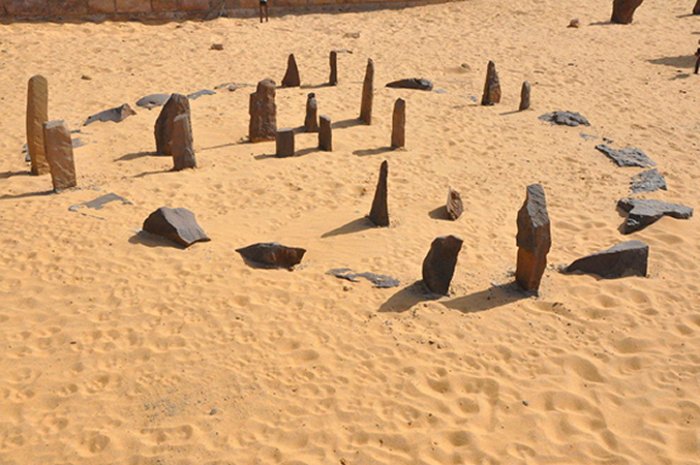
Napta Playa - Image credit: Raymbetz - Own work, CC BY-SA 3.0
The second-star alignment is to Dubhe, the brightest star in Ursa Major, and there are also alignments to stars in the belt of Orion (as with the pyramids at Giza).
Napta Playa And Goddess Hathor
The earliest settlements in the area date to around 11,000-9300 years ago. The people made ceramics and domesticated cattle. Many fire-reddened stones have been found there, remnants of their campfires. There is also evidence of ceremonial sacrifices of cattle.
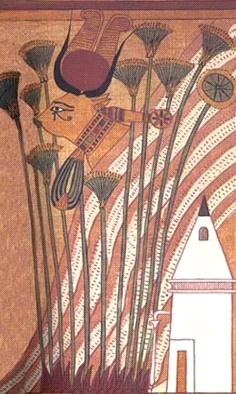
Goddess Hathor as a cow. Image credit: Wikipedia
The people probably came from the south or the Nile Valley in search of pasture and left when the water dried up in the fall.
The early cattle herders probably contributed to the later development of the Apis bull worship and the importance of the goddess Hathor, even though cattle were not so important to the economy.
Cattle in early cultures often represented status and wealth, as is reflected in the first letter of the Runic alphabet, or Futhark.
Feoh means both cattle and wealth. The letter in early alphabets that became our 'A' also originally represented a horned cow.
Written by – Thalia Lightbringer – AncientPages.com Staff Writer
Copyright © AncientPages.com All rights reserved. This material may not be published, broadcast, rewritten or redistributed in whole or part without the express written permission of AncientPages.com
Expand for referencesMore From Ancient Pages
-
 Amanirenas – Fearless Queen Of Kush Who Defeated Ancient Romans
-
 Surprising Discovery Reveals Ancient Tibetan Bowl Shows Alexander The Great – The Jewish Version And Not The Homer’s Iliad
-
 Mystery Of The Hidden Shoes Discovered In Ancient European Houses – What Is Behind This Bizarre Tradition?
-
 Image Of The Day: Chacmool – Famous Ancient Statue Of Pre-Columbian Mesoamerica
-
 Mystery Of Ancient Sami People Buried Underwater – New DNA Breakthrough
-
 Ancient Intercontinental Underground Tunnels Built By Survivors Of A Great Catastrophe And The Snake God Connection
-
 Xochipilli: Aztec God Of Love, Music, Song And Ecstatic Mushroom Trance
-
 11 Ancient Sacred Indian Symbols Explained
-
 Archaeological Discoveries At Fort San Juan Reveal Hidden History Of Conquistadors In American South
-
 Secret Ancient Knowledge Of The Toltecs Examined
-
 Lazarus – An Obscure Biblical Figure
-
 Fire-Burning Event At The Maya Kingdom Of K’anwitznal Was A Reaction To Regime Change
-
 Major Discovery Of A Complete Ancient Roman City In Luxor, Egypt
-
 The Iron Man In The Kottenforst And Other Puzzling Ancient Artifacts Of Unknown Origin And Purpose
-
 Ancient DNA Study Reveals Surprise About Britain’s Bronze Age – What Happened On The Orkney Islands?
-
 Underwater Robot Investigates Edo Period Decorative Tiles Off Shizuoka, Japan
-
 Ancient Egyptian Men Used Eye Makeup For Many Reasons
-
 Choctaw Indians’ Legend Of Nanih Waiya Cave Mound – Mysterious Underground Realm Of Their Ancestors And Their Battle With Giants
-
 Geronimo: Story About This Western Indian Chief Will Never Die
-
 Mystery Of The Lost Golden Chain Of Huayna Capac: Will The Ancient Inca Treasure Ever Be Found?

