
Huldra: Seductive Female Creature Living In Forest Or Mountains In Norse Beliefs
A. Sutherland - AncientPages.com - Among the most commonly encountered creatures in Norse mythology is Huldra.
In Norwegian folklore, there are many stories about Huldra (which means "secret," "covered") and her people known as Huldre Folk ("mountain people," "the small ones underground," or "hidden people"). They also occupy a special place in the superstition lore of Icelandic people.
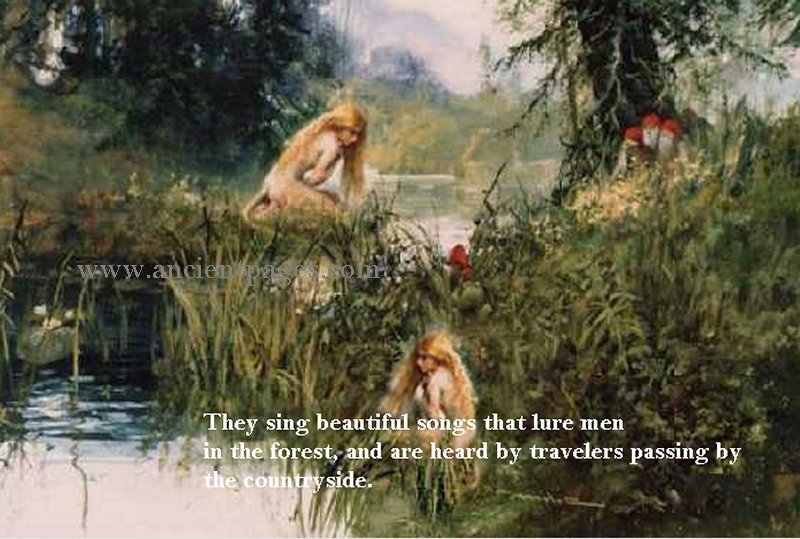
They are protectors of the cattle on the mountainsides. These mysterious beings sing beautiful songs that lure men into the forest and are heard by travelers passing by the countryside.
Huldra also has other names such as "owner of the forest" or "hill lady." She is a young woman with superhuman strength, sometimes naked or dressed like peasant girls. She often has a lovely human appearance, as seen from the front.
From behind, she is shockingly ugly with her hallow bark back and a cow's tail or that of a fox that is almost impossible to conceal.
Gotland's folklore says that Huldra and her people, "the small ones underground," could be easily recognized by the tip of a cow's tail trailing from beneath their long snow-white robes.
Huldra is often a malicious creature, but she shows friendly behavior toward human males, as when she appears before the herdsman, speaks, and dances with him. Huldra had her male equivalent (' huldur') but her beauty and charming grace often attracted human males, too.
When Christianity appeared in Norway in the early 8th century, many old beliefs did not disappear, but their versions changed. Huldra could get married in a church, her tail fell off, and she became human. At the same time, she lost the superhuman powers she once possessed.
From this relationship, ordinary human children were born, and one or another couple lived long and happy until the end of their days.
But sometimes, life is a little less colorful. While mistreated by her husband, the Huldra still has her true nature and – even without her powers - can be hateful, seek revenge, or frighten her partner or husband.
Updated on September 3, 2022
Written by – A. Sutherland AncientPages.com Staff Writer
Copyright © AncientPages.com All rights reserved. This material may not be published, broadcast, rewritten or redistributed in whole or part without the express written permission of AncientPages.com
More From Ancient Pages
-
 The Phoenicians – And Their Great Experience As Sea Traders
-
 Qanat Firaun -‘Canal Of The Pharaohs’ Is The Ancient World’s Longest Underground Tunnel
-
 The Egyptian Dream Book Reveals Ancient Predictions Of The Future
-
 Evidence Ancient Civilizations Had Knowledge About Planets In Our Solar System Thousand Years Ago
-
 Vikings’ Unicorn Bluff Fooled Europeans For Hundreds Of Years
-
 Oldest Known Evidence Of Artificial Cranial Deformation Revealed In Croatia
-
 Mysterious Magical Healing Gift Of The Whisperers – Meet The Enigmatic Szeptunka
-
 More Than 2,000 Seal Impressions Found In The Ancient City Of Doliche
-
 People With Blue Eyes Have One Common Ancestor Who Appeared 10,000 Years Ago
-
 Ancient Mystery Of The Ladies Of Anavlochos: Bronze Age Art Found On Crete
-
 Who Were The Goths And Where Did They Come From?
-
 2,500-Year-Old Tibetan Medical Text Describes A Coronavirus-Like Outbreak In Surprisingly Accurate Details
-
 On This Day In History: American Astronomer Edwin Hubble Announced Existence Of Other Galaxies – On Dec 30, 1924
-
 Mystery Of The Lost Golden Chain Of Huayna Capac: Will The Ancient Inca Treasure Ever Be Found?
-
 Shipboard Cannon Found On The Swedish West Coast May Be Europe’s Oldest!
-
 Ancient DNA Reveals How European Skin, Eye, And Hair Color Evolved Over The Past 45,000 Years
-
 Mystery Of Ancient Magnetic Potbelly Statues In Mesoamerica Revealed – But Something Is Still Wrong
-
 New Moai Statue Found On Easter Island
-
 A Presently Submerged Land Bridge Could Help Early Human Move From Turkiye To Europe
-
 Native Americans’ Visions Of Distant Explorers May Unravel Some Ancient Mysteries Of North America – The Arrival – Part 1

