
Nicholas Owen ‘Little John’ Who Paid Highest Price For His Ingenious, Camouflaged Places To Hide
A. Sutherland - AncientPages.com - ‘Priest holes’ saved many lives of Catholic priests and became their sanctuaries in times of persecution during England’s Anti-Catholic times.
They were so unusual and perfectly camouflaged that they still surprised modern inventors and designers.
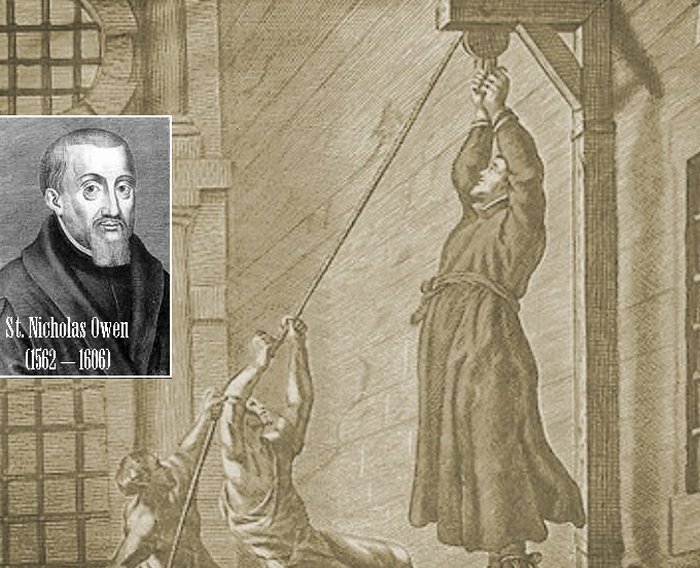
They were designed and created by St. Nicholas Owen (c. 1562 – 1/2 March 1606), a Jesuit, talented stonemason, and carpenter’s son from Oxford.
Owen was a defender of persecuted Catholics. He entered the Jesuit Order in 1588, and for the next 18 years, until his martyr died in 1606, he devoted himself to constructing safe and effectively concealed hiding places for priests in danger.
In these sanctuaries, built-in houses of Catholic families, priests, altar vessels, and related objects could survive.
Owen worked in dangerous times during the reign of Queen Elizabeth I of England (also known as "Good Queen Bess").
Historical records confirm that persecution of Catholics began before Henry VIII's time, when Pope Paul III refused to give him a divorce from Catherine of Aragon. This forced Henry to break with Rome.

Owen disguised the entrances to the priest-holes, with such skills that priests lived in them, protected from martyrdom, for years. Image credit: The Catholic Catalogue
Anti-Catholic persecutions continued during the reign of Elizabeth I (1558-1605) and included eliminating the celebration of Mass, recitation of the Rosary and Catholic prayers were forbidden at the risk of being extradited, priests would be sentenced to a year in prison, jailed for life or put to death, by hanging, drawing, and quartering.
Repression also affected those who did not swear allegiance to the English ruler and did not recognize his supremacy over the Church in England.

Another very harsh law was passed that punished with death any Catholic who should convert a Protestant.
Nicholas Owen—one of the most skilled builders of priest holes—devoted the greater part of his life to helping persecuted Catholics. He could accommodate up to 10 people in one hiding place, and none of his priest holes was the same.
In case of danger, the persecuted priests could escape by underground tunnels up to several kilometers away from the house. Several entrances and exits camouflaged the real hiding place.

Under the name of "Little John", "Draper" or "Little Michael", he often traveled from one house to another, and in exchange for only the necessities of life as payment, he created hiding places. During the daytime, Owen worked as a traveling carpenter and at nights built hide places camouflaged under basements, under floors, and between walls.
Famous priest-holes are found at Baddesley Clinton in Warwickshire, Naworth Castle in Cumbria, at Harvington Hall, near Kidderminster in Worcestershire, Ufton Court, near Reading, Scotney Old Castle in Kent, Oxburgh Hall in Norfolk, Thurnham Hall near Lancaster, Baddesley Clinton and Coughton Court in Warwickshire and many more.
Many Catholic priests survived thanks to people like Nicholas Owen, who sacrificed his life to hide them.
In “Secret Chambers and Hiding Places”, Allan Fea (1860-1956) wrote about Nicholas Owen’s work:
“With incomparable skill,” says an authority,
“he knew how to conduct priests to a place of safety along subterranean passages, to hide them between walls and bury them in impenetrable recesses, and to entangle them in labyrinths and a thousand windings…”
Many believe that some of them may still be undiscovered. Today, modern technology such as 3-D laser scanning may help uncover the ingenious work left by a 16th-century English martyr, Nicholas Owen.
Nicholas Owen was arrested in 1594 and interrogated, but despite torture, he did not reveal anything. Early in 1606, Owen was arrested a final time and placed in the Tower of London, where he was tortured to death by prison authorities.
He died in the night between 1 and 2 March 1606. In 1927, Nicholas Owen was beatified and finally canonized in 1970 by Pope Paul VI.
Updated on March 23, 2024
Written by – A. Sutherland AncientPages.com Staff Writer
Copyright © AncientPages.com All rights reserved. This material may not be published, broadcast, rewritten or redistributed in whole or part without the express written permission of AncientPages.com
Expand for referencesMore From Ancient Pages
-
 Unexplained 17th Century Encounters With A Malevolent Entity That Defy Rational Explanation
-
 Satellite Images Reveal A Mysterious Ancient Site On A Remote Island Is Much Larger Than Previously Thought, Prompting New Questions
-
 Aboriginal People Made Pottery And Navigated To Remote Islands Millennia Before Europeans Arrived
-
 Humans In Africa Fled To The Mountains During The Last Ice Age
-
 Roman-Era Residence Unearthed In Ancient Capital Of Memphis, Egypt
-
 6,000-Year-Old Village Unearthed In Kurdestan
-
 Excavation Of A Mysterious 5,000-Year-Old Tomb Linked To King Arthur Has Started
-
 Vindolanda Treasures: Rare Roman Cornu Mouthpiece – Instrument of War – Uncovered
-
 Unsolved Ancient Mystery Of Hand Of Prêles – Unique Discovery Of Ancient Bronze Hand Puzzles Scientists
-
 Evidence Of Brain Surgery Performed 3,000 Years Ago Discovered In Tel Megiddo, Israel
-
 Unique Sword Casts New Light On Viking Voyages Across The North Sea
-
 Artifacts Unearthed In Mit-Rahina, South Of Giza, Egypt
-
 Mysterious Ancient Rulers With Elongated Skulls – Who Were They Really?
-
 First Scandinavian farmers were far more advanced than previously thought
-
 Controversial Unexplained Ancient Mystery In Mongolia – Horrifying Sight – Part 2
-
 New Details On Discovery Of San Jose 300-Year-Old Shipwreck That Sank With Treasure Of Gold, Silver, And Emeralds
-
 Highly Debated Early Homo Erectus Skull From Turkana – Age And Origin Now Verified
-
 On This Day In History: ‘Principia Mathematica’ Monumental Work Published By Isaac Newton – On July 5, 1687
-
 Leonardo Da Vinci Has 14 Living Male Descendants – DNA Study Reveals
-
 Scientists Question Whether Meat Eating Really Changed Human Evolution

