
Millennia Old Ceremonial Stone Belt And Maya Pok-A-Tok Ball Game
A. Sutherland - AncientPages.com - This fascinating artifact, which is displayed in the Mexican gallery of the British Museum, resembles a giant stone horseshoe.
It weighs almost 40 kilos (90 lbs; it is approximately 40 centimeters (15 inches) long and about 12 centimeters (4 inches) thick, and is made of a very beautiful green-grey speckled stone.

It is a ceremonial stone belt, as old as Pok-A-Tok, a ball game that ancient Maya most probably inherited from the Olmecs. Pok-A-Tok was played since at least 1,400 BC by the pre-Columbian peoples of ancient Mesoamerica. Known among the Aztecs as “tlachtli”, Pok-A-Tok was an important part of their political and religious festivals.
Its purpose has long remained a puzzle. It was not a typical yoke for draught animals or carthorses (as it was initially thought) because there were no such horses or other draught animals in Central America until the Spaniards brought them from Europe in the sixteenth century.
According to Michael Whittington, an expert on these ancient ball games, these heavy, yoke-like stone belts were probably worn as part of the ritual ceremonies at the beginning of the game and for a very brief time. Worn during the games, they would significantly slow down a player’s competition capabilities such as maneuverability.
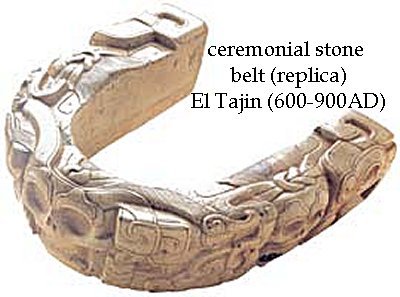
Ceremonial stone belts are representations of represent the padded belts made of leather, padded cloth or other textiles and worn by players to protect their hips. Other protection made of jaguar skin or deer) was for the head, knees, hips and elbows.
When the Spaniards arrived they were amazed by the ball that the game was played with, because it was made of rubber, a substance unknown to Europeans.
The very first view of a bouncing ball, a round object seemingly defying gravity and shooting around in random directions, must have been extremely perplexing.

A relief of the Crown showing a scene from the Mesoamerican Ball Game. Image credit: Adrian Hernandez - CC BY-SA 4.0
“They call the material of this ball hule [rubber] … jumping and bouncing are its qualities, upward and downward, to and fro. It can exhaust the pursuer running after it before he can catch up with it…” wrote the Spanish after he observed the game.
Pre-Columbian ball courts have been found in the center of almost every Maya city, throughout Mesoamerica, as for example at Copán, as far south as modern Nicaragua, and possibly as far north as what is now the U.S. state of Arizona.
In some modern form and with slightly varying rules, the ball game tradition has survived through time until today in many places throughout Mesoamerica. One rule, however, has remained unchanged: the game was played on an I-shaped court, with rings set 20 to 30 feet off the ground.

One of the Ball Courts of the Mayan ruins in Coba, Mexico. Image credit: Wikipedia
Ball games were spectacular and dangerous in ancient Central America. In Pok-A-Tok, captives were forced to play the game for their lives. It was not easy to stay alive in this game. The aim was to keep the ball in the air and finally to land it in the opponents’ end of the court.
The losers became sacrificial victims and faced torture and execution immediately following the competition.
Even if played as a sport and for fun, there was always a team of losers and at least, their captain was traditionally sacrificed to the gods.
To the game, it used an 8- inch (or more) ball of solid baked rubber (at least eight times a soccer ball). It was heavy and it could weigh from 3 or 4 kilos (8 lbs) to almost 15 kilos (30 lbs).

The number of players ("Pitzhil") varied between 2 and 5 in each team.
The players had only one desire: to get the ball through a narrow, stone ring placed on the court wall, often as high up as 20 feet from the ground (or onto a marker).
They used only shoulders, heads, elbows, wrists, and hips but never – hands.
Symbolic Meaning
For the Maya, the ball represented the Sun, the Moon, or planets and the court was the cosmos.
Pok-A-Tok was considered the sacred game of the gods played on Earth and was not just a competitive sport.
It held a special place in the belief system of the ancient Central Americans and symbolized a mythical struggle of life, death, war, and sacrifice. The ball game was a ceremony dedicated to the memory of the ancestors and linked to agriculture and calendar cycles.
The ball courts were considered entrances to the underworld. The biggest ball court of all in Mesoamerica - 545 feet long and 225 feet wide – is located among the ruins of Chichén Itzá in Mexico's Yucatán peninsula.
For the Aztec, for example, the game symbolized reenactment of the daily trial of the Sun rising after being born again from nighttime of fighting the underworld.
Written by – A. Sutherland AncientPages.com Staff Writer
Copyright © AncientPages.com All rights reserved. This material may not be published, broadcast, rewritten or redistributed in whole or part without the express written permission of AncientPages.com
Expand for referencesReferences:
Scarborough Vernon L. The Mesoamerican Ballgame
Gillings T. Last Game For The Gods
More From Ancient Pages
-
 Rock-Cut Chambers In “House of Muses” Of Zeugma, Home To Numerous Mosaics
-
 Aboriginals Inhabited South Australia 29,000 Years Ago – New Study
-
 Nue – Mysterious Mythological Shape-Shifting Creature Transforming Into A Black Cloud
-
 Relics Dated To Byzantine And Late Period Unearthed In Meir Necropolis In Assiut, Upper Egypt
-
 1,800-Year-Old Military Medal with Medusa Head Unearthed In Ancient City of Perge (Perrhe), Southeastern Turkey
-
 2,000-years-old tomb found in S. China
-
 Amazing Archaeological Discovery In Washington Confirms Thousand-Year-Old Legend
-
 Unas (Unis): First Pharaoh Who Decorated His Burial Chamber With Pyramid Texts
-
 Ireland, Wales And The Scholar Who Helped Unravel Their Celtic Connections
-
 Ancient Mexican City Endured For Centuries Without Extremes In Wealth And Power
-
 Rare Gold Coins And Treasures Linked To Crusaders’ Conquest Of Caesarea – Discovered
-
 Cuicuilco Circular Pyramid: Ancient Astronomical Observatory And Place Of Power
-
 Babylon Excavation Uncovers 478 Artifacts, Including Cuneiform Tablets and Seals
-
 Baffling Sanxingdui Civilization: Why Did These People Have Fascination For Eyes?
-
 What Caused The Year Without A Summer In 1816?
-
 Enigmatic Ancient City Where People Experience Telepathy And Higher Level Of Consciousness
-
 Secrets Of Quipu – One Of The Most Mysterious Phenomena That Existed In Odd Number Of Dimensions
-
 Mystery Of Andreas Rill: Was He A Time Traveler, Holy Man Or An Unidentified Prophet In Disguise?
-
 How Did Hindu God Shiva Get His Third Eye?
-
 200 Tons Of Silver Hidden From The Romans On The Shores Of The River Lahn

