
Curious Ritual Wooden ‘Duho’ Stool Of Ancient Taino People
A. Sutherland - AncientPages.com - This ceremonial four-legged wooden stool known as 'duho' originates from Santo Domingo, Dominican Republic, and dates back to 1200– 1500 AD.

The grimacing, bizarre face of seat's half-human and half-animal creature. Image credit: British Museum
Scholars have long argued over the function of the Taino stool, which is not entirely known. However, the duho' was definitely not any domestic object for ordinary people.
Pre-Columbian duhos have their roots in the ancient tradition of the Taino culture, indigenous peoples of the Caribbean, what is today Haiti and the Dominican Republic), Puerto Rico, and the Bahamas.
People believed the "duho" stool possessed great power. It was carved into the shape of a weird, male creature, half-animal and half-human, with a large mouth, wide ears, and two arms, which form the front two legs of the stool. From there, a broad curve of wood sweeps upwards, supported by two more legs.
Underneath the creature and between the hind legs were carved male genitals, as described by researchers.
Many believe Taino shamans and chiefs used the artifact (only about the size of a footstool) during ceremonial communication with the spirit world.

According to José R. Oliver, a Puerto Rican/Catalan archaeologist specializing in the archaeology of the Caribbean, the duho was not a piece of furniture but rather a symbolic location of where the chief would stand, most probably a symbolic portal and a vehicle to the supernatural world.
A hallucinogenic snuff "Cohoba" prepared from the charred seeds of the cohoba tree and inhaled in a Y-shaped, twin-nasal pipe was used as a mind-altering substance. The effect of this snuff was experienced within half an hour and lasted from two to three hours, giving diverse special effects such as weird sounds, voices, and dream-like hallucinations.
By sitting on the duhos, chiefs could come in contact with the realm of the cemi (the spirit of the ancestor) and publicly display their power over the spirit world and their ability to manage and control the invisible forces governing the natural world as well as human affairs.
The Taino people believed they lived in parallel with an invisible world of ancestors and gods, from whom their leaders could seek knowledge of the future.
The Europeans who had an opportunity to see the Taino duho called it "the 'wood of life' ("lignum vitae"), which was believed to treat successfully many illnesses, from sore throats to syphilis.
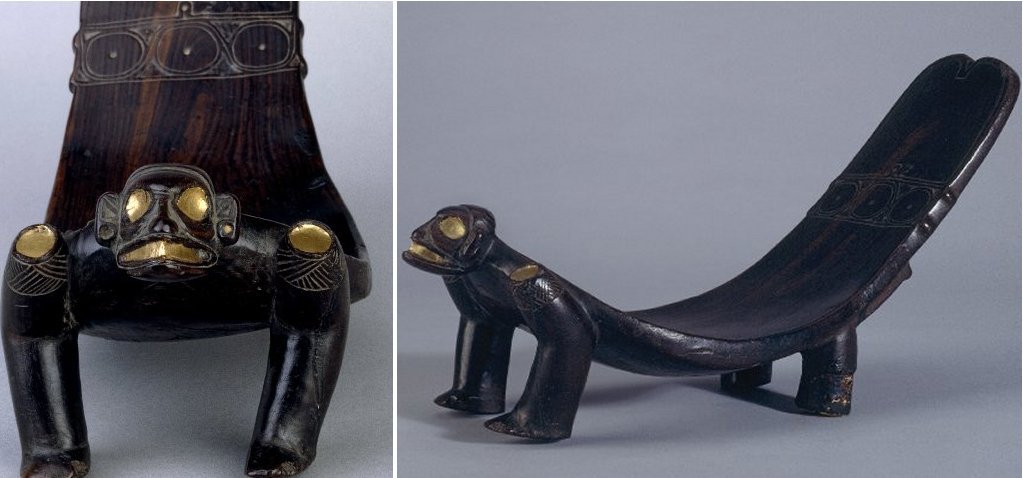
Wooden four-legged stool carved in anthropomorphic form and inlaid with gold; called duho. Image credits: British Museum
The wood of the duho - smooth and perfect - originated from the Caribbean and was intentionally chosen and had remarkable qualities. It was so unusually dense that it could sink in water.
Not much is known about the Taino people. They lived in small settlements of a few thousand people, in large circular houses, each accommodating perhaps a dozen families, clustered around a central square. Their life was ruled by centers of power whose leaders fought, negotiated, and allied among themselves.
The Tainos' contact with the Europeans was fatal. Consequently, it brought enslavement, disease, and finally, the collapse of indigenous Taino society.
Many believe the artifact (only about the size of a foot stool) was used by Taino shamans and chiefs during ceremonial communication with the spirit world.
Written by – A. Sutherland AncientPages.com Staff Writer
Updated on July 22, 2022
Copyright © AncientPages.com All rights reserved. This material may not be published, broadcast, rewritten or redistributed in whole or part without the express written permission of AncientPages.com
Expand for referencesMore From Ancient Pages
-
 Curious Story How Sæmundur The Wise Tricked The Devil Three Times
-
 Millennium Old Dice Found In Vadnagar, Gujarat, India
-
 Neanderthal-Denisovan Ancestors Interbred With ‘Superarchaic’ Population 700,000 Years Ago
-
 Extremely Brutal Conflicts Among Maya Broke Out Before Civilization’s Decline
-
 Number ‘Seven’: Mystical Number Of The Universe And One Of The Most Sacred Numbers
-
 Mysterious Disappearance of Scythians Still Remains Unsolved
-
 Lao Tzu: Legendary Thinker And Founder Of Taoism Who Advocated Modesty, Self-Restraint And Balance
-
 Baffling Copper Scroll – A Treasure Map Leading To A Secret Lost Temple?
-
 Surprising Discovery Of Almost Intact Roman Sanctuary With Temples In The Netherlands
-
 Draken Harald Hårfagre – World’s Largest Viking Ship On Its Way To U.S And Canada
-
 18,000-Year-Old Relics Discovered In Oregon – Oldest Home In North America?
-
 On This Day In History: Vädersol Painting Depicting ‘Sun Dog’ Phenomenon Observed Over Stockholm – On Apr 20, 1535
-
 Neanderthal Intelligence Revealed By Their Use Of Fire For Cooking
-
 Royal Inscription Of Naram-Sîn Of Akkad: The First Ancient King To Use Blocks For Printing Bricks
-
 Can This Ancient Underwater Graveyard Solve The Mystery Of The Great Flood And Noah’s Ark?
-
 We Need To Look Underwater To Understand Our Past – New Study
-
 Mysterious Advanced Underground Civilization And A Secret Society – Dangerous Knowledge And Verdict – Part 3
-
 Why Have So Few Who Have Seen This Mysterious Victorian-Era Entity Survived?
-
 Ancestral Māori Adapted Quickly In The Face Of Rapid Climate Change – New Study Shows
-
 Humans In Africa Fled To The Mountains During The Last Ice Age

