
Bog Body Of The Elling Woman: Was She Sacrificed To The Gods Because Of Climate Change?
AncientPages.com - It took many years before scientists could finally determine the age and identity of a bog body discovered in 1938 west of Silkeborg, Denmark.
Many of the 1,000 or so bodies or body parts that have been unearthed were never properly examined at the time of the discovery.
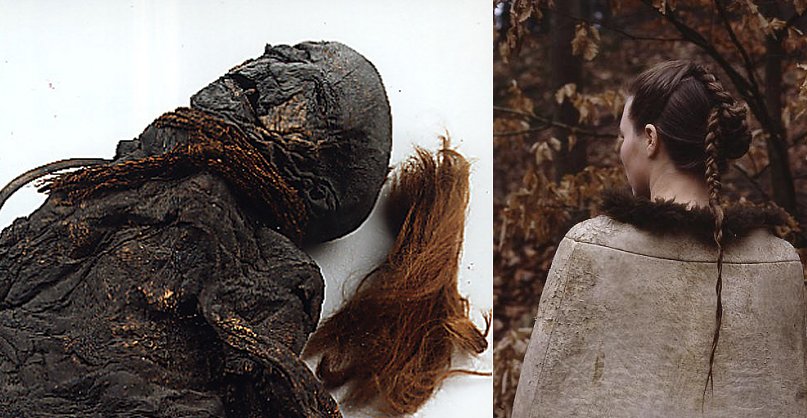
Several of the bog bodies were destroyed, but bog mummies that remain have been investigated with modern technology and today, we can learn more about the people who lived and died during the Iron Age in Europe.
Iron Age People Considered Bogs To Be Gateways To The Supernatural World
Bog bodies are the naturally preserved human corpses found in the sphagnum bogs in Northern Europe. Unlike most ancient human remains, bog bodies have retained their skin and internal organs due to the unusual conditions of the surrounding area.
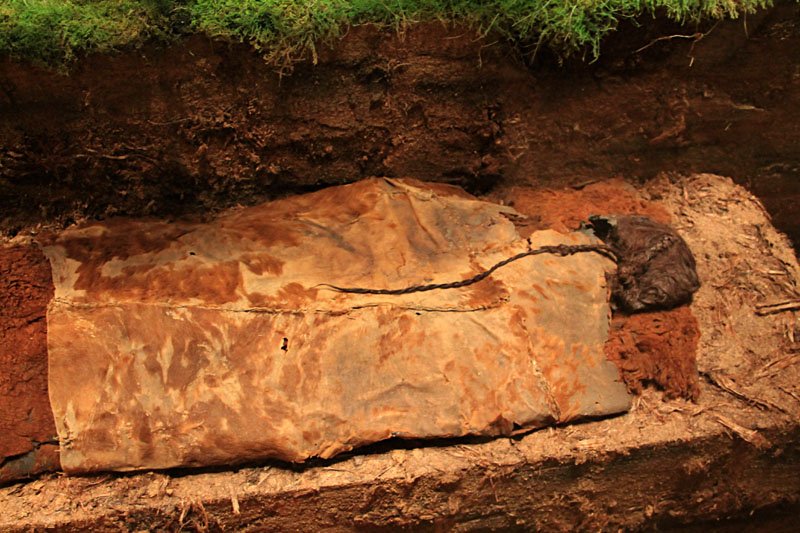
Elling Woman displayed at the Silkeborg Museum in a manner similar to how she was found buried in peat. Note the well-preserved hair. Image credit: J.S. Aber.
From 2,500 to 2,000 years ago, the Germanic tribes of Iron Age northwestern Europe had a habit of killing people and leaving their bodies in bogs.
Bogs were sacred places for Iron Age folk, acting as gateways to the supernatural world, where gifts could be presented to the gods.
Who Was The Elling Woman?
In 1976, archaeologists, forensic examiners, radiologists, forensic dentists and the Carbon-14 laboratory of the National Museum in Denmark started to examine the body found in a pit bog in Bjældskovdal and today we know more about the person who has become known as the Elling Woman.
The Elling Woman, who was discovered by a local farmer, Jens Zakariasson. Examination of the body revealed that she was only 25 years when she met a gruesome death.
She was hanged with a leather thong in 280 B.C. The thong left a V-shaped furrow that is clearly visible in her neck. She was wrapped in one sheepskin cape, and another covered her legs and feet.

Reconstruction of Elling Woman's hairstyle and cloak - Image credit: The Tollund Man
It is logical to assume that the Ellinge Woman was a human sacrifice, but why she was selected is unknown.
See also:
Unsolved Mystery Of The Huldremose Woman: One Of The Best Preserved Bog Bodies Ever Found
Archaeologist Christian Fischer, director of Denmark’s Silkeborg Museum suggests the Ellinge Woman might have been sacrificed during a stressful time of changing climate.
Fischer wants to investigate the possibility that her deaths could be linked to the weather. Maybe if something was going wrong, the people could have felt pressed to give a sacrifice to the gods, he says. And that sacrifice could be gold, silver, or even a human being.
Using carbon-14 method, experts were able to reveal that the Ellinge Woman died at approximately the same time as the Tollund Man, an unusually well-preserved body of an adult male who was approximately 30 to 40 years old when he died.
The Tollund Man is probably the most well-preserved body from pre-historic times in the world. However, the uncertainty connected with the method makes it impossible for to say if Elling Woman and the Tollund Man were placed in the bog at approximately the same time or if the sacrifices took place with an interval of 100 years.
Copyright © AncientPages.com All rights reserved. This material may not be published, broadcast, rewritten or redistributed in whole or part without the express written permission of AncientPages.com
Expand for referencesMore From Ancient Pages
-
 Mystery Of The Amazing 2,500-Year-Old Underwater Rochelongue Treasure
-
 Utukku Lemnutu: Incantations Used As Therapy In Mesopotamia
-
 On This Day In History: The Great Fire Of London – On July 10, 1212
-
 Odd Encounter With A Mysterious Cave-Dwelling Creature Who Issued A Warning Described In A Norse Saga
-
 Astronomers Confirm Solar Eclipses Mentioned In Indigenous Folklore And Historical Documents In Japan
-
 Intriguing 3,400-Year-Old Multipurpose Pyramid Found In Kazakhstan
-
 On This Day In History: ‘Devil’s Footprints’ Appeared In Devon, England – Feb 8/9, 1855
-
 Rare Roman Mosaic Of Amazon Warriors Unearthed In Syria Hailed As Major Archaeological Discovery
-
 Surprisingly Complex History Of Crocodiles – New Study
-
 A Head Of A Statue Dated To 700 BC, Animal Figurines And Jordan Valley’s Occupation History
-
 Ancient Mummy Of ‘Hatason’: Woman Who Died In Egypt More Than 3,000 Years Ago – Stanford Radiologists Investigate
-
 Sailor’s Strange Discovery Of An Unknown Ancient Underground World At The North Pole
-
 Unexpected Discovery Of 600 B.C Assyrian Palace In Shrine Destroyed By Isil Militants
-
 Modern Human DNA Contains Bits From All Over The Neanderthal Genome – Except The Y Chromosome. What Happened?
-
 Lazarus – An Obscure Biblical Figure
-
 Secret Hidden Freemasonic Messages Concealed In Ancient Egyptian Artifacts And Roman Works – A Misunderstood Object? – Part 1
-
 Mysterious Devil’s Footprints In Maine – An Ancient Mystery That Will Never Be Solved
-
 Mysterious Ancient Ruins Of Engaruka – Why Was The Site Abandoned?
-
 Fascinating Expedition In A Dugout Canoe Sheds Light On Long Unanswered Questions
-
 Underwater Archaeologists Retrieve Over 100 Magnificent Glass Objects at Chengene Skele Bay, Bulgaria

