
Kukulkan (Quetzalcoatl): Feathered Serpent And Mighty Snake God
A. Sutherland - AncientPages.com - Known under several different names, Kukulkan (also Kukulcan), the Feathered Serpent, was one of the most important gods in Mesoamerica.
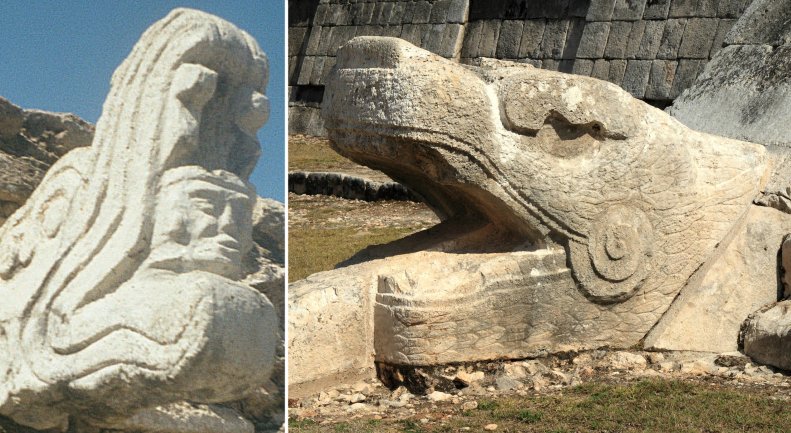 Left: Ballcourt marker from the Postclassic site of Mixco Viejo in Guatemala. This sculpture depicts Kukulkan, jaws agape, with the head of a human warrior emerging from his maw. Iamge credit: Simon Burchell - CC BY-SA 3.0; Right: Kukulkan at the base of the west face of the northern stairway of El Castillo, Chichen Itza. Image credit: Frank Kovalchek - CC BY 2.0
The Aztecs called him Quetzalcoatl, and the ancient Maya called him Kukulkan. The K'iche' group of Maya named him Gukumatz.
Was this mighty snake deity a genuine historical person?
It is not easy to trace the ancient history of Kukulkan. Like all of the feathered serpent gods in Mesoamerican cultures, Kukulkan is thought to have originated in Olmec mythology, and we still know very little about the mysterious Olmec civilization.
The true identity of the god Kukulkan becomes an even more significant problem due to the confusing references to a man who bore the name of the Mayan god. Because of this, the distinction between the two has become blurred.
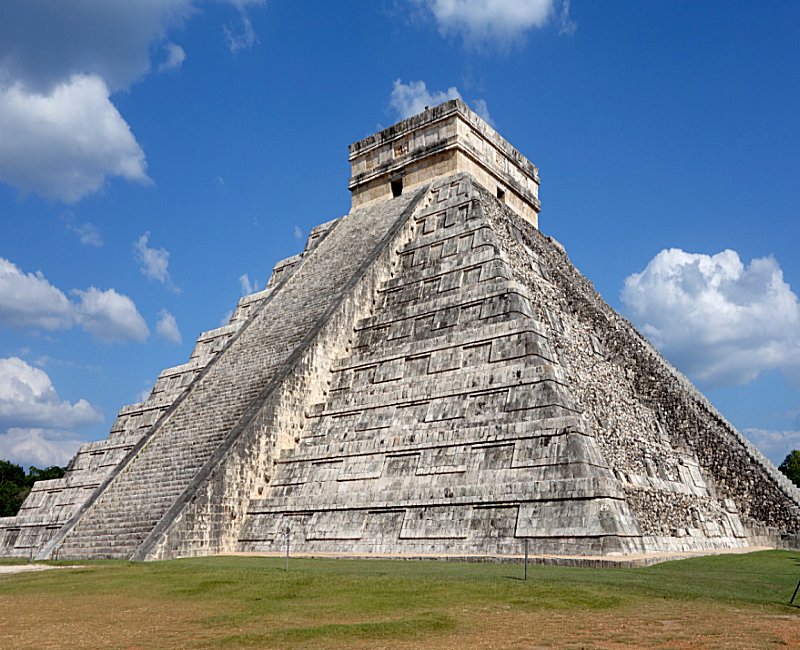
Westside of the Temple of Kukulcan. Image credit: - CC BY-SA 4.0
Around the 10th century, a priest or ruler appeared in Chichen Itza. This sacred site was one of the most potent Mayan centers of the Yucatán peninsula, Mexico, where we find El Castillo, also known as the Temple of Kukulkan.
Depicted as a serpent with feathers, Kukulkan showed up on many Mayan temples. This god later on became adopted by the Aztecs and Toltec people, and his name changed to Quetzalcoatl.
El Castillo square in plan and reaching 30 meters in height dominates the Main Plaza, and is the spectular structure at Chichen Itza. The temple was dedicated to the Feathered Serpent, Quetzalcoatl (known locally as Kukulkan). This deity is of Central Mexican origin and assumed a preeminent position in the pantheons of Teotihuacan and Toltec Tula.
Attesting to this dedication, low stone railings flanking the principal staircase on the northeastern side, those facing the Venus Platform, terminate in carved heads of Feathered Serpents.
Kukulkan originated among the Maya of the Classic Period (200 AD to 1000) when he was known as Waxaklahun Ubah Kan, the War Serpent. Maya writers of the 16th century describe Kukulkan as a historical person. Still, the earlier 9th-century texts at Chichen Itza never identified him as human, and artistic representations depicted him as a Vision Serpent entwined around the figures of nobles.
According to ancient Maya beliefs, Kukulkan - popularly known as the Feathered Serpent - was the god of the wind, sky, and the Sun. In Aztec culture and literature, he was a supreme leader of the gods, depicted just like Quetzalcoatl, whose name originates from the Nahuatl language and means "Precious serpent" or "Quetzal-feathered Serpent." Kukulkan gave humanity his learning and laws. He was merciful and kind but could also change his nature and inflict great punishment and suffering on humans.
According to Maya legend, the Maya were visited by a robed Caucasian man with blond hair, blue eyes, and a beard, who taught the Maya about agriculture, medicine, mathematics, and astronomy. This being was Kukulkan – the Feathered Serpent.
Kukulcan warned the Maya of another bearded white man who would not only conquer the indigenous people of Central America but would also enforce a new religion upon them before he was to return. Despite the warning, the Maya mistakenly welcomed the invading Cortes as Quetzalcoatl.
The cult of Kukulkan spread as far as the Guatemalan Highlands, where Postclassic feathered serpent sculptures are found with open mouths from which protrude the heads of human warriors.
Hundreds of North and South American Indian and South Pacific legends tell of a white-skinned, bearded lord who traveled among the many tribes to bring peace about 2,000 years ago. This spiritual hero was best known as Quetzalcoatl.
Some of his many other names were:
Kate-Zahl (Toltec)
Kul-kul-kan (Maya)
Tah-co-mah (NW America)
Waicomak (Dakota)
Wakea (Cheyenne, Hawaiian, and Polynesian)
Waikano (Orinoco)
Hurakan, the Mighty Mexico,
E-See-Co-Wah (Lord of Wind and Water)
Chee-Zoos
the Dawn God (Puan, Mississippi)
Hea-Wah-Sah (Seneca),
Taiowa, Ahunt Azoma
E-See-Cotl (New Guinea)
Itza-Matul (Yucatan)
Zac-Mutul (Mayan)
Wakon-Tah (Navajo)
Wakona (Algonquin)
Kukulkan emerged from the ocean and disappeared in it afterward. Before he left, he promised to return someday, but he never revealed when.
Written by – A. Sutherland - AncientPages.com Senior Staff Writer
Updated on February 13, 2024
Copyright © AncientPages.com All rights reserved. This material may not be published, broadcast, rewritten or redistributed in whole or part without the express written permission of AncientPages.com
Expand for referencesReferences:
Nichols, Deborah L. The Oxford Handbook of Mesoamerican Archaeology
Sierras E. The Shadow of Kukulkan
More From Ancient Pages
-
 Hidden Prophecies Inside The Great Pyramid Of Giza Discovered By Scientists
-
 Vimanas – Flying Machines Soaring Through Ancient Sky Of India
-
 Hunter-Gatherers, Neolithic Farmers Followed “Danube Route” To Central Europe Expanded, Coexisted And Gradually Mixed
-
 Cosmic Rays Reveal Mysterious Void Inside Great Pyramid – What’s Hiding Inside?
-
 A Hoard Of Silver Coins Found Accidentally Under An Uprooted Tree Near Pieštany, Slovakia
-
 Ancient Maya Destroyed Their Environment 2,000 Years Ago – Effects Are Still Visible Today
-
 Mysterious Secret ‘Square’ Discovered Beneath Avebury Stone Circle
-
 Mysterious Death Of 20 Celts Who Died 2,000 Years Ago In The Three Lakes, Switzerland – Re-Examined
-
 On This Day In History: ‘The Wars Of The Roses’ – Fighting For The Throne Of England At Tewkesbury – On May 4, 1471
-
 How Can Busy People Also Keep Fit And Healthy? What The Ancient Greeks And Romans Did?
-
 Secrets Of An Unusual And Mysterious Medieval Danish Axe Revealed By Scientist
-
 Nemesis: Winged Goddess Of Justice And Revenge
-
 Ancient Graffiti On Sacred Mountain Reveals Secrets Of North Korea
-
 Rock-Hewn Ancient Churches Of Lalibela
-
 Ancient DNA Reveals Surprises About Life Of Early Africans
-
 Celtiberians: Intriguing Martial Culture And Their Skilled Warrior Infantry
-
 Hidden Details Discovered In Picasso’s Painting The Crouching Woman
-
 Cupbearer Was Privy To Conversations And Political Secrets Hidden Behind Closed Doors
-
 The Late Antique Little Ice Age Weakened The Roman Empire – Study Reveals
-
 Tipón (Tipon): Who Taught The Inca How To Build Artificially Irrigated Garden?

