
Parthians: Their Great Empire And Skilled Horse Archers
A. Sutherland - AncientPages.com - The Parthian people established an empire that lasted almost 500 years, from the mid-3rd century BC until 224 CE. Their empire was the most lasting of the empires of the ancient Near East.

They came to power under king Mithradates the Great (171-138 BC); their territories stretched from the Euphrates River in the west to Central Asia and the borders of Bactria in the east. The Parthian empire occupied Iraq, Armenia, all of modern Iran, parts of Turkey, Georgia, Azerbaijan, Turkmenistan, Afghanistan and Tajikistan, and for short time, also territories in Pakistan, Syria, Lebanon, Israel and Palestine.
Strangely, despite their enormous role in forming a strong link between the peoples of East Asia and Europe - the Parthians were overshadowed by the Achaemenids and Sassanids.
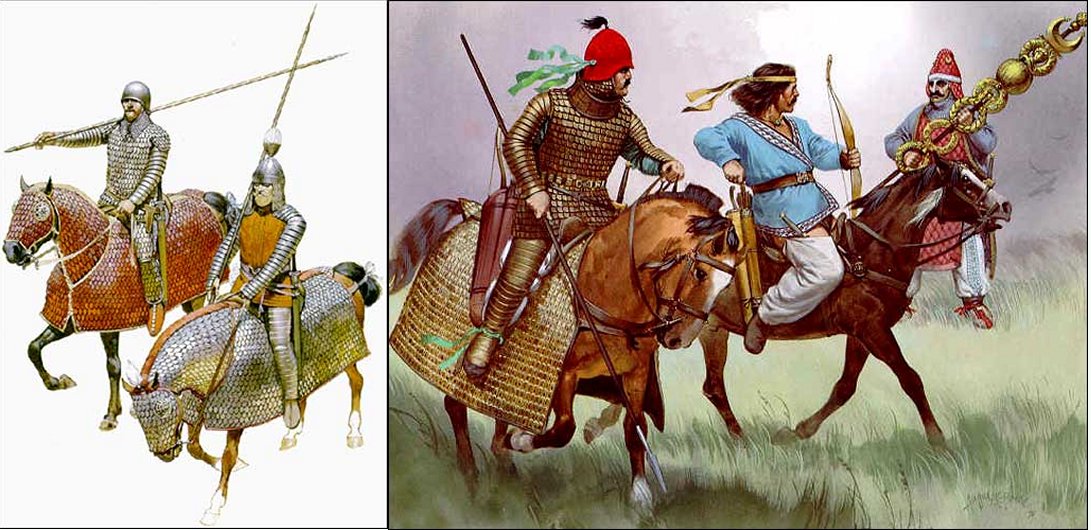
Left: Parthian Cataphracts (Fully Armoured Parthian Cavalry); Right from Left: East Parthian Cataphract (heavy cavalry with man and horse decked in mailed armor.); Middle: Parthian Horse-Archer; Right: Parthian Cataphract from Hatra. Image credit: www.iranchamber.com
The Parthians were originally part of a tribe known as the Parni (or Aparni), who originated on the eastern edge of the Caspian Sea. We know about their history but only from Greek and Roman sources, which mainly describe the Roman battles with the Parthians and their excellent warfare.
The Parthians were literate people but unfortunately, they did not record histories of their dynasty. They built temples, monuments, tombs, and Parthian coins, which they made for the reigns of their kings and this procedure – although, rather unusual in Antiquity – functioned very well.
Their religion was an early form of Zoroastrianism, but they were also tolerant of other religious beliefs.
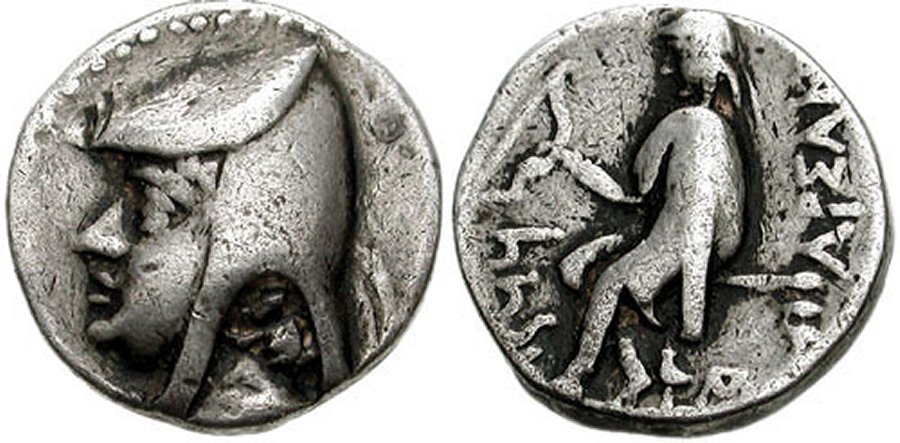 The silver drachma of Arsaces I of Parthia (r. c. 247–211 BC) with a Greek-alphabet inscription of his name. Image - Classical Numismatic Group, Inc. http://www.cngcoins.com - CC BY-SA 3.0
Their most famous towns such as Ctesiphon, Seleucia, Ecbatana, Rhagae, Hecatompylus, Nisâ, and Susa flourished. The first king of the Parthians was Tiridates' brother Arsaces I. His capital was Hecatompylus, the capital of the Parthian Arsacid dynasty by 200 BC.
The Parthians, like their neighbors, the Scythians, were able to succeed in battle often due to their use of horse archers. Ancient Parthians were brave and extremely skilled archers mounted on light horses. While pretending to flee at a full gallop in panic, they turned their bodies back to shoot at the pursuing enemy. It was their strategy - to confuse the enemy by pretending to be in retreat – and then, attack.
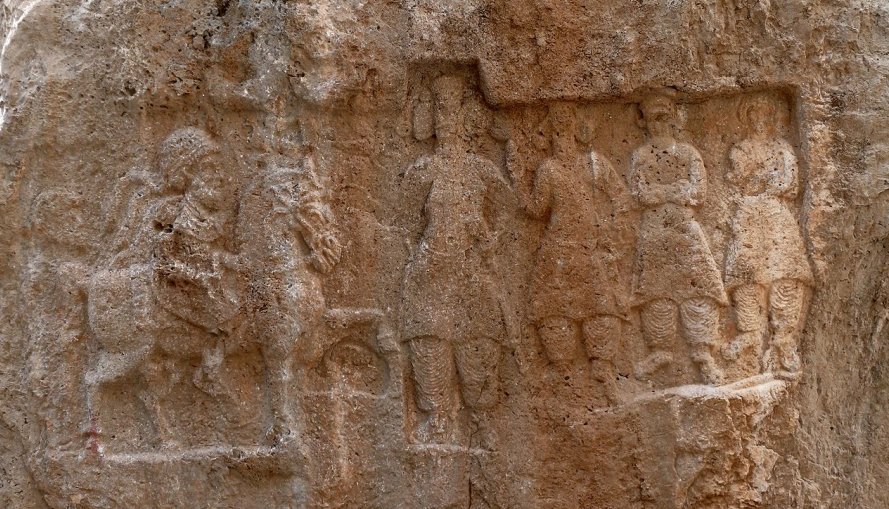 A rock-carved relief of Mithridates I of Parthia (r. c. 171–138 BC), seen riding on horseback at Xong-e Ashdar,city of Izeh, Khuzestan Province, Iran. Image: https://iranontrip.ir/page/en-637/Parthian-Empire
From this ancient Parthian strategy originates the term "Parthian shot" that symbolizes perfection and deadly accuracy. Now it is known as “parting shot”.
The key to their many victories was the crucial role of Parthian archers.
The Roman-Parthian wars lasted so long because the Parthians were hard to defeat. The Romans relied on heavy infantry; the Parthian armies contained of two types of cavalry: the heavy-armed and armored cataphracts and light brigades of mounted archers.
Written by – A. Sutherland AncientPages.com Staff Writer
Updated on Oct 14, 2023
Copyright © AncientPages.com All rights reserved. This material may not be published, broadcast, rewritten or redistributed in whole or part without the express written permission of AncientPages.com
Expand for referencesReferences:
More From Ancient Pages
-
 Investigation Of The Elusive Will-o’-the-Wisp Leads To A Surprising Discovery
-
 Sogdian Temple Of Jartepa II On Caravan Road Of The Silk Road
-
 Extraordinary Ancient Roman Ceremonial Chariot Discovered In Pompeii – It’s Still Almost Intact
-
 Neanderthals Had More Children And Lived In Smaller Groups Than Was Previously Thought
-
 Earliest Known Abecedary Engraved On Shard Of Pottery Dated To 15th Century BC – Deciphered
-
 Archaeologists Uncover A 20,000-Year-Old Secret That Rewrites The Ancient History Of North America Forever
-
 4,500-Year-Old Ramp Might Explain How Huge Stones Were Transported To Great Pyramids’ Building Site
-
 Genuine Bronze Warrior Statuette Unearthed At Technologically Advanced Celtic Settlement Oppidum Of Manching
-
 Rare 4,000-Year-Old Sauna Discovered In Scotland
-
 Mediterranean Migration Was Low Over 8,000 Years – New Study
-
 Intriguing Discovery Could Offer Proof Of The Tabernacle – Has The Dwelling Place Of God Been Located?
-
 Abu Dhabi Fossil Dunes May Have Inspired The Ancient Great Flood Story – Professor Says
-
 Etruscan Beautiful Bronze Lamp of Cortona – Studied
-
 Thor’s Hammer Pendant Found In Norfolk May Be Linked To The Great Heathen Army
-
 Ancient Greek Goddesses Aphrodite And Artemis – Rivalry And Conflict Over Prestige Illustrated In Hippolytus By Euripides
-
 2,000-Year-Old Ruins In Mary Magdalene’s Town Of Magdala On The Shore Of The Sea Of Galilee
-
 New Light On Prehistoric Chalk Plaques From Stonehenge Using Innovative Technology
-
 Unexpected Neanderthal Behavior In Spain’s Southern Pyrenees – Revealed
-
 Why Were These People Buried In A Remote, Unmarked Grave In New Hampshire In The Mid-1800s?
-
 Rapa Nui’s Population: Growth And Decline – Lesson For Our Future?

