
Shaka Zulu: African Hero And One Of Greatest Military Leaders Of All Time
Ellen Lloyd - AncientPages.com - Shaka Zulu will be remembered as a great leader and conqueror who united over 100 chiefdoms into one mighty kingdom.
He was one of the greatest military leaders of all time, and many consider him a ruthless ruler who trained his troops with severe discipline and questionable methods. According to historians, there are many stories about his life, some of which are exaggerated.
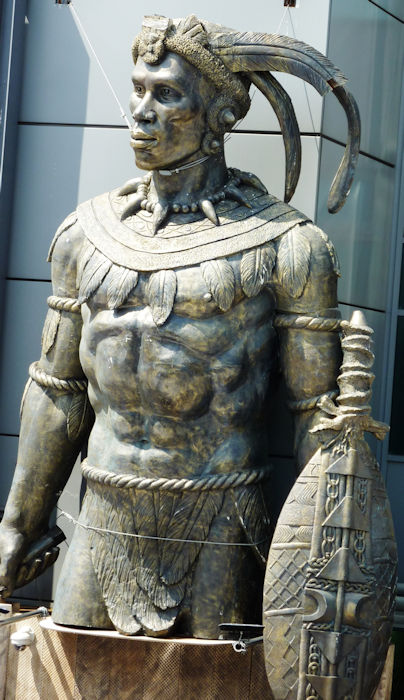
Shaka Zulu (1787-1828) was one of the greatest heroes in Africa. Shaka Zulu restaurant statue. Camden, London Credit: Adobe Stock - ajay
Yet, there is no doubt that he is considered a great man and one of the most famous Africans. Shaka the Mighty is often compared with Alexander the Great, Julius Caesar, Attila the Hun, and Napoleon.
Born c. 1787, Shaka Zulu had a difficult childhood. His father, Senzangakhona was a minor Zulu chief, but his mother was an unranked woman. His parents belonged to the same clan, and their marriage violated Zulu custom.
Shaka was just a boy when he and his mother were banished from their tiny Zulu clan, one among many clans that dotted the hillsides of southern Africa. He dreamt of becoming a great warrior, and he achieved his dreams. Shaka served as a warrior under Dingiswayo, the Mthethwa paramount chieftain, and he became a mighty warrior of the Mthethwa Empire.
Shaka Becomes Zulu Leader
When a rival clan murdered the Zulu leader, Shaka assumed the throne, but he remained a vassal of the Mthethwa Empire until Dingiswayo's death.
When Shaka learned Dingiswayo had been murdered by Zwide, the powerful chief of the Ndwandwe (Nxumalo) nation, he sought vengeance. He organized the remaining warriors of the Mthethwa together with other tribes and defeated Dingiswayo during the Zulu War in 1819-1820.
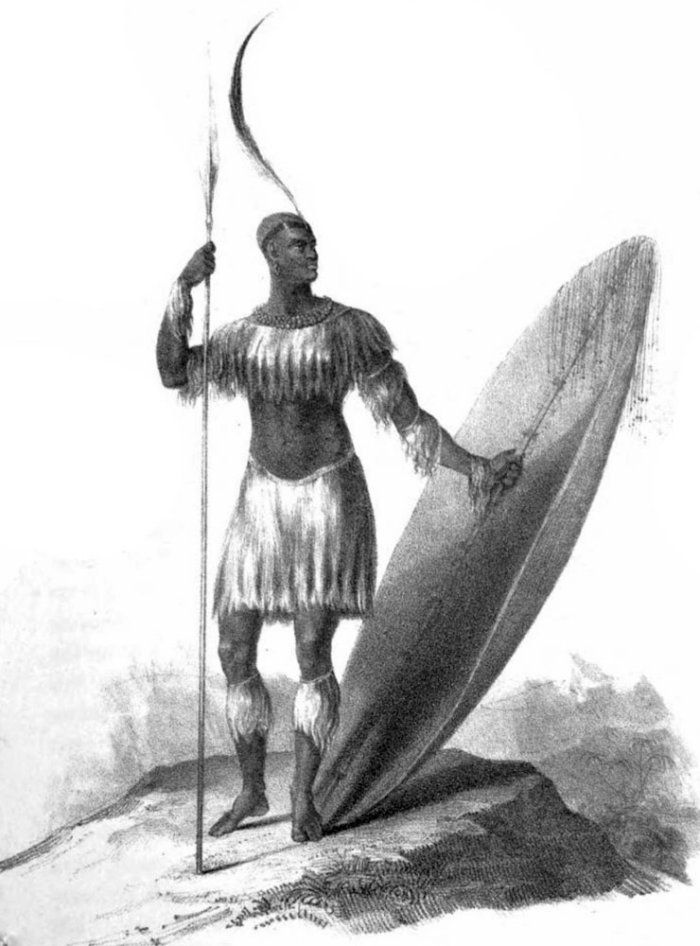
Sketch of King Shaka (1781 - 1828) from 1824. Attributed to James King, it appeared in Nathanial Isaacs’ "Travels and Adventures in Eastern Africa", published in 1836.
The Zulu belonged to a large ethnic clan called the Bantu. These were migratory, cattle-keeping people composed of many subgroups speaking over 200 related languages. The Bantu had gradually moved from the North into the Eastern portions of South Africa.
It was Shaka who united the tribes and formed a powerful state in 1818. This became the Zulu Kingdom.
How Shaka Zulu Trained His Fearsome Warriors
Shaka Zulu did not become a great military leader immediately it took time before people trusted him, but as he created alliances with other tribes, his name became widely recognized.
The Zulu tribe soon developed a "warrior" mindset, which Shaka turned to his advantage. He used his soldier skills to teach the Zulus the most effective way of quickly becoming powerful by conquering and controlling other tribes. His teachings greatly influenced the social outlook of the Zulu people.
He also introduced new weapons to his warriors. One of them was the ikwla, a weapon with a shorter sphere and a longer spearhead the ikwla resembled a sword and gave the Zulu warriors a great advantage in combat with their enemies. Shaka prohibited the wearing of sandals, toughened his warriors' feet by making them run barefoot over the rough thorny ground, and secured their greater mobility. His warriors had to run many miles daily, and those who complained were killed.
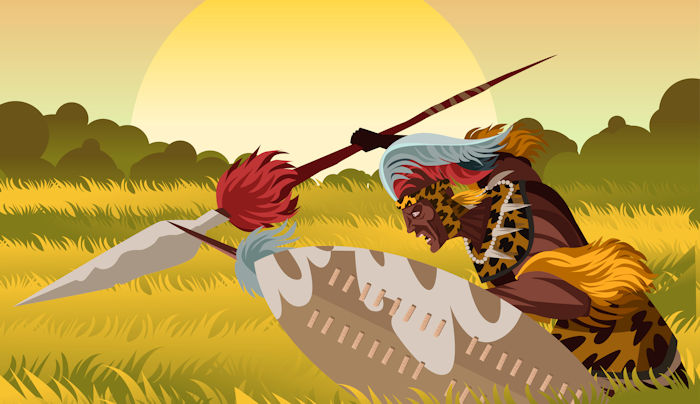
Credit: Adobe Stock - matiasdelcarmine
Shaka was a rigorous leader, and his training was very demanding and brutal, but he gained a lot of respect, confidence, and support. He eliminated privilege and class. Warriors had to earn their positions and rank. All the spoils of war taken from the defeated armies were to be split among the warriors, and all resources were shared. Aging members of society were to be treated with dignity and allowed to retire. He also got rid of witch doctors.
Shaka and his Zulu warriors used a famous and very successful battle tactic known as the “Buffalo Horns”. There is no doubt that this tactic played a vital role in military success.
Previously the Zulu warriors had only used the “Buffalo Horns” tactics for hunting, but Shaka adapted it for battle with great success. The Buffalo Horns formation would see the Zulus split their forces into four distinct elements. Each represented a part of the Buffalo, such as the chest's left and right horns. The Chest of the Buffalo would engage the enemy head-on. This element of the Zulu force would usually be made up of the best warriors, proven in battle.
While the Chest of the Buffalo was pinning down the enemy, the Horns would encircle them to the left and right, surrounding the opposition. Any survivors were given the option to join the Zulus or be killed. This tactic was the main reason the Zulu warriors became feared.
Shaka maintained a good relationship with the Europeans in Africa, including the Colonial authorities. However, his constant wars were disliked by other Africans, including his own people.
Shaka Zulu’s Death
Shaka Zulu became psychologically unstable and obsessively worried about being replaced by an heir. When his mother died in 1827, his mental condition worsened. He imposed a year of celibacy on his people, executed anyone who did not show enough grief at the death of his mother and about 7,000 Zulus were killed during his grief.
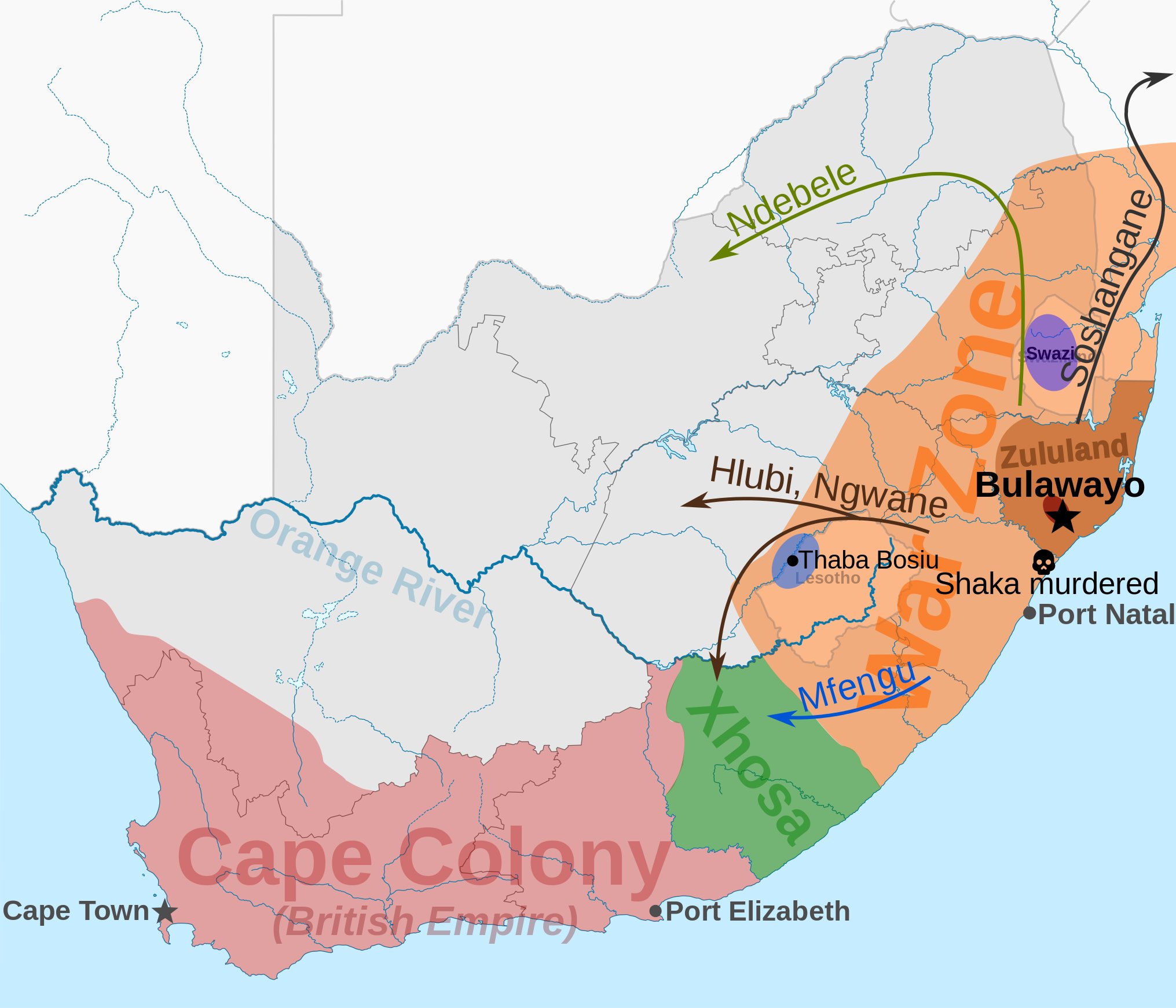
This map illustrates the rise of the Zulu Empire under Shaka (1816–1828) in present-day South Africa. The rise of the Zulu Empire under Shaka forced other chiefdoms and clans to flee across a wide area of southern Africa. Clans fleeing the Zulu war zone included the Soshangane, Zwangendaba, Ndebele, Hlubi, Ngwane, and the Mfengu. A number of clans were caught between the Zulu Empire and advancing Voortrekkers and British Empire such as the Xhosa. Image credit: Wikipedia
For a year, no crops were planted, milk was prohibited, and all women found pregnant were slain with their husbands.
Shaka wanted everyone to know how it felt to lose a mother.
All this was too much for the people around him. One year later, in 1827, Shaka was murdered by his half-brother, Dingane, who succeeded him as ruler.
Today, Shaka remains a revered founding figure for many Zulu speakers and continues to be seen as an important historical figure by huge numbers of other people.
Updated on May 8, 2022
Written by Ellen Lloyd – AncientPages.com
Copyright © AncientPages.com All rights reserved. This material may not be published, broadcast, rewritten or redistributed in whole or part without the express written permission of AncientPages.com
Expand for referencesMore From Ancient Pages
-
 Curious Ancient Prairie Mystery In Washington Scientists Cannot Solve – Maybe You Have An Idea What Happened?
-
 Mysterious Water Indians: Brotherhood Of Semi-Divine Beings Described As Half Men And Half Fish
-
 Rare Viking Artifacts Hidden Beneath The Ice Discovered By Archaeologists In Norway
-
 Unexpected Archeogenetic Study Results Obtained In Graves Of Mödling And Leobersdorf, Lower Austria
-
 Taíno Indians Are Not Extinct – Ancient Tooth Reveals Indigenous Americans Still Have Living Descendants In The Caribbean
-
 Siberian Shigir Idol With Seven Faces Is The World’s Oldest Wooden Sculpture
-
 Aztecs: Facts And History About The Ancient And Powerful Mesoamerican Civilization From Aztlán
-
 Megalithic Cemetery With 49-50M Long Tombs Was Accidentally Found In Poland
-
 Battle Of Visby – Death Came With King Atterdag’s Ships
-
 The Rise And Fall Of The Sasanian Empire
-
 Fenrir: Oldest Of Three Monstrous Children Of God Loki In Norse Mythology
-
 Artifacts Unearthed In Mit-Rahina, South Of Giza, Egypt
-
 Ancient Brewing And Natufian Rituals – What Came First, Beer Or Bread?
-
 LIDAR Technology Reveals Lost Bronze Age Forts In Devon
-
 Ancient Maya Lessons On Surviving Drought – Examined By Scientists
-
 Nottingham Scientists Investigate An Ancient Boat Buried Under A Pub Car Park
-
 On This Day In History: Eugène Dubois Who Discovered Remains Of Java Man Was Born – On Jan 28, 1858
-
 Ancient DNA Reveals A 50,000-Year-Old Secret And Re-Writes History Of Australia
-
 Evidence Of 10,000 Years Of Violent Conflict Among The Hunter-Gatherer Societies In The Atacama Desert
-
 Mysterious Hieroglyphs Point To The Location Of Queen Nefertiti’s Tomb?

