
Mythical Egyptian Bennu Bird And Deity
A. Sutherland - AncientPages.com - The Bennu is an ancient Egyptian deity linked with the sun, creation, and rebirth. It may have been the inspiration for the phoenix in Greek mythology.
According to Egyptian mythology, the Bennu was a self-created being. This being played a role in the creation of the world. It was said to be the ba of Ra and enabled the creative actions of Atum.

According to Egyptian mythology, the Bennu was a self-created being. The Egyptian meaning of the Bennu is 'palm tree' and also 'purple heron'. This bird is clearly associated with the Phoenix and its legend is associated with the Bennu. The Bennu bird has red and golden plumage and is the sacred bird of Heliopolis, one of the oldest cities of ancient Egypt. Sacred Bennu has been also interpreted as the reincarnation of the Gods Ra and Osiris. Heliopolis is referred to as the City of the Sun and is known as one of the oldest Egyptian cities.
The ancient Egyptians believed the Bennu created itself from a fire that burned upon a holy tree in the temple of Ra and yet others believed that it exploded from the heart of Osiris.
It was said to have flown over the waters of Nun that existed before creation, landing on a rock and issuing a call that determined the nature of creation. It was also a symbol of rebirth and was therefore associated with Osiris.
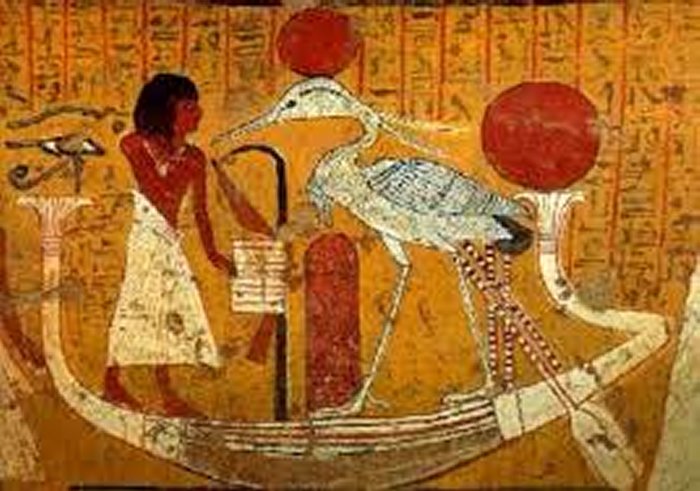
The Bennu was probably worshipped in their cult center at Heliopolis. Image via wikipedia
Some of the titles of the Bennu bird were "He Who Came Into Being by Himself", and "Lord of Jubilees"; the latter epithet referred to the belief that the Bennu periodically renewed itself like the sun. Its name is related to the Egyptian verb wbn, meaning "to rise in brilliance" or "to shine".
The Pyramid Texts refer to the yellow wagtail as a symbol of Atum, and it may have been the original form of the Bennu bird. New Kingdom artwork shows the Bennu as a grey heron with a long beak and a two-feathered crest, sometimes perched on a benben stone (representing Ra) or in a willow tree (representing Osiris). Because of its connection with Osiris, it sometimes wears the atef crown.

‘Benu’-bird (the Phoenix). Inerkhau ("Onuris appears" - Onuris was a Greek inflection of the name of the god Iny-Hor) who was the son of Hay and his wife was named Wabet. - here: worshipping the Benu-bird, the sacred phoenix wearing the Atef-Crown. Bennu bird - a symbol of resurrection.
A large species of heron, currently extinct, lived on the Arabian Peninsula in comparatively recent times; it may have been the ultimate inspiration for the Bennu. Reflecting this, the species was described as the Bennu heron (Ardea bennuides). Like Atum and Ra, the Bennu was probably worshipped in their cult center at Heliopolis. It also appears on funerary scarab amulets as a symbol of rebirth.
According to the Greek historian Herodotus, who wrote about Egypt in the fifth century BC, the priests at Heliopolis described the phoenix to him. They said it lived for 500 years before building its own funerary pyre and setting it alight.
The newborn offspring of the previous phoenix rose from the ashes of this fire and carried them to Heliopolis, depositing them on the temple's altar. Greek descriptions of the phoenix liken it to an eagle with red and gold plumage, reminiscent of the sun or of flames.
The name of the phoenix could be derived from "Bennu", and its rebirth and connections with the sun resemble those of the Bennu bird, although Egyptian sources do not mention the bird's death.
Written by A. Sutherland - AncientPages.com Staff Writer
Copyright © AncientPages.com All rights reserved. This material may not be published, broadcast, rewritten or redistributed in whole or part without the express written permission of AncientPages.com
More From Ancient Pages
-
 Surprising DNA Study Links Present-Day Native American Tribe To Ancestors In San Francisco Bay Area
-
 Ancient Mystery Of The Unknown White Bearded Rulers
-
 Adapa – Why Did The Wise Apkallu Refuse The Gift Of Immortality?
-
 Oldest Known Sami Manuscript Discovered – It’s Undeciphered And Written By An Unknown Author
-
 Huge Maya Civilization With Pyramids, Settlements, Ball Courts, Roads And More Discovered By LIDAR In Guatemala
-
 Ghostly Appearance Of Weird Ancient City Suspended In The Sky Witnessed By Many People
-
 Mysterious Watson Brake: Old Mound Complex In North America With Earthworks Raised For Unknown Purpose
-
 Riddle Of Brazilian Atlantis – Strange Discovered Rocks The World Forgot About
-
 The Parthenon Marbles Evoke Particularly Fierce Repatriation Debates – An Archaeologist Explains Why
-
 The Enigma Of People And Gods With Horns In Ancient Times
-
 How Large Was The ‘Giant’ Dunkleosteus Terrelli – Prehistoric King Of The Oceans?
-
 Louvre Museum’s Entire Collection Is Now Available Online To Anyone
-
 Large Statue Of Ancient Guardian Discovered At Angkor Wat
-
 Sirrush – Powerful “Glamorous Snake” Guarded Marduk But Did This Hybrid Really Exist?
-
 Etzanoa: Long-Lost Native American City Discovered In Kansas After 400 Years
-
 First 5th Century Mosaic Found Near Cirencester Once The Second-Largest Roman-British Town In England
-
 Sarcophagus Of The Amazons: Etruscan Coffin With Paintings Of Dynamic Fighting Scenes Of Greeks With Amazons
-
 Myth Of The Pale Sun Followed By A Catastrophe Confirmed By Archaeologists
-
 Powerful Chola Rulers Of Southern India: Patrons Of Architecture, Art And Literature
-
 Submerged Ancient Bridge Found In Genovesa Cave Reveals Humans Settled In Mediterranean Much Earlier Than Previously Thought

