
Code Of Chivalry: ‘Knightly’ Behavior, Courageous Medieval Knights, Warriors And Superior Men
A. Sutherland - AncientPages.com - Medieval knights followed chivalry - the lifestyle and moral code. The term takes its name from the French word chevalier (meaning ‘horseman’), and it was with horsemen that chivalry began.
Anyone who could bravely ride into battle on a good horse, he was a knight.

The knights - courageous warriors and superior men - swore service and loyalty to their lords and along with them, went to war and took part in all kinds of adventure, which tested their skills and strength.
This relationship between knights and their lords was an important part of the ‘code of chivalry’, a moral system – a kind of unwritten law, that went beyond rules of fight and had to do with knightly qualities, which defined chivalry.
The code - a mixture of military, social, and Christian ethics - included the values of honor, courtesy, valor, loyalty to a lord, a noblewoman, or simply to a cause, and it had to be followed strictly by knights.
Although chivalry began as a code of conduct for medieval warriors, it adapted to the changing social conditions of the Renaissance, including style, etiquette, and the proper way to conduct a love affair.
It all began around the time of the emperor Henry IV – that is to say, after the year 1000 and continued for several centuries, in Germany and in England, but especially in France, where the so-called tournaments, pas d'armes were favorite entertainment at the French court of the 16th century.

Knights from many countries gathered to test their strength at these war games.
The culture of chivalry remained popular in the late Middle Ages and well into the Renaissance. Wealthy nobles of the Renaissance continued to promote military traditions and to show off their strength in tournaments and in war.
However, unlike medieval knights, who usually acted on their own, the nobles had a tendency to form knightly orders and brotherhoods supported by the ruling government. By 1469 such orders had formed in almost every major court in Europe.
The nobility had a passion for chivalry and the cult of chivalry was fostered at the royal court; prominence was given to games of chivalry - joust and tournaments - the games, which were widely appreciated spectacles. A knight would demonstrate his skills and courage and the finest warfare, in these games. He also had to meet many competitors.
Knights from many countries gathered to test their strength at these war games. Dressed in full armor they galloped towards one another at full tilt, trying to unhorse the other with his powerful lance. The lady of the castle presented the winner with a prize – usually a garland of flowers.
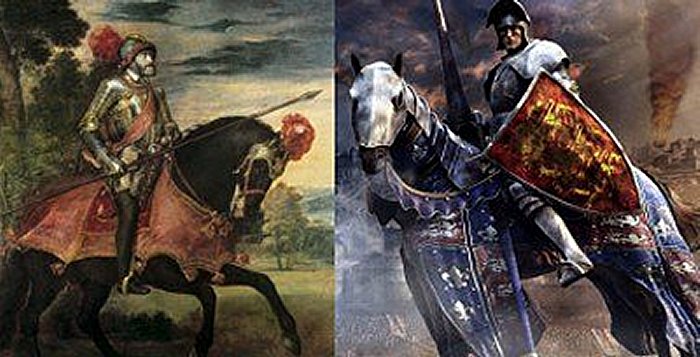
The lady of the castle presented the winner with a prize – usually a garland of flowers.
These knightly games were closely linked to the flourishing culture of chivalry and knighthood, which had found expression in the rise of courtly romantic literature.
However, to please the ladies a knight had to do much more than shine at feats of arms.
He had to behave in a noble and moderate manner, not curse or swear as soldiers usually did; he had to master chess-playing and poetry, which was not difficult because many knights were often accomplished, poets.
Bravery was not enough in order to be a good knight. It was the knight’s duty to protect the weak and defenseless, women, widows, the poor, and orphans. He had to be neither brutal nor cowardly, and in battle, he must only fight man to man, never two against one.
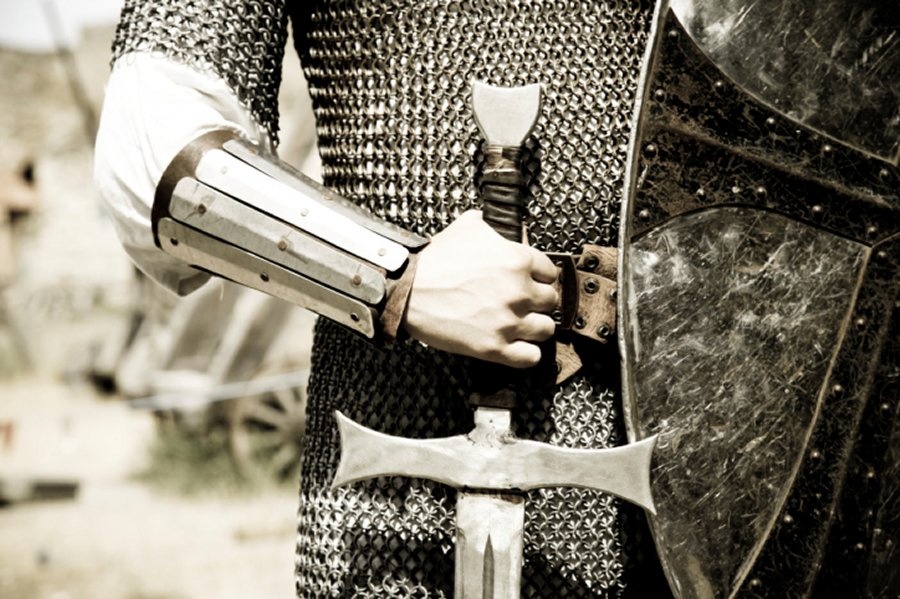
However, unlike medieval knights, who usually acted on their own, the nobles had a tendency to form knightly orders and brotherhoods supported by the ruling government.
Unfortunately, the well-intended and beautiful "chivalric code", rarely affected most knights, who plundered, slaughtered, and looted often when given the chance. Our modern notion of knights is very much based in the ideas of chivalry, and we have to blame medieval romantic literature for presenting knights as the chivalrous ideal.
The medieval tradition of chivalry did not survive because of the political situation in Europe following the Renaissance. People’s self-interest and materialism eliminated the knightly code of honor and the spiritual capability of chivalry of old times has been replaced by conventional social etiquette, which includes the act of showing regard for others, good manners and politeness.
Today, we do not have knights with formidable weapons and chivalric tournaments, where they present their strength, skills, and courage. But we have courageous firefighters, brave policemen, and many other men who take part in chivalry and usually do not even expect appreciation for what they’ve done.
Written by – A. Sutherland AncientPages.com Staff Writer
Copyright © AncientPages.com All rights reserved. This material may not be published, broadcast, rewritten or redistributed in whole or part without the express written permission of AncientPages.com
Expand for referencesReferences:
Stevenson, Chivalry and Knighthood in Scotland, 1424-1513
Meron, Bloody Constraint: War and Chivalry in Shakespeare
Mills, History Of Chivalry, Volym 2
More From Ancient Pages
-
 On This Day In History: Great English Dramatist And Poet William Shakespeare, Was Probably Born – On Apr 23, 1564
-
 Tracing Footsteps Of Giants In Africa – Obscure Past Of Mzoura Stones
-
 Puzzling Extinct Giants Depicted On 12,000-Year-Old Rock Paintings In The Colombian Amazon Rainforest Baffle Scientists
-
 Roman-era mass grave with 60 bodies found in farmer’s field
-
 Wars Of The Roses: Thirty Two Years Of Struggle To Claim English Throne
-
 Tiger Cave: Rock-Cut Hindu Temple Complex Dated To East India’s Pallava Empire
-
 London Was Always A Multicultural City, DNA Research Confirms
-
 Draugr – Vikings Feared This Ugly Living Dead With Prophetic Visions
-
 Masroor Temples – India’s Marvelous Ancient Cave Temples
-
 Rock-Hewn Ancient Churches Of Lalibela
-
 Mysterious Ancient Stone Structure Discovered In Torreano, Italy
-
 Incredible Discovery Of A Poem By Virgil On A Roman Oil Amphora
-
 Enigma Of The Chime Hours And People Who Can See Beyond The Visible Realm
-
 Neolithic Farmers Invented Methods To Fight Pests 8,000 Years Ago
-
 Ancient Jericho – City Of Giants And Home Of The Mighty Gibborim
-
 Remains Of 1,600-Year-Old Roman City Of Neapolis Devastated By A Tsunami Discovered
-
 Secrets Of The Ancient Temple Of Dimitra At The Acropolis Of Falasarna Revealed By Archaeologists
-
 Achaemenid Empire Was The World’s Largest Ancient Empire
-
 Fascinating Altamura Man – One Of The Most Complete Neanderthal Skeletons Ever Discovered
-
 Ancient Wooden Slips Inform About China’s First Emperor’s Search For Mysterious Elixir Of Immortality

