
Native American Sun Dance: Important Ceremony Of The Plains Indians Of North America
Ellen Lloyd - AncientPages.com - The Native American Sun Dance is an important religious ceremony of the Plains Indians of North America. The tribes of the Great Plains saw the Sun as a manifestation of the Great Spirit.
The Sun Dance is performed not only in honor of the Sun but also to bring the dancers visions. It is a spiritual ritual intended to strengthen ties between people, animals, and nature.
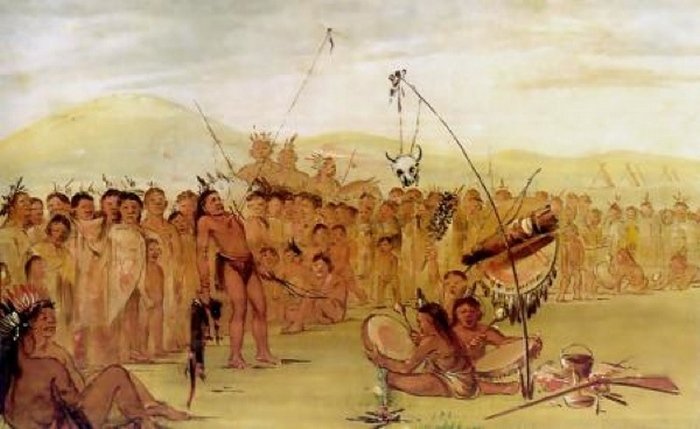
The Sun Dance painted by George Catlin
The Sun Dance can last for several days and nights. It is often an agonizing ordeal for those who participate. The authorities in the United States found the ritual barbaric and prohibited the Sun Dance between 1905 and 1978.
In the 1930s, the Sun Dance was relearned and practiced once again. When and where the Sun Dance originally began is not entirely clear. According to some historians, the tribes Cheyenne, Blackfoot, and the Sioux were the first who performed the dance. Later the tradition spread among the Indians, and today it is practiced by numerous tribes.
Traditionally, a Sun Dance was held by each tribe once a year in late spring or early summer, when the buffalo congregated after the long Plains winters.
The Sun Dance is performed in a sacred circle around a high pole.
According to the Oklahoma Historical Society, young men dance around a pole to which they are fastened by "rawhide thongs pegged through the skin of their chests." Although not all Sun Dance ceremonies include dancers being ritually pierced, the object of the sun dance is to offer personal sacrifice as a prayer for the benefit of one's family and community.
At most ceremonies, family members and friends stay in the surrounding camp and pray and support the dancers, and the Medicine Man prays on behalf of the tribe, the world, and all creation. The dancers fast for many days, and the ceremony takes place over a period lasting several days and nights. More than 100 tribe members dance to a drum beat, which represents the heart of the universe.
The ceremony is brutal and causes many dancers to collapse, what Indians call taking a fall. During the dance, the participants move sideways around the pile while they lean back so that the breast skin is stretched out and eventually burst, after hours or days full of pain. This is followed by a vision, similar to what happens on a vision quest, only here many people are given guidance for the good of the tribe. In a sense, this is a community vision quest to renew the people and the bioregion.
The Arapaho, Cheyenne, Blackfoot, and Sioux nations all practice sacrificial acts of piercing the flesh, often described pejoratively as "torture" by outsiders. Others, such as the Ute, Shoshone, and Crow nations, perform sacrificial acts of embodying their spiritual intentions through fasting and intense dancing, but not through the piercing.
Some Indigenous interpreters have suggested an analogy between the piercing of sun dancers and the piercing of Jesus on the cross, seeing both as acts of voluntary sacrifice on behalf of other beings and the cosmic welfare.
Self-inflicted torture has also come to symbolize rebirth. The torture represents death. The Sun Dancer is reborn, mentally and spiritually, and physically, along with the renewal of the buffalo and the entire universe. Then, the person is symbolically resurrected.
Written by Ellen Lloyd - AncientPages.com
Updated on July 28, 2021
Copyright © AncientPages.com All rights reserved. This material may not be published, broadcast, rewritten or redistributed in whole or part without the express written permission of AncientPages.com
More From Ancient Pages
-
 Sacred Artifact With Mystical Powers – The Legend – Part 1
-
 2000 Ancient Gold Spirals Used By Sun-Worshiping Priest-Kings During The Bronze Age Discovered In Denmark
-
 Mysterious Nine Worlds Of Yggdrasil – The Sacred Tree Of Life In Norse Mythology
-
 Mystery Of The Ancient Talayot Sword
-
 Unknown 500,000-Year-Old Migration Route Of Homo Erectus From Africa – Discovered
-
 Why Are There No Unicorn Fossils In A Museum?
-
 Etruscan Beautiful Bronze Lamp of Cortona – Studied
-
 7,000-Year-Old Unique Artifacts Discovered Under Melting Ice In Canada
-
 Archaeological Discovery Of “Once-In-A-Lifetime” Medieval Gold Necklace In Britain
-
 Daily Life Of Priests And Priestesses In Ancient Egypt
-
 First Animals On Earth Could Have Evolved Much Earlier Than The Oldest Fossils Suggest
-
 World’s Oldest Dala Horse Discovered In Sweden
-
 Ancient DNA Provides Comprehensive Genomic History Of The “Cradle Of Civilization”
-
 Rare Stone Showing Ancient Rome’s City Limits – Accidentally Found
-
 Unique Medieval Cog Shipwrecks And Artifacts Found In Sweden
-
 Flexible Glass – Lost Ancient Roman Invention Because Glassmaker Was Beheaded By Emperor Tiberius
-
 Colossus Of Standing Falcon-Headed God Horus Unearthed In Egypt’s Luxor
-
 Saraswati – Hindu Goddess Of Knowledge, Learning And Vedic Symbol Of Speech, Vach
-
 Mystery Of The Neanderthals – Search For Traces Of Neanderthals’ Lives And Hints Of Their Demise
-
 DNA Reveals Secrets Of The Phoenician-Punic Civilization’s Success – Ancient Mediterranean Societies Were Cosmopolitan

