
World’s Largest Complex Of Borobudur – Spectacular Buddhist Masterpiece
A. Sutherland - AncientPages.com - The magnificent Borobudur is the world's largest Buddhist shrine, and one of the finest examples of eighth-century temple architecture. The Borobudur Temple, situated in central Java.
It was constructed in the 8th and 9th centuries AD during the reign of the Syailendra Dynasty, a prominent Indonesian dynasty that flourished in Java after the fall of the Funan kingdom of mainland Southeast Asia.

Aerial view of Borobudur, it took the form of a step pyramid and mandala plan. source
This architectural marvel was constructed when Buddhism and Hinduism were still the dominant religion in the region. Later, the temple was several times buried due to powerful volcanic eruptions. It remained abandoned for several hundred years before its rediscovery by the British in the 19th century.
The whole temple is in the form of a lotus, the sacred flower of Buddha. It was built in three tiers: a pyramidal base with five concentric square terraces, the trunk of a cone with three circular platforms, and at the top, a monumental stupa. The walls and balustrades are decorated with fine low reliefs, and around the circular platforms, seventy-two openwork stupas with Buddhas were constructed.
For each direction, there are 1,460 relief scenes and ninety-two Dhyani Buddha statues. (Dhyani’ is derived from the Sanskrit dhyana, meaning “meditation.” )
The monument is located in the Kedu Valley, in the southern part of Central Java, at the center of Java, Indonesia.
The structure, composed of 55,000 square meters of lava-rock is erected on a hilltop and it has a shape of a stepped pyramid of six rectangular stories, three circular terraces, and a central stupa is located at the summit.

Borobudur Temple Compounds (Indonesia) © UNESCO
Borobudur covers a huge area, measuring 123 x 123 meters. The perfection of this stone monument is clearly seen in its design and its decoration in the form of 2,672 carved relief panels and 504 Buddha statues.
Despite its gigantic size, historical records of its decades-long construction are sparse. The structure, built without using any kind of cement or mortar, and yet, all its parts – hold together, perfectly.

Aerial view of Borobudur. Credit: Adobe Stock - Adel
The vertical division of Borobudur Temple into base, body, and superstructure is in perfect agreement with the concept of the Universe in Buddhist cosmology - Bhumisambara, Borobudur’s original name.
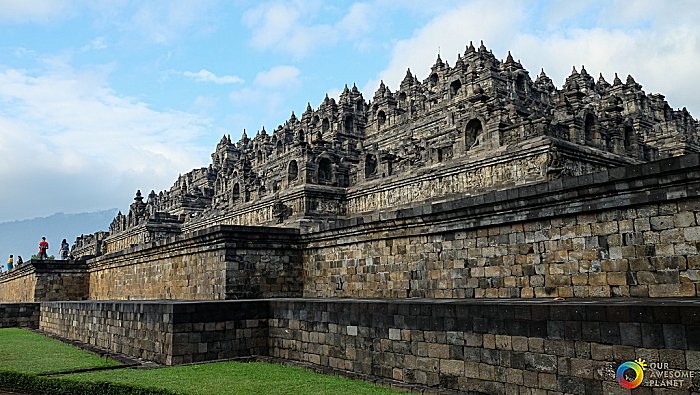
Borobudur. Image credit: Anton Diaz. source
The shrine was built as a stepped pyramid. At the base of the massive temple, there are reliefs of Karmawibhangga' - depiction of human life in the endless cycle of death and rebirth (samsara) and the law of cause and effect, according to the karmic law.
See also:
8 Remarkable Jain Temples – Marvelous Ancient Architecture And Stone Carvings
These reliefs were carved on all sides over andesite stones. Above the base of the shrine, there are multiple layers of structures that symbolize the world of desires (Kamadhatu) at the low levels; the world of forms (Rupadhatu) is at the mid-levels, and the so-called formless world (Arupadhatu) is at the upper levels.
To attain enlightenment - means to walk this long path.
Written by – A. Sutherland - AncientPages.com Senior Staff Writer
Copyright © AncientPages.com All rights reserved. This material may not be published, broadcast, rewritten or redistributed in whole or part without the express written permission of AncientPages.com
Expand for referencesMore From Ancient Pages
-
 Innocent-Looking Japanese War Fan – Surprise Weapon Used By The Samurai And Female Ninja
-
 Day Of The Dead: From Aztec Goddess Worship To Modern Mexican Celebration
-
 DNA Reveals The History Of Modern And Archaic Humans Is Much Longer And More Complicated Than Previously Thought
-
 Eastern Necropolis Of Ancient Thracian And Roman City Of Serdica – Unearthed
-
 Pharaoh Ramses II’s Sarcophagus On Display For The First Time In 50 Years
-
 Wreckage From Famous Warships Explored In 3D On Anniversary Of Sinking
-
 Magnificent Ancient Rock-Cut Lycian Tombs Of Myra, Antalya, Turkey
-
 Mysterious Bronze Age Face Carved In Rock And Rare Artifacts Found In Kazakhstan
-
 Goddess Huitaca – Moon Goddess Of Intoxication, Joyful Life And Unlimited Pleasures In Muisca Mythology
-
 Cosmic Rays Reveal Mysterious Void Inside Great Pyramid – What’s Hiding Inside?
-
 Durendal – Magical Sword Of Knight Roland That Cut Stone Boulders With A Single Strike
-
 What Is The Roman Silver Fragment Found In Norfolk? Experts Are Baffled
-
 Ravana: Ten-Headed And Multi-Armed Demon King Of Lanka And Chief Antagonist In Epic Ramayana
-
 Amazing Archaeological Discovery In Washington Confirms Thousand-Year-Old Legend
-
 Unique Bones Decorated With Black Markings Discovered In 4,500-Year-Old Tomb In Ukraine
-
 Earliest Evidence Of Flip Flops In The Middle Stone Age
-
 Stunning Images Of Shackleton’s Lost Ship Endurance Discovered Off The Coast Of Antarctica
-
 Study Reveals Average Age That Women And Men Had Children Over Past 250,000 Years
-
 Ancient DNA Unravels The Mystery Of Huge 6,500-Year-Old Cemetery And The Tomb Of A ‘Masculine Woman’ In Normandy, France
-
 Third-Century Sculpture Of Roman Emperor Aurelian Unearthed In Bulgaria

