
Who Was Pseudo-Nero?
Conny Waters - AncientPages.com - Nero (37-68 A.D) was one of ancient Rome’s famous, or rather infamous emperors. Nero was a tyrant, and he is today best known for his debaucheries, killing his mother, committing several political murders, and persecuting Christians. He also had a passion for music that probably led to an apocryphal rumor that he “fiddled” while Rome burned during the great fire of 64 A.D.
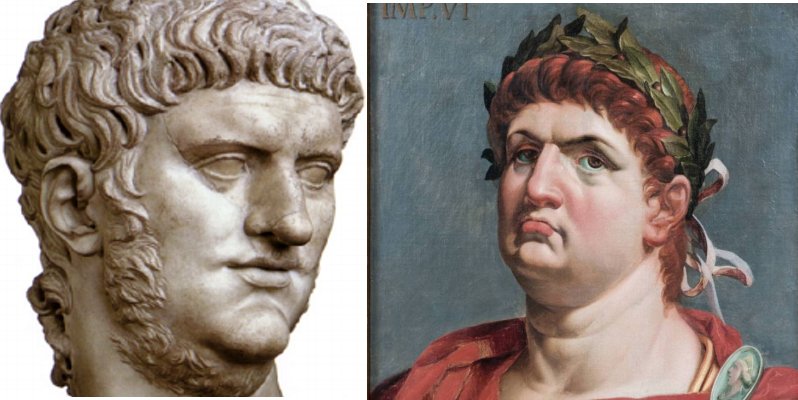
Credit: Public Domain
In June 68 A.D, Emperor Nero committed suicide near the villa of his freedman Phaon, and it did not take long before various Nero impostors appeared between the autumn of 69 AD and the reign of the emperor Domitian, the third and last emperor of the Flavian dynasty.
The first pseudo-Nero appeared in the Roman province of Achaia, which is today in modern Greece. It is unknown why he chose this specific place. Still, it could be because Nero had recently visited Greece (66-67 AD) to participate in its Panhellenic Games.
After the emperor Nero committed suicide near the villa of his freedman Phaon in June of 68 AD, various Nero impostors appeared between the autumn of 69 AD and the reign of the emperor Domitian.
According to historians, there were three pseudo-Neros. These historical imposters were most likely inspired by circulating prophecies that predicted Nero would regain his kingdom in the East.
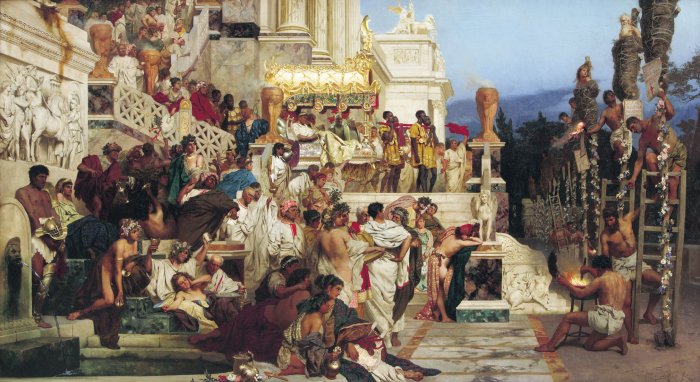
The Torches of Nero, by Henryk Siemiradzki. According to Tacitus, Nero targeted Christians as those responsible for the fire.
The first Pseudo-Nero appeared in the autumn of 68 AD, or the early winter of 69 AD, in the Roman province of Achaia, modern Greece. Nero had recently visited Greece (66-67 AD) to participate in its Panhellenic Games, which may account for some of the impostor's support.
According to the historian Tacitus, the fake Nero, who was either a slave from Pontus or a freedman from Italy, made appeals to bring Roman soldiers en route to Italy over to his growing armed force.
Tacitus does not reveal much about the impostor's early career, except that the Pseudo-Nero gathered around him a group of army deserters and then set out to sea, where he began a career in piracy while maintaining his claim to be the emperor. He was eventually apprehended and beheaded.
The second pseudo-Nero was a Roman man named Terentius Maximus.
He gained his first followers in Asia and many more during his march to the Euphrates. When things did not turn out as he hoped, he fled to Parthia and tried to gain their support.
In time, his true identity was revealed, and he was executed.
Twenty years after Emperor Nero’s death, the third pseudo-Nero appeared during the reign of Domitian. Parthians supported him, but he, too, had to give up the idea of pretending to be the genuine Emperor Nero.
Updated on November 15, 2023
Written by - Conny Waters AncientPages.com Staff
Expand for referencesGallivan, P.A. "The False Neros: A Re-Examination," Historia 22 (1973)
More From Ancient Pages
-
 ‘Joyeuse’ – Legendary Sword With Relics Of Saints Was A Private Treasure Of Emperor Charlemagne
-
 DNA Study Of Remains At Delaware Site Find Kinship Among European Settlers, African Slaves
-
 Artifacts From Shakhi Kora Reveal The Rejection Of Early Centralized Governance In Ancient Mesopotamia
-
 Mysterious White Mass On The Heads Of The Tarim Basin Mummies Identified
-
 Asclepius Sanctuary On Acropolis Slope Will Be Restored
-
 2,000 Years Ago Mysterious Foreigner With Unique Ancestry Traveled To Cambridgeshire – Who Was He?
-
 The Aztec Sun Stone And Medusa Reveal An Intriguing Connection – Surprising Discovery – Part 1
-
 The Iron Man In The Kottenforst And Other Puzzling Ancient Artifacts Of Unknown Origin And Purpose
-
 Seppuku: Ancient Suicide Ritual That Guaranteed Honorable Death Instead For Life In Shame
-
 Collection Of 2,500 Years Old Sealed Coffins Unearthed In Saqqara, Egypt
-
 Late-Surviving Dinosaurs In New Mexico Lived In Vibrant, Regionally Distinct Communities Until The Very End
-
 Are The Mysterious ‘Ubeidiya Limestone Spheroids Of Early Hominins Evidence Of Intentional Symmetric Geometry?
-
 The Red Dragon Of Wales – Ancient Symbol Dating Back To Roman Times
-
 Giant Bath Tub Built For Tsar Alexander I – Why Was It So Large?
-
 The Faery Grail Of Hospitality And Accord – Secrets Of The Elucidation – Part 2
-
 Apkallu – Seven Antediluvian Sages Created By God Enki – Were They The Watchers?
-
 On This Day In History: The Battle Of The Nile Concludes In A British Victory – On August 2, 1798
-
 400-Year-Old Shipwreck Found Off The Coast Of Portugal Labeled ‘Discovery Of A Decade’
-
 Sam Bass – Texas’s Beloved Bandit Who Was Admired By The Poor
-
 Humans Started Wearing Clothes 100,000 To 500,000 Years Ago

