
Great Pyramid of Cholula Is The Largest In The World Today
A. Sutherland - AncientPages.com - Located in Cholula, Puebla, Mexico, the pyramid stands 55 meters (180 ft) above the surrounding plain, and in its final form, it measured 400 by 400 meters (1,300 by 1,300 ft).
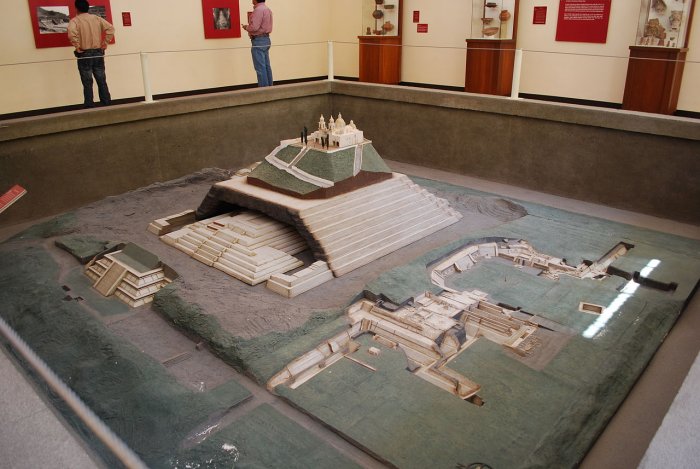
Reconstruction of the Cholula pyramid. Image credit: - CC BY-SA 4.0
According to the myth, the pyramid was built by a giant named Xelhua of adobe bricks after he escaped a flood in the neighboring Valley of Mexico.
Legend has it, Xelhua one of the seven giants of Aztec mythology who climbed the mountain of the rain god Tlaloc. Later, they built the Great Pyramid at Cholula. The Dominican monk wrote the following report:
"Before the great watershed occurred 4,800 years after the foundation of the world, the country of Anahuac was inhabited by giants, all of whom either died in the great watershed or were turned into fish, except for seven who fled to caves.
"When the waters receded, one of the Giants named Xelhua, nicknamed "The Architect," went to Cholula, where as a monument in honor of Tlaloc, who served as a shelter for him and his six brothers, he built an artificial hill in the form of a pyramid.
"He ordered the bricks to be made in the province of Tlalmanalco, at the foot of the Sierra Cecotl, and in order to deliver them to Cholula, he set up a government of men one by one who passed them from hand to hand. The gods noticed with anger the building, whose top was supposed to reach the clouds. Angered by Xelhuy's bold attempt, they threw fire at the pyramid.
"Many workers died. The work was abandoned and the monument was later dedicated to Quetzalcoatl..."
The Great Pyramid of Cholula (or in nahuatl Tlachihualtepetl), is a temple building in Cholula, in the state of Puebla in Mexico. Its name in nahuatl means "handmade mountain". It was dedicated to the god Quetzalcoatl. In time, Cholula became a mecca for pilgrims from all over Mexico, who flocked to the city to pay homage to the feathered serpent god.
Approximately one hundred years before Christ, the pyramid's construction began. Cholula, by this time, was already one of Mexico's largest cities, having been settled circa 1700 B.C. Various groups carried out the pyramid's structure, and affiliated temples over hundreds of years carried out the pyramid's construction.
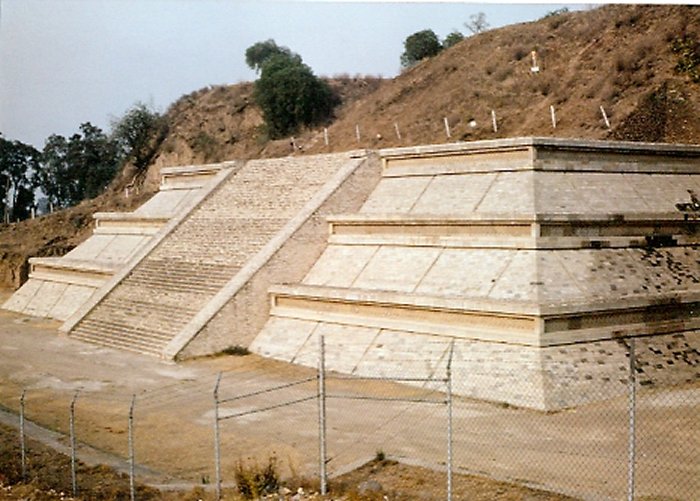
Great Pyramid of Cholula, Puebla, Mexico. Image credit: Ernest Mettendorf - Public Domain
Upon the arrival of Cortés, Cholula was Mexico's second-largest city, with a population of up to 100,000 by some estimates. There is some disagreement about what happened next, but it appears that Cortés discovered the alliance between Cholula and Tenochtitlán; perhaps he became aware of a plot against the Spaniards, and he decided to make a pre-emptive attack. The temple was destroyed, and a church was built on the pyramid of Cholula, which the Spaniards believed was only a large hill.
The history of the pyramid is relatively unknown, From the 1930s until today, massive efforts have been made to excavate the pyramid. The pyramid consists of six superimposed structures, one for each ethnic group that dominated it.
The Great Pyramid of Cholula has a base four times the size of Pharaoh Khufu's Great Pyramid of Giza and is the most extensive pyramid base in the Americas.It is the largest pyramid found by archaeologists to date, with a base area four times larger than the Pyramid of Cheops in Egypt. The height of the pyramid is 66 m, and the width is 450 m. It is a very impressive structure.
The history of the pyramid is relatively unknown, but construction began around 300 f.Kr. It is dedicated to the Aztec Quetzalcoatl, and the area has been sacred from the beginning. Scientific explorations of the pyramid began in the 1930s.
Written by – A. Sutherland - AncientPages.com Senior Staff Writer
Updated on October 25, 2022
Copyright © AncientPages.com All rights reserved. This material may not be published, broadcast, rewritten or redistributed in whole or part without the express written permission of AncientPages.com
Expand for referencesMore From Ancient Pages
-
 On This Day In History: Battle Of Dettingen – English Armies Were Victorious Over The French – On June 27, 1743
-
 Rare Discovery Of 8,500-Year-Old Human Teeth Used As Jewelry
-
 On This Day In History: Greek Archaeologist Manolis Andronikos Who Discovered Tomb of Philip II of Macedon, Was Born – On Oct 23, 1919
-
 1,800-Year-Old Legio VI Ferrata Military Camp Uncovered In Israel
-
 Very Rare Ancient Roman Horse Brooch Discovered In UK
-
 Why The Discovery Of Cleopatra’s Tomb Would Rewrite History
-
 What Was Legio Martia And Why Were The Roman Soldiers Called The Martians?
-
 Mysterious Denny – 90,000-Year-Old Child Whose Parents Were Two Different Human Species
-
 Recently Found ‘Neanderthal Footprints’ In the South Of Spain Could Be 275,000 Years Old
-
 On This Day In History: Practical Underwater Diving Suit Patented By Maine Inventor – On June 14, 1834
-
 Lost Kingdom Of Idu And Its Seven Unknown Kings
-
 Mysterious Ancient Dark Object Hidden In The Colorado Mountains – What Happened To It?
-
 Pakhet ‘Night Huntress’: Egyptian War-Like Lioness Goddess Associated With Artemis
-
 Mysterious El Caracol At Chichen Itza: What Did Maya Astronomer-Priests Observe In The Sky?
-
 Biblical Prophet Jeremiah Whose Prophecies Disappointed People
-
 Traces Of Early Humans Discovered In Southern Iran
-
 Magnificent Ancient Treasures Of The Mysterious Kangju Kingdom Found By Archaeologists
-
 Satellite Images Of 66 New Roman Army Sites Show More Clues About One Of The Empire’s Most Infamous Conflicts
-
 3,000-Year-Old Geoglyphs May Depict The Heavens
-
 Ancient DNA Reveals How Yamnaya People Re-Wrote Northern Europeans’ Genetic Story 5,000 Years Ago

