
Magnificent Skellig Michael And A 1,400-Year Old Christian Monastery
A. Sutherland - AncientPages.om - The magnificent Skellig Islands lie 8 miles (12 km) off the coast of Portmagee in South West Kerry. Rising majestically from the sea, Skellig Michael (or Great Skellig, one of the two Skellig Islands) towers 714ft (218 meters) above sea level.

Skellig Michael Monastery
The island's name is taken from the Irish language and means Michael's Rock. On the summit of this fantastic rock is a remarkably well-preserved 1,400-year-old Christian monastery, but it is not easy to visit Skellig Michael.
It is believed that the monastery was established in the 7th century on an island uninhabited earlier. Skelligs rocks are 350 million years old, dating from the Devonian Period; the area is remote and highly inaccessible.
The monastery, within an inner and outer enclosure, is situated on the sloping rock plateau at the northeastern summit. But despite the altitude, the location was perfectly chosen because it provided shelter and water collection: moreover, stone material was abundant, which enabled the building of the monastery.
 The drystone buildings on Skellig Michael were all corbelled. In this way, the interior space reduces as it rises up to form a dome-like structure. All the stones are positioned so that they slope outwards allowing for wind-borne rain to run off and so keep the building watertight. Credits: World Heritage Ireland
The early Irish Christian monks lived their Spartan life there until the 12th or 13th century in harsh conditions. Their life was undoubtedly more than difficult; during this time, the climate around Skellig Michael became colder and more prone to furious storms.
The remarkably well-preserved monastic enclosure of Skellig Michael is located 15 m (50 ft) below the northern peak on a long narrow terrace.
The central monastic area contains six beehive-shaped structures or huts called 'clochans,' the early traditional inverted boat-shaped oratory, and the medieval St. Michael's Church.
Other raised platforms contain incised crosses, cross-slabs, and the monk's graveyard with 22 early grave slabs. The gravestones have remained in their original positions.
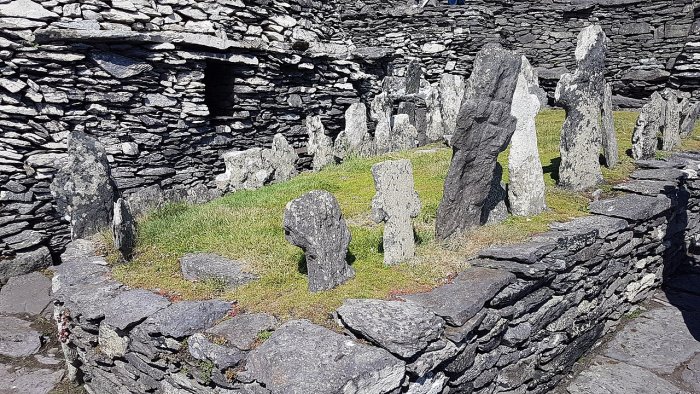
The Monks Graveyard. The monastery at Skellig Michael. Image credit: - CC BY-SA 4.0
The larger oratory, internally about 2.3 m (7.5 ft) high, has a white quartz cross, a later addition, set into the stones above the door on the outside.
The largest of the beehive huts were more sturdily built, 5 m (16.4 ft) high, with walls 1.8m (6 ft) thick at its base, with two cupboards and a double-lintelled door. Another, smaller oratory of later date stands on a northeastern shelf above the cliffs, with the boat landing far below.
The monastery was terraced due to the sheer sites of the Skelligs rocks. The lower terraces within the outer enclosure functioned as garden areas (for example, the Monks' Garden) for cultivation.
The monks constructed three sets of steps to their monastery, affording access during differing weather conditions. These are known as the East, South, and North Steps.
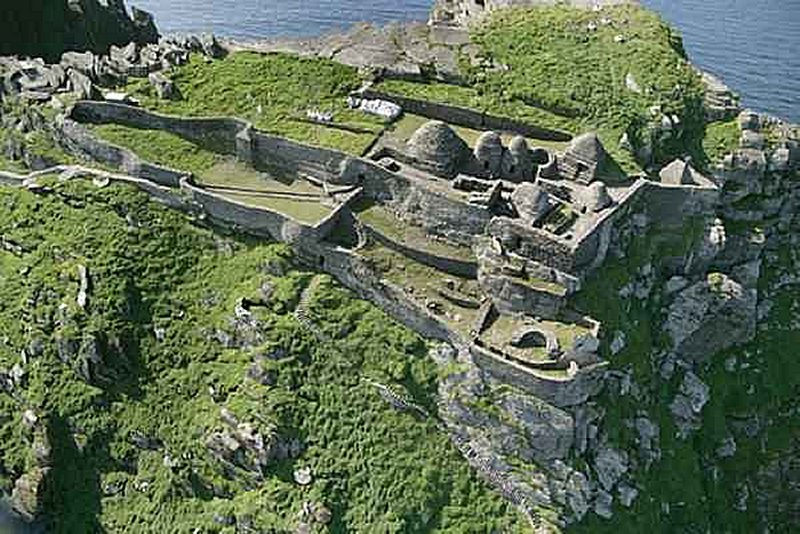
Skellig Michael (Sceilg Mhichíl) Monastery, Image credit: https://www.worldheritageireland.ie/
Only the South Steps are accessible to the public today. The South and North Steps meet at Christ's Saddle, the only reasonably flat part of the island, and continue as one as far as the monastery.
There were probably never more than a dozen monks on the island at any one time, plus an abbot. It must indeed have been a very lonesome existence for the monks, despite the faith which initiated their decision to move there.
The monks' graveyard is located to the east of the Large Oratory. The series of crosses set into the west side are in their original locations. These crosses are roughly shaped, and some have plain incised decorations.

Clocháns; dry-stone huts with a corbel roofs. Image credit: - CC BY-SA 4.0
Why the monks decided to build a monastery in such a remote and inaccessible place remains unknown. One possibility is they tried to escape Viking raids, and the monastic settlement on Great Skellig became the sanctuary of last resort.
The monastery survived several Viking raids in the 9th century, notably in 823 A.D. It was later significantly expanded with a new chapel built around 1000 A.D.
Sometime in the 12th century, the monks abandoned Skellig Michael and moved to the Augustinian Monastery at Ballinskelligs, near Waterville in County Kerry on the mainland.
Copyright © AncientPages.com All rights reserved. This material may not be published, broadcast, rewritten or redistributed in whole or part without the express written permission of AncientPages.com
Expand for referencesMore From Ancient Pages
-
 Silla: The Most Successful Of Three Korean Kingdoms
-
 Burnt Mound Complex Dated To Bronze Age – Uncovered At Suffolk Site
-
 Ancient Scents Can Be Reconstructed With Help Of Modern Science – Researchers Say
-
 Rare 2,000-Year-Old Roman Hoard Discovered In Suffolk
-
 Roman Woman Depicted On Ancient Marble Sculpture Found In Crimea Identified
-
 Mystery Of Ancient Magnetic Potbelly Statues In Mesoamerica Revealed – But Something Is Still Wrong
-
 Mysterious Handprint And Cry For Justice From Beyond The Grave
-
 Vindelev Treasure – Surprising Evidence Of Nordic Connection With The European Iron Age Elite
-
 Miraculous Cauldrons Of The Ancient Celtic World
-
 Controversial Hollow Earth Theory – Scientific Facts Presented By Researchers – Part 1
-
 More Than 300 ‘Sun Stones’ Dated To Stone Age Discovered On Danish Island Of Bornholm
-
 Din Lligwy: Prehistoric Celtic Settlement Of Anglesey, Wales
-
 Oldest Evidence Of Beer Was Found On A Sumerian Tablet In Mesopotamia
-
 Early Homo Sapiens From Southeast Asia Could Adapt To A Rainforest Environment
-
 Study Of Ancient Skulls Sheds Light On Human Interbreeding With Neandertals
-
 Jolly Roger – Symbol Of Golden Age Piracy
-
 Previously Unknown Monumental Etruscan Temple Found Near The Tempio Grande, Vulci, Latium, Italy
-
 Roman Treasure Decorated With A Triskelion Symbol Found On The Isle Of Anglesey
-
 DNA Confirms 2,000-Year-Old Sustainable Fishing Practices Of Tsleil-Waututh Nation
-
 Traces Of Advanced Beings Who Walked Earth Millions Of Years Ago: Controversial Ancient History Examined

