
The Great Stupa At Sanchi – Oldest Stone Structure In India
A. Sutherland - AncientPages.com - Sanchi is famous in the world for stupas, monolithic Ashokan pillars, temples, monasteries, and sculptural wealth.
Located at Sanchi Town in Raisen District of the state of Madhya Pradesh, India we find the country’s oldest stone structure known as the “Great Stupa of Sanchi”.
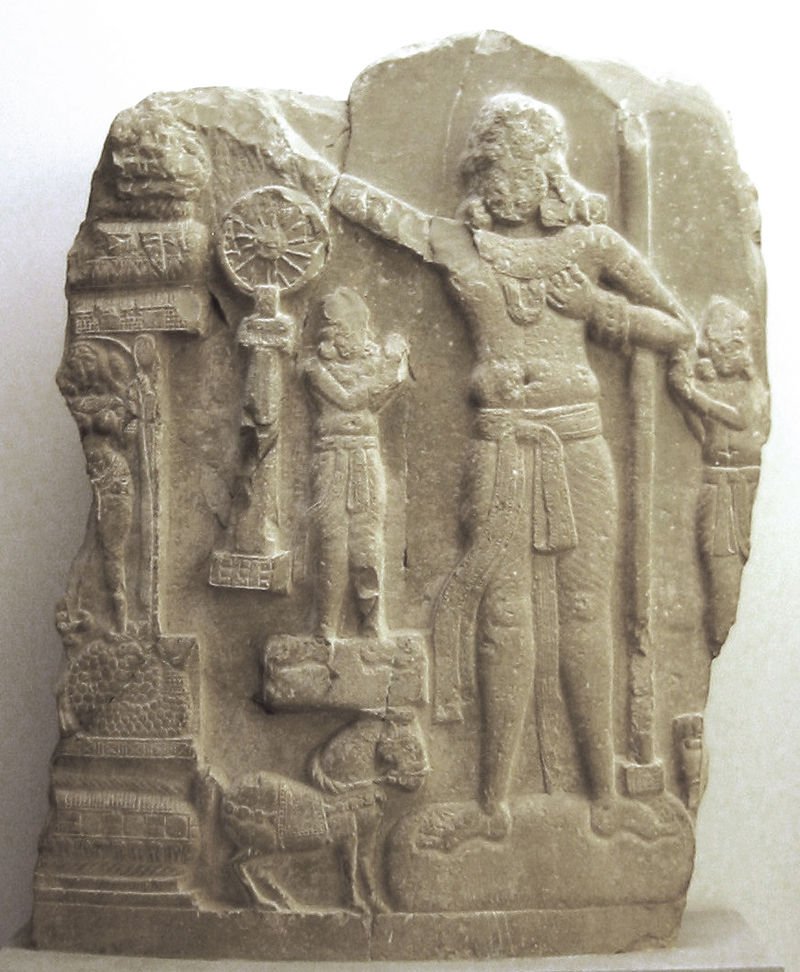
A c. 1st century BCE/CE relief from Amaravati, Andhra Pradesh (India). The figure in the center may represent Ashoka.
Great Emperor Ashoka laid the foundations of a religious center at Sanchi
Commissioned by the emperor Ashoka the Great in the 3rd century BC, the stupa was originally a low structure of brick, half the diameter of the present edifice hemispherical in shape with raised terraces at the base.
It was enclosed by a wooden railing and a stone umbrella at the top. This Great Stupa served as a nucleus to the large Buddhist establishment during the later period.
Sanchi, variously known as Kakanaya, Kakanava, Kakanadabota, and Bota-Sriparvata in ancient times, has a singular distinction of having a remarkable specimen of Buddhist art and architecture right from the early Mauryan period (c. third century BC to twelfth century AD)
During Sunga times, several edifices were raised at Sanchi and its surrounding hills. The Asokan stupa was enlarged and faced with stones and decorated with balustrades, staircases, and a harmika on the top, which in Buddhist architecture, a square fence-like enclosure symbolizing heaven on top of the dome of a stupa.

Image credit: Nagarjun
In the first century BC the Andhra-Satavahanas, who had extended their sway over the eastern Malwa, caused the elaborately carved gateways to Stupa 1. The Great Stupa of Sanchi displays an austere grandeur and the exquisite carvings of the doorway depict in detail the significant episodes and miracles from Lord Buddha’s life and events depicted in the Buddhist Jataka stories.
Depictions of Buddha as a non-human figure
The Sanchi gateways are made of stone, but they were constructed in the manner of wood and covered with narrative sculptures.

Carved decoration of the Northern gateway to the Great Stupa of Sanchi. Torana Panels: Chhaddanta, Sujata's offering, Vessantara Jataka, East Columns: Shakra's visit, Royal procession, Bimbisara's visit, West Column: Foreigners, Monkeys, Kapilvastu. Image credit: Biswarup Ganguly
They show scenes from the life of the Buddha integrated with everyday events that should be familiar to the onlookers and make it easier for them to understand the Buddhist creed as relevant to their lives.
Some of the stone carvings at Sanchi show the Buddha as a non-human figure. Instead, the artists chose to represent him by certain attributes, such as the horse on which he left his father’s home, his footprints, or a canopy under the bodhi tree at the point of his enlightenment. The human body was thought to be too confining for the Buddha.

Sanchi Stupa inside
Since the fourteenth century, Sanchi remained deserted and uncared for till 1818 when General Taylor rediscovered the site. Sir John Marshall established an archaeological museum in 1919, which was later transformed into the present site museum at Sanchi.
Presently under a UNESCO project Sanchi and Satdhara, a Buddhist site, 10 km south-east of Sanchi, is being further excavated, conserved, and environmentally developed.
Written by - A. Sutherland - AncientPages.com Senior Staff Writer
Copyright © AncientPages.com All rights reserved. This material may not be published, broadcast, rewritten or redistributed in whole or part without the express written permission of AncientPages.com
Expand for referencesReferences:
More From Ancient Pages
-
 Famous Ancient Hittite Figures And Symbols Engraved In Stone By A Local Artist From Çorum Province, Anatolia
-
 Legend Of Kauravas – Ancient Cloning And Test Tube Babies In India?
-
 Discovery Of World’s Oldest Fortresses Reshapes Our Understanding Of Hunter–Gatherers
-
 Vettuvan Koil Temple Spectacular Monolith Dedicated To Lord Shiva And Built By Pandya Dynasty
-
 Why Was Grette The Strong, Icelandic Poet And Warrior Afraid Of Darkness?
-
 12 Ancient Egyptian Symbols Explained
-
 Was Biblical Adam A Giant Who Emerged From An Underground World?
-
 Puzzling Palpa Lines In Peru Made By The Paracas Culture Are Even Older Than The Nazca Lines
-
 Unique Native American Artifacts Found At The River Bend Site, Wyoming
-
 Why Were Uncomfortable Poulaines High Fashion During The Middle Ages?
-
 Ancient European Buildings Form A Sacred Symbol When Viewed From The Air – Scientist Reveals
-
 Daily Life Of Télpochcalli Students Of The Aztec Empire Was A Challenge
-
 Meet The First Neanderthal Family And Community
-
 First Ancient ‘Cube-Shaped’ Skull Discovered In Tamaulipas, Mexico
-
 Ancient World’s Second Largest Library Of Codices, Manuscripts Reopened In Sinai
-
 Being Left-Handed Was A Sign Of Evil Until Only Recently
-
 Secrets Of The Lost Tomb X – Enigmatic Boxes And Unusual Samples – Part 2
-
 Mythical Egyptian Bennu Bird And Deity
-
 World’s Oldest ‘Picture Story’ Found Deep Inside Indonesian Cave
-
 Why Did Stone Age People Cut Off Their Fingers?

