
Jizo – Protector Of Children, Travelers And Women In Japanese Mythology
Ellen Lloyd - AncientPages.com - As a protector of children, women, and travelers, Jizo (Jizō ) plays an important role in Japanese mythology.
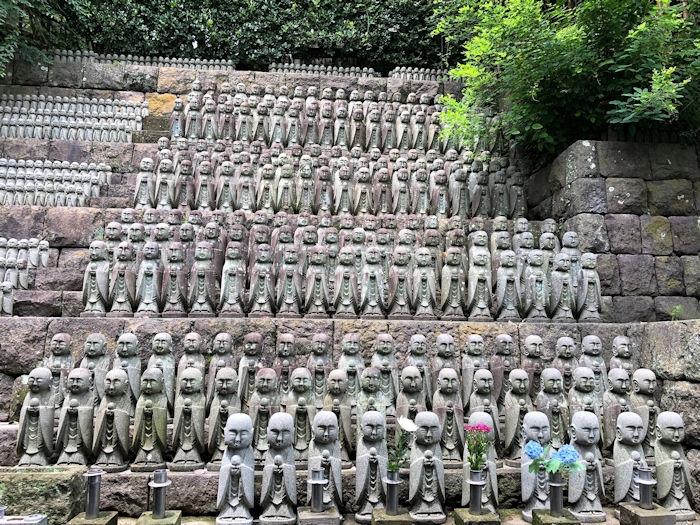
Rows of stoneJizo statues in the Hasedera temple garden in Kamakura. Credit: Adobe Stock - QBE852
When you visit one of the 190,000 temples and shrines or a cemetery in Japan, you can easily find a Jizo statue because they appear in large numbers. Jizo statues are often very cute, and they take on countless forms. They can be male, female, adult, and child. Most often, Jizo appears as a small monk-like figure.
Jizo - One Of The Most Popular Buddhist Divinities
Jizo is the Japanese version of Bodhisattva Ksitigarbha, a Buddhist god worshiped mainly in East Asia. Jizo is, without doubt, one of the most popular and lovable of the Buddhist divinities. He has all the wisdom of the Lord Buddha himself, with this important difference: Jizo has waived aside Nirvana and does not sit upon the Golden Lotus but has become, through exquisitely beautiful self-sacrifice, the divine playmate and protector of Japanese children.
Jizo – Protector Of Children, Travelers, Women And The Weak
Jizo has many functions and duties, but the most important of them all is that he acts as a protector of children and unborn children who died before their parents. According to Japanese Buddhist stories, children who face judgment in the afterlife are doomed to stack rocks on the riverbed of souls in purgatory because they didn't have a chance to build up good karma on earth. Jizo helps these children to cross the river in the sleeves of his robe.
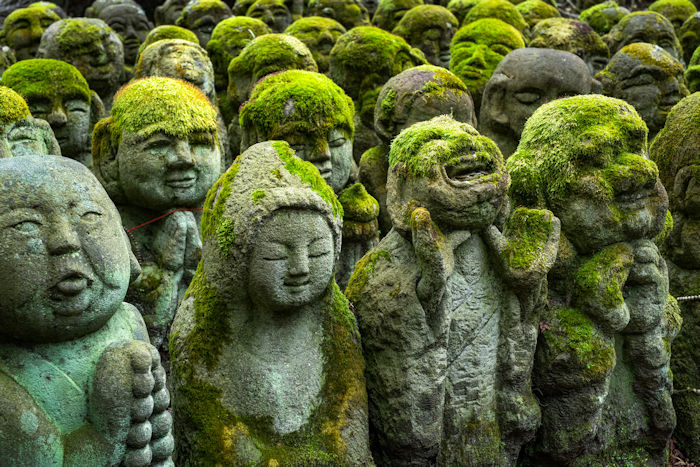
Stone statues at the Otagi Nenbutsu ji temple in Kyoto, Japan. Credit: Adobe Stock - eyetronic
He is the God of smiles and long sleeves, the enemy of evil spirits, and the one being who can heal the wound of a mother who has lost her child in death. Jizo is also the guardian of travelers, women, and the weak.
The Visit Of Jizo Is Much Dreaded
An intriguing custom occurs in Izumo, a Shimane Prefecture, Japan city.
When a wedding occurs in the house of an unpopular man in the country, the village's young men carry a roadside statue of Jizo into the Zashiki and announce the coming of God.
Kyoto, Japan. Credit: Adobe Stock - frdric
God demands food and wine. The family members must come in, salute the deity, and give all the saké and food demanded while any remains in the house. Refusing is dangerous; the young peasants would probably wreck the house. After this, the statue is carried back again to its place. The visit of Jizō is much dreaded. It is never made for persons who are liked.
Jizo Statues Can Be Found All Over Japan
Due to his popularity, we can find depictions of Jizo in many places in Japan. Jizo is the first deity most people encounter when they set foot in Japan. This is because he is the protector of travelers.
You can find Jizo peeking out among the grasses along the road, standing at intersections, overseeing borders, or sitting in a wooden shelter built especially for him. Jizo is at temples too, where sometimes he holds a baby in his arms. He is found at boundaries between physical and spiritual places, between here and there, life and death.
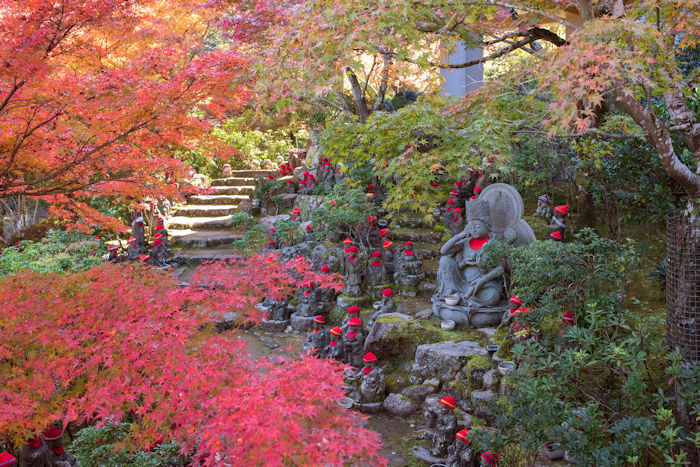
Daisho-in Temple in Miyajima, Hiroshima, Japan. Credit: Adobe Stock - wooooooojpn
Jizo statues are very often carved out of a rock. According to Hank Glassman, associate professor of East Asian Studies at Haverford College in Pennsylvania and author of “The Face of Jizo: Image and Cult in Medieval Japanese Buddhism” the material of the Jizo statue is important. The power of stones to engage the human heart.” Stone is a material that has been worshipped and used for protection since ancient times. Stones having spiritual value predates Buddhism.

Red Maple leaf on the head of Jizo sculpture doll (little Japanese Buddhist monk doll rock) in Japanese Garden.
Credit: Adobe Stock - structuresx
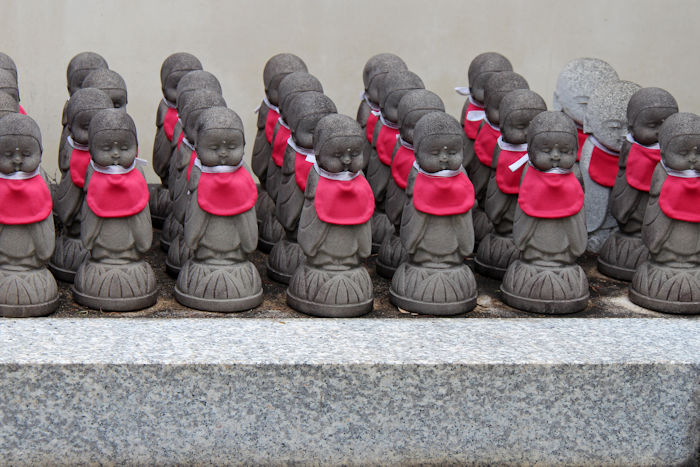
Jizo statues are often dressed in a small red bib around their necks. This practice of dressing Jizo includes hats, robes, or anything one wishes to adorn his figure. Such red bibs were said to have been worn by children earlier. Although the bibs are usually red, representing safety and protection, they can be any color, fabric, or pattern.
Jizo represents a monk; when people dress a monk statue, they accrue merit. Dressing Jizo gives people a chance to interact with him.
Updated on August 2, 2023
Written by Ellen Lloyd – AncientPages.com
Copyright © AncientPages.com All rights reserved. This material may not be published, broadcast, rewritten or redistributed in whole or part without the express written permission of AncientPages.com
More From Ancient Pages
-
 Secrets Of The Serpent Kingdom Revealed On Maya ‘Game Of Thrones’ Altar
-
 Knowledge Of Ancient Medicine Hidden In Undeciphered Egyptian Manuscripts
-
 4000-Year-Old Large Bronze Age Cemetery Discovered In Lower Silesia, Poland
-
 Unusual 4,000-Year-Old Site And Other Curiosities Discovered In Overstone, Northamptonshire, UK
-
 More Than 2,000 Seal Impressions Found In The Ancient City Of Doliche
-
 Huangluo: Long-Hair Village Where Women Don’t Cut Their Hair – A 2,000-Year-Old Tradition Of The Yao People
-
 Unusual Parcel With 500-Year-Old Horn Container Discovered In South Africa Sheds Light On Pre-Colonial Khoisan Medicines
-
 Mystery Of The Watchers And Book Of Enoch – Fallen Angels And Their Secret Knowledge
-
 Glass Technology Was Known In Sahara Centuries Before The Arrival Of Europeans
-
 2,000-Year-Old Rock Art Sites Discovered In Jalapão, Brazil
-
 Dunstanburgh Castle: Underground Passageways And The Legend Of Sir Guy The Seeker
-
 Did Lead Pollution Cause IQ Declines Among Ancient Romans?
-
 Long-Lost Mesopotamian Queen Hama Discovered By Student Just By Reading Books
-
 Oral Stories Of Australia’s First Nations Might Be 10,000 Years Old – Evidence Found
-
 Precious Ancient Chinese Immortality Suits Made Of Jade
-
 Dearg-Due Frightening Female Demon And Tyrannical Abhartach Of Irish Folklore
-
 Why Did Modern Humans Replace The Neanderthals? The Key Might Lie In Our Social Structures
-
 What Were Victorian Bathing Machines?
-
 Citrus Was An Ancient Roman Symbol Of Status And Luxury
-
 Excavations At Urartu Fortress Will Shed Light On Mysteries Of Ancient Temple

