
Tartarus – The Land Of The Dead – Mysterious Underground World
A. Sutherland - AncientPages.com - Humanity has always been fascinated by the mysterious and unexplored. Mythology, folklore, and sacred texts worldwide are full of stories of mysterious underground and hidden regions where one could physically pass from this world and into another.

Tartaros - TARTAROS (Tartarus) was the primordial god (protogenos) of the stormy pit of Tartaros that lies beneath the foundations of the earth. He was the body of the pit itself rather than an athropomorphic deity. Tartaros was envisaged as the opposite of the sky, an inverted-dome lying beneath the flat earth
Image credit: Anna Zinonos - CC BY 4.0
Tartarus, the land of the dead, is said to be a sunless, gloomy pit beyond a three-fold layer of night.
Tartarus also contained a variety of regions or kingdoms, the twilight "fairyland," the Elysian Fields, and many caves, caverns, and pits of torment, which were reserved for the damned and despised.
The name 'Tartarus' occurs in the mythology and legends of ancient Greece and was initially used for the deepest region of the world, the bottomless pit, the deepest abyss of Hades, where the gods locked up their worst enemies. Tartarus was reserved for the grossest sinners who had violated some divine laws.
As the KJV Bible says, it's where ´'the fallen angels are kept until the Day of Judgment'.
"Deep in the depths of Tartarus were the imprisoned, most-feared of its inhabitants, the defeated, ancient, and dethroned gods called Titans, and their monstrous children; they had been thrown into the dungeon-like gulfs of the underworld, hopefully never again to emerge into the sunlit world.
Tartarus also contained a variety of regions or kingdoms, ranging from the twilight "fairyland" of dim pleasure, the Elysian Fields, to the many caves, caverns, and pits of torment which were reserved for the damned and despised…" we read in W. M. Mott's 'Caverns, Cauldrons, and Concealed Creatures.'
In this mythical place, the laws that govern the known world are not always in effect, and time itself does not always pass in a respectable, predictable way as it does in our daily reality.
Dividing the lands of the living from the land of the dead, Tartarus, were many fierce obstacles, fire, and gigantic bodies of water such as Oceanus or Ocean, the greatest of them because it not only comprised all the seas of the world but was also rivers, which swept into and through Tartarus, to emerge from the underworld on the opposite side of the Earth.
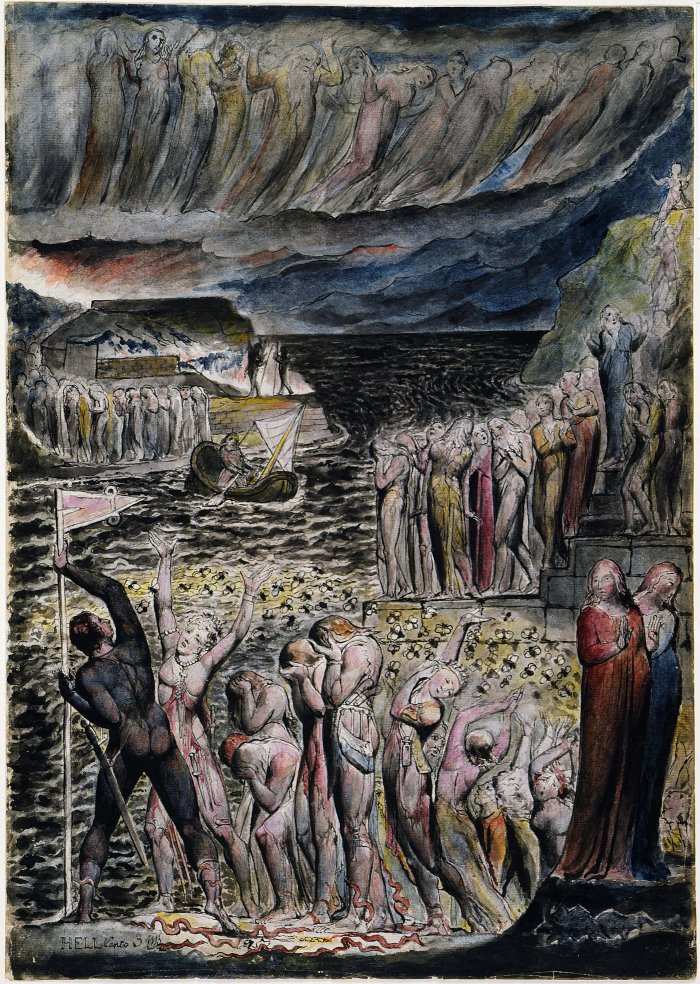
William Blake's depiction of "The Vestibule of Hell and the Souls Mustering to Cross the Acheron" in his Illustrations to Dante's "Divine Comedy", object 5, c. 1824–27. The original for the work is held by the National Gallery of Victoria. Public Domain
Another of these subterranean rushing water cascades was the Lethe, the river of forgetfulness. Yet, another was the Styx, the river of death and one of the five central bodies of water that bordered Tartarus and was all but impenetrable.
In "Iliad," Tartarus is described as a gloomy, sunless, deep abyss as far beneath Hades as heaven above the Earth. The place was said to be closed in by iron gates, and there, Zeus kept those who rebelled against him and his authority. In later sources, Tartarus was believed to be a place of punishment for the spirits of the wicked. Finally, the place's name became synonymous with Hades.
According to 'The Odyssey,' one of two major ancient Greek epic poems attributed to Homer, there was also the river Cocytus, the fiery, magma-filled river Pyriphlegethon, and the sludge-filled Acheron, a dark river, which is supposed to flow into the realm of the dead.
Interestingly, this Acheron River was believed to have surfaced in different areas worldwide.
Tartarus, with its rivers, has exact underworld counterparts in other peoples' beliefs worldwide.
The most fascinating aspect of Tartarus is that in this mythical place, the laws that govern the known world are not always in effect, and time itself does not always pass in a respectable, predictable way as it does in our daily reality.
Written by – A. Sutherland - AncientPages.com Senior Staff Writer
Updated on December 16, 2023
Copyright © AncientPages.com All rights reserved. This material may not be published, broadcast, rewritten or redistributed in whole or part without the express written permission of AncientPages.com
Expand for referencesReferences:
Morrigan, Acheron
M. Mott, ‘Caverns, Cauldrons, and Concealed Creatures’
More From Ancient Pages
-
 South Africa ‘s Blombos Cave: Ochre Was A Tool For Stone Toolmaking During The Middle Stone Age
-
 Incredibly Well-Preserved 2,000-Year-Old Statue Of Greek God Hermes Found In Heraclea Sintica, Bulgaria
-
 Inca Communication: Mailmen Of The Inca Empire Were Fast Roadrunners
-
 Dead City Of Serjilla – Byzantine Village In Syria Struggling To Survive The Middle Of A War Zone
-
 Stone Age Hunter-Gatherers Were Far-Traveled To Find Tool Material In Striking Colors
-
 Wonderful And Unique Viking Silver Treasure Uncovered In Täby In Stockholm, Sweden
-
 Mystery Of The Unique Tiarp Dolmen – One Of Oldest The Stone Burial Chambers In Scandinavia
-
 Medieval Mystery Of The Booted Man Found In The Thames Mud
-
 Are Relics In Santi Apostoli Church Really The Remains Of St. James And St. Philip?
-
 On This Day In History: American General Benedict Arnold Commits Treason – On Sep 21, 1780
-
 Young Boy Finds Unique Micro-Mosaic Cross Medallion In Jerusalem
-
 Mysterious And Feared Underground World That No One Can Visit And Return To Tell About – Cherokee Reveal A Secret
-
 Was Megalithic Stone Circle Of Mzoura The Tomb Of Giant Antaeus?
-
 Mysterious City Lost In The Sands And Its Hidden Treasures
-
 Was Napoleon Bonaparte Defeated At Waterloo Because Of Volcanic Eruption?
-
 Operation Nightingale – Veterans Uncover Impressive 2,000-Year-Old Celtic Treasure
-
 On This Day In History: Battle of Castillon Ended ‘Hundred Years’ War – On July 17, 1453
-
 Ancient Necropolis With Lead Coffins Sheds Light On Early Christian Funeral Practices
-
 Magnificent Bronze Age Female Burial At Tepe Chalow Reveals Secrets Of The Greater Khorasan Civilization
-
 DNA Sheds Light On The Iron Age Log Coffin Culture In Pang Mapha, Thailand

