
Controversial Artifact Fuente Magna Could Re-Write Ancient History – America’s Mysterious Rosetta Stone
A. Sutherland - AncientPages.com - The Fuente Magna is a very controversial artifact that is sometimes referred to as America's Rosetta Stone.
This mysterious object raises a number of interesting and thought-provoking questions. How did an ancient artifact, with Sumerian cuneiform writing, wind up in the Andes? Was there a connection in ancient times between the Sumerians and inhabitants of the Andes, located thousands of miles away?

The Fuente Magna is a large stone vessel resembling a bowl. It was accidentally discovered in 1958 by a farmer working near Lake Titicaca in Bolivia. The artifact was taken to the city hall of La Paz. On the bowl there are several beautiful engravings zoological motifs and anthropomorphic characters.
However, most interesting are the Sumerian cuneiform script found on the vessel.
The artifact was kept in the Museo de los Metales Preciosos ("Museum of Precious Metals") for almost 40 years before two Bolivian researchers, Argentine Bernardo Biados and archaeologist Freddy Arce made an attempt to examine the object and its mysterious origin.
Who made it? Where did it come from?

The Fuerta Magna artifact could re-write ancient history.
An old local who saw a photo of the artifact said it was once in his possessions and he used the bowl to feed his pigs. Obviously the old man was totally unaware of the ancient object's value. How did the Fuente Magna end up later close to Lake Titicaca? Answer to that question remains unknown.
When Bolivian archaeologist Max Portugal Zamora learned about this curious object, he made several attempts to decipher the script, but failed because he did not understand the bowl was a type of cuneiform text dating back some 5,000 years.
After a careful examination of the Fuente Magna, linear script expert Dr. Clyde A. Winters determined that it was probably Proto-Sumerian, which is found on many artifacts from Mesopotamia. An identical script was used by the Elamites called Proto-Elamite.
For some time, the Fuente Magna was considered a fake. That is often the case with artifacts that pose a challenge and threat to orthodox science. However, after closer examination of the Fuerta Magna researchers were able to conclude the artifact was genuine. Still, researchers could not decipher the inscription written with Sumerian cuneiform script.
Dr. Winters believed that researchers could not read the writing because they refused to compare Proto-Elamite and Proto-Sumerian writing with other writing systems used in 3000-2000 BC. He compared the writing to the Libyco-Berber writing used in the Sahara 5000 years ago. This writing was used by the Proto-Dravidians (of the Indus Valley), Proto-Mande, Proto-Elamites and Proto-Sumerians.
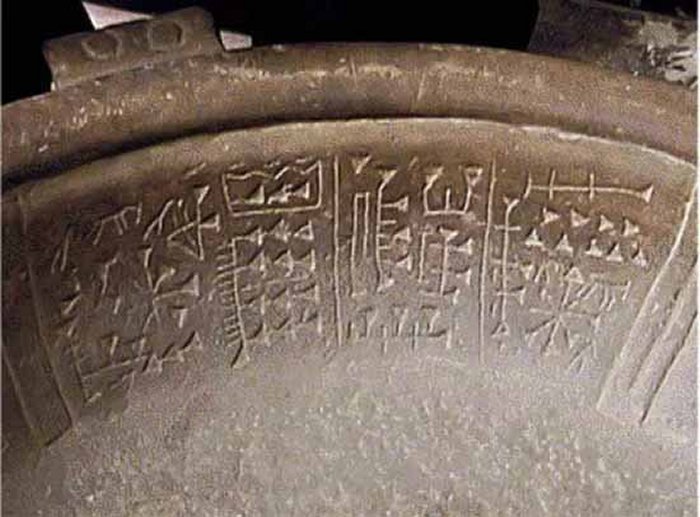
Inscriptions on the Fuenta Magna artifact.
These people formerly lived in Middle Africa, until the extensive desertification of the Sahara began after 3500 BC.
According to Dr. Winters, the inscription on the bowl read as follows:
"Approach in the future (one) endowed with great protection the Great Nia. [The Divine One Nia(sh) to] establish purity, establish gladness, establish character. (This favorable oracle of the people to establish purity and to establish character [for all who seek it]). [Use this talisman (the Fuente bowl)] To sprout [oh] diviner the unique advice [at] the temple. The righteous shrine, anoint (this) shrine, anoint (this) shrine; The leader takes an oath [to] establish purity, a favorable oracle (and to) establish character. [Oh leader of the cult,] open up a unique light [for all], [who] wish for a noble life."
Dr. Winters said that some part of the inscriptions he deciphered suggest the ancient bowl was used to make libations to the Goddess Nia to request fertility, and to offer thanks to the bountiful fauna and flora in the area that made it possible for these Sumerian explorers to support themselves in Bolivia.

A figure on the Fuente Magna bowl.
Of particular interest is that the people of the Fuente Magna, referred to the Goddess as Nia. Nia, is the Linear-A term for Neith. Neith is the Greek name for the Egyptian Goddess Nt or Neit, Semitic Anat. This goddess was very popular among the ancient people of Libya and other parts of Middle Africa, before these people left the region to settle Mesopotamia, the Indus Valley and Minoan Crete.
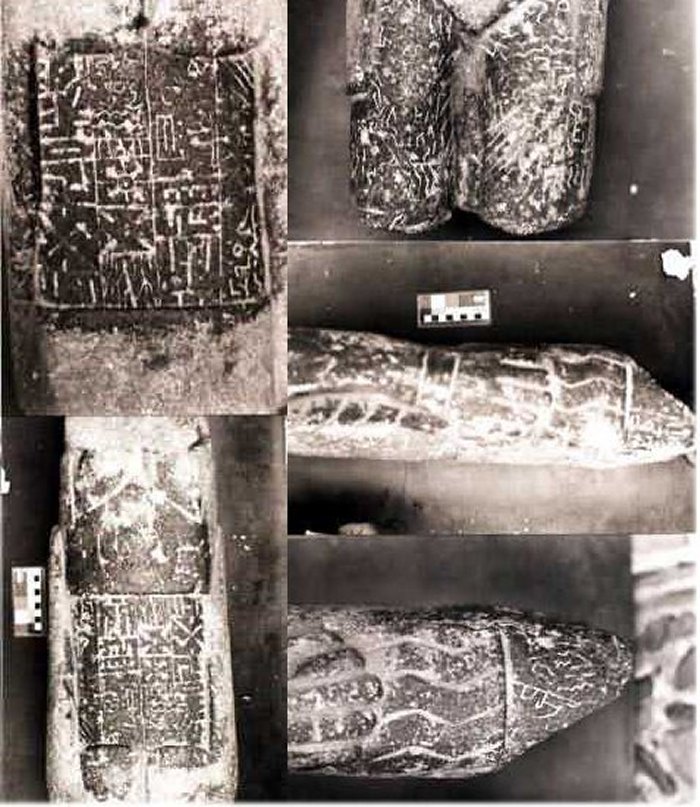
Inscriptions on the Pokotia monolith
Dr. Winters noted that his translation of the Fuente Magna inscriptions supports the hypothesis of Awen Dawn that the Fuente was used in celebration of the Goddess religion of the ancient people of Bolivia.
Awen Dawn recognized that the figure on the Fuente Magna was in a Goddess pose, with open arms and legs spread, which supports Winters' translation.. In addition, the identification of symbols on the bowl by Awen that relate to European signs for the Mother Goddess, probably reflects the early influence of the Goddess Neith on the mainland of Greece and Crete.
See also:
- Bolivia And The Mystery Of The Twins Of Atlantis
- Secret Ancient Subterranean Tunnels And Caverns Across America: Who Or What Were Our Ancestors Hiding From?
- Controversial Prehistoric Bronze Gears Of Peru
The Fuente Magna artifact remains a highly controversial artifact until today.
The artifact's existence and cuneiform writing suggest there was a strong connection between the Sumerian civilization and the ancient culture of Bolivia.
"How is it possible that proto-Sumerian inscriptions were found in a bowl that has been found near the Titicaca Lake, 3800 meters above sea level, thousands of kilometers far away from the area where the Sumerian people used to live?", author and ancient history reseaecher Yuri Leveratto asks. The Fuente Magna artifact is by no means the only object that offers evidence of ancient transatlantic contact. MessageToEagle.com has previously published the controversial story dealing with the Pokotia Monolith.
An enigmatic inscription on the Pokotia Monolith confirms that Sumerians crossed the ocean thousands of years ago and left traces of their civilization.
Further investigations of such intriguing and mysterious ancient artifacts can shed more light on prehistoric trans-Atlantic crossings and the influence Sumerian civilization had on the ancient people of Bolivia, Peru and other countries in South America and of course even North America.
Written by – A. Sutherland AncientPages.com Staff Writer
Copyright © AncientPages.com All rights reserved. This material may not be published, broadcast, rewritten or redistributed in whole or part without the express written permission of AncientPages.com
More From Ancient Pages
-
 6,000 Years Ago, Europe’s Oldest Cities Relied On Fertilizer And Plant Protein, Isotope – Analysis Shows
-
 Unique Ancient Human Statue Found Embedded In A Wall At Göbekli Tepe
-
 Countless Artifacts, Structures And Roads Discovered In Ancient City Of Aigai, Turkey
-
 Unknown Highly Advanced Civilization Created Malta’s Cart Ruts With Sophisticated Machinery
-
 Magnificent ‘Sword Pyramid’ Lost By A Sutton Hoo-Era Lord Discovered In Norfolk
-
 Scientific Disagreement Over The Bronze Age Tin Ingots From The Uluburun Shipwreck
-
 On This Day In History: King Alexander II Was Crowned At Scone, Scotland – On Dec 6, 1214
-
 On This Day In History: Columbus Reached Honduras With His Ships – On July 30, 1502
-
 Indigenous People In Oconee Valley Remained In Southeastern US For Nearly 150 Years
-
 Surprising Evidence Of 12,000-Year-Old Unknown Advanced Secret Knowledge Held By Elite Individuals – The Connection – Part 2
-
 Iraq’s Ancient Kish City Survived The Great Flood – Today It’s Neglected And Lies Buried In Sand
-
 Ancient DNA Reconstructs Rise Of Largest Empires In History Of Inner Asia
-
 On This Day In History: ‘Sea King’ Ragnar Lodbrok Seizes Paris – On March 28, 845
-
 Beware Of The Shapeshifting Gaelic Bodach Who May Be Difficult To Trick
-
 Controversial Evidence – Ancient Chinese Visited America 2,500 Years Ago
-
 Hoard Of Roman Bronze Coins Turns Out To Be Offering For Safe Crossing
-
 Is ‘Someone’ Regularly Altering The Course Of History? – Is So How, Why And Who? Part 1
-
 Peculiar Millennia-Old Genetic Mystery Traced To One Individual From The Black Sea Solved
-
 Mystery Of Europe’s Bog Body Phenomenon Solved By Scientists
-
 Reconstructed Roman Gateway Tells The Story Of Britain’s Invasion

