
Brilliant Prehistoric Cave Paintings Of Lascaux – Who Were Their Unknown Creators?
A.Sutherland - AncientPages.com - The identity of the masters of Lascaux, who possessed impressive knowledge of artistic technique and equally sophisticated knowledge, remains shrouded in mystery.
What source of light did they use? How did they protect their great work at Lascaux from atmospheric damage?
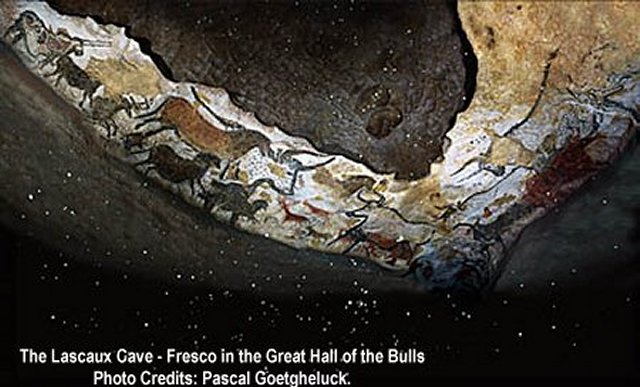
As the Italian journalist Loris Mannucci once wrote: "these works of art are 25,000 years old, yet they show such perfection in their design, color-scheme (especially red, yellow and black) and sense of movement as to upset many of our ideas concerning prehistoric man.
The paintings were made at different times, and it is a problem how these artists managed to construct a scaffolding to paint the roofs of caves that were several yards in height."
In the Lascaux Caverns, world-renowned for their Magdalenian paintings, one can still see the holes in the rock that supported wooden crossbeams. Probably looking similar to what Michelangelo utilized many millennia later, these crossbeams held scaffolding that enabled the Cro-Magnon artists to execute their works on the cave ceilings, ten to twelve feet above the cavern floor.

We do not know whether the Lascaux caves were a sanctuary or a dwelling place, but we can say with certainty that many people frequently used the place and the pictures at Lascaux managed to survive millennia.
Curiously, the last two to three decades of frequent tourist visitations at Lascaux have seriously damaged the beautiful wall paintings, and the cave's rocky interior has begun to disintegrate in many places.

A very long time ago, in prehistory, the Lascaux Cave, a deep and dark place, could be the humans' first center of observation of the sky.
A painted map of the prehistoric cosmos covers one of the walls of the Lascaux Cave in the vicinity of the Shaft of the Dead Man.
The Lascaux Cave, located on a hill at Dordogne, near Montignac, in southern France, is one and most known of over 350 ancient decorated sites.
It was discovered accidentally in September 1940 by a group of teenagers. It is a classified historic building which as one of the first sites, profited from a new method of dating: Carbon-14. There are more than 100 Paleolithic caves in the region.
According to German researcher Michael Rappenglueck of the University of Munich, a map depicting the eyes of the bull, birdman, and bird represents the three prominent stars Vega, Deneb, and Altair.

All three represents the so-called "Summer Triangle" composed of the brightest celestial objects in the sky during the middle of a northern summer.
Among other frescoes located near the cave entrance, there is an impressive painting of a bull. Hanging over its shoulder is a depiction of a map of the Pleiades, the cluster of stars sometimes called the Seven Sisters.
Inside the bull painting, there are also indications of spots that may represent other stars found in that region of the sky. Today, this region forms part of the constellation of Taurus the bull. The ancients, who lived thousands of years ago, were much more sophisticated than previously thought.
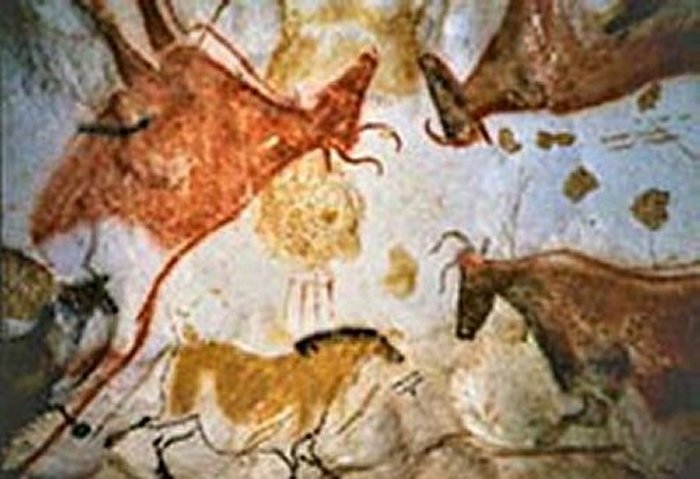
Was the Lascaux cave some ancient planetarium where stars were charted?
In recent years, new research has suggested that the Lascaux paintings may incorporate prehistoric star charts. Dr. Michael Rappenglueck of the University of Munich argued that some of the non-figurative dot clusters and dots within some of the figurative images correlate with the constellations of Taurus, The Pleiades, and the grouping known as the "Summer Triangle".
This impressive legacy left to us by the ancients consists of more than 1,800 figures of animals like horses, bison, wolves, mammoths, ibex, aurochs, deer, lions and bears, and many other abstract designs.
The original cave, a very fragile ancient place of 250 m long, was closed to the public in 1963 when a deteriorating fungus "attacked" its walls. Since 1983 people can visit Lascaux Cave's "reproduction".
The first hall of the system is the Great Hall of the Bulls. This large fresco, covering about 20 meters, depicts horses, bulls, and stags. After the Great Hall, there is about thirty meters long surface called the Painted Gallery, with the walls entirely covered with various figures. There is the Lateral Passage, a low corridor, where only a few paintings and engravings survived to the right of the Great Hall of the Bulls.

This corridor connects the Chamber of Engravings, a large round area with more than 600 hundred engraved figures, with the Main Gallery and the Chamber of Felines. The Shaft of the Dead Man, where no traces of any human were ever found, is set a little apart, at the far end of the Chamber of Engravings, and the Silted-up Chambers are in the same direction.
Brilliant prehistoric paintings of Lascaux, with their anatomically perfect details of all depicted animals, are rendered with great art skills like shadowing, highlighting, stenciling, and the use of perspective, a technique that was not rediscovered until the Golden Age in Greece.
However, looking at the millennia-old Paleolithic artwork of Lascaux, where only simple stick figures represent a man, we cannot tell if the artists were a Neanderthal man or Cro-Magnon man or perhaps someone else.
Written by – A. Sutherland - AncientPages.com Senior Staff Writer
Copyright © AncientPages.com All rights reserved. This material may not be published, broadcast, rewritten or redistributed in whole or part without the express written permission of AncientPages.com
More From Ancient Pages
-
 Cerberus – Giant Multi-Headed Dog Guards The Underworld Of God Hades In Greek Mythology
-
 Medieval Well-Preserved Sword Discovered In A Peat Bog In Poland
-
 Ancient Iconic Armenian Wheel Of Eternity Depicted Inside A Six Pointed Star
-
 Krakatoa Prophecy – Samson’s Mysterious Dream
-
 You Can Visit The Tomb Of Jesus – 3D Virtual Tour Opens Soon
-
 Mysterious Rock Art By Unknown Ancient Culture Found In Venezuela
-
 Huge Viking Winter Camp Unearthed In England
-
 Pre-Clovis, Paisley Caves: Archaeologists Identified The Earliest Population Of North America
-
 Unique Over 1,000-Year-Old ‘Telephone’ Invented By A Lost Forgotten Civilization With No Written Language
-
 Fragment Of A Royal Memorial Inscription Attributed To Sargon II – Unearthed
-
 Rock-Hewn Burial Shafts And 38 Symbolic Pots Discovered In Abusir Necropolis, Egypt
-
 Spectacular Victory Tower Dedicated To Hindu God Vishnu And Pioneered By King Rana Kumbha
-
 Indigenous People In Oconee Valley Remained In Southeastern US For Nearly 150 Years
-
 Sogdian Temple Of Jartepa II On Caravan Road Of The Silk Road
-
 Ancient Road Used By The Teutonic Knights Discovered In A Lake In Poland
-
 Egyptian Artisans In The Valley Of The Kings Had Permanent Jobs In The Time Of The Pharaohs
-
 On This Day In History: Terrorist Attacks On World Trade Center And Pentagon – On Sep 11, 2001
-
 2,000-Year-Old Antikythera Mechanism May Not Be What We Previously Thought
-
 On This Day In History: Samuel F.B. Morse Receives A Patent For His Dot-Dash Telegraphy Signals – On June 20, 1840
-
 Archaeologists Investigate The Mysterious Disappearance Of Human Skeletons In England And Wales During The 5th Century

