
The City Of David – Why Is It So Controversial?
David Tee - AncientPages.com - The city of what is now called the City of David, was first established somewhere in the 3 millennium BC. It was Canaanite and though few archaeological discoveries have illuminated this history, it remained Canaanite until David conquered it in the 10th century BC.
The Amarna letters have scholars and archaeologists thinking that Jerusalem was a mighty city prior to David’s conquest. Joshua did defeat an alliance of Kings, one from Jerusalem, but he did not overthrow the city itself.

Left: Statue of King David by Nicolas Cordier in the Borghese Chapel of the Basilica di Santa Maria Maggiore. Image credit: Wikipedia, Jastrow- Right: The City of David and the Mount of Olives. Image credit: Wikipedia, Joe Freeman
Archaeologically it is said that the original City of David lay on a small patch of land no bigger than 12 acres in size. This can be contested as archaeology is incapable of uncovering every building from the past. This stated size is part of the controversies surrounding this city.
Controversies Galore
It goes without saying that anything connected to the Bible or showing its contents correct will face opposition. Whenever a 10th Century BC discovery is made, the Minimalists object to the identification of the artifact and refuse to link it to David’s or King Solomon’s reign.
Israel Finkelstein is a leading opponent to 10th century identification and has written that David and Solomon were not rulers of a large empire but small tribal leaders. Eilat Mazar has spent most of her career excavating in the City of David.
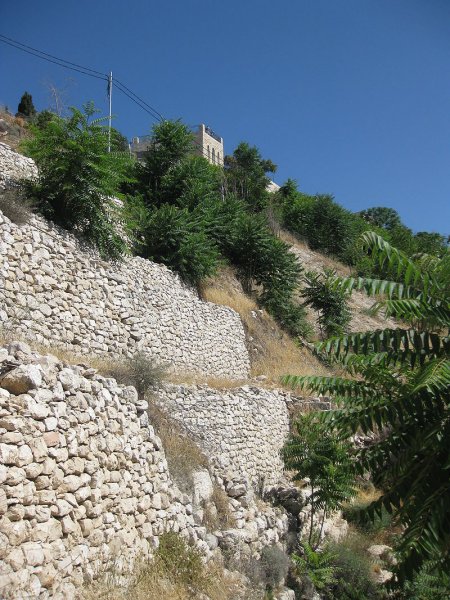
Jebusite wall facing the Kidron Valley. Image credit: Wikipedia, Deror Avi - CC BY-SA 3.0
Ms. Mazar has found the Solomonic walls and also possibly the palace of David. Both discoveries have been highly contested by Mr. Finkelstein and other Minimalists. Her reasoning for her identification stems from the geographical topography surrounding the city. The Bible says David went down to the citadel from his palace.
These words indicate that David’s and the Jebusites’ stronghold could only be north of the City of David. Ms. Mazar’s identification and location go in contrast to Kathleen Kenyon’s conclusions who did not dig outside of the old city’s walls.
Part of the controversy surrounding archaeological work in the City of David comes from the fact that excavations have intruded on the homes and property of Arab residents in the Kidron Valley and Silwan Village.
It is a well-known fact that Muslims in medieval times built over key Christian and biblical sites to hide the history of the area. This causes a lot of problems when excavating the City of David.
Military Importance Of The City Of David
As the biblical record shows, both Joshua and David had a difficult time in overthrowing the city of Jerusalem. The Jebusites actually taunted King David when he tried. That is because the Jebusite stronghold had a lot of natural defenses helping to make the area very difficult to attack. The north side was the only vulnerable side as it had to depend on human fortifications for its defense.

Wall in the Old Town of Jerusalem. Image credit: Public Domain
But two other things helped make the City of David very difficult to overcome. First, the stronghold was high up. It commanded a very clear view of the surrounding area. Early warnings would help the residents prepare to defend themselves.
The second vital influence on military strategy was the location of the Gihon spring. The Jebusites built guard towers to protect their water supply, then they used a tunnel system to make sure they did not have to go outside the city to get their water.
These two things made the city almost impregnable.
Other Discoveries In The City Of David
The City of David is not just known for its relationship with King David and the conquest of the Promised land. It holds many other secrets as well. In recent excavations, many clay bullae were found which held the names of a variety of biblical figures. Over 50 of them date to the Babylonian conquest in the 6th century BC.
Another discovery records the name Bethlehem which is the first mentioning of that town outside of the Bible. Then there was the discovery of an edifice from the second temple era, dating to Queen Helena of Adiabene’s time. She was a lady who made a pilgrimage to Jerusalem and converted to Judaism during her visit.
While its actual size may be in doubt, the city holds many secrets to Israel’s past. Most of those uncovered secrets show that accuracy of the Biblical record.
Written by – David Tee AncientPages.com Staff Writer
Copyright © AncientPages.com All rights reserved. This material may not be published, broadcast, rewritten or redistributed in whole or part without the express written permission of AncientPages.com
Expand for referencesDiscovering the Solomonic Wall in Jerusalem: A Remarkable Archaeological Adventure by Eilat Mazar
Jerusalem Report: Solomonic Riddle by Abraham Rabinovich (1980). Bible and Spade, 9(2), 64.
New Light On David’s Capture Of Jerusalem by Bryant G. Wood (1972). Bible and Spade, 1(4), 99.
More From Ancient Pages
-
 Isotope Analysis Helps Tell The Stories Of Aboriginal People Living Under Early Colonial Expansion
-
 Mystery Of Andreas Rill: Was He A Time Traveler, Holy Man Or An Unidentified Prophet In Disguise?
-
 Where Is The 12,000-Year-Old Map That Could Change All We Know About Ancient Egypt Hidden?
-
 Treasure Coins Dated To 15th And 16th Century Unearthed In Historical Region Of Slovakia
-
 Prehistoric Heavy Machinery Of The Ancient Times Or A Piece Of Jewelry?
-
 Empusa – Shape-Shifting Evil Female Demon In Greek Myth And Folklore
-
 Forgotten Ancient Empire That Extended Far Beyond America To Iceland And Its Mysterious Inscriptions
-
 Ancient Glass Workshop Unearthed At Iron Age Of Němčice
-
 Tile Tomb Dated To The Late Hellenistic Era – Discovered In Surroundings Of Istanbul, Turkey
-
 1,300-Year-Old Avar Warrior Tomb With Rare Well-Preserved Treasures Discovered In Hungary
-
 Living Descendant Of Legendary Native American Leader Sitting Bull Confirmed Using DNA From Hair
-
 El Volcán: Mysterious Volcano-Shaped Pyramid With Never Revealed Secrets In Peru
-
 Evolution Of Paleodiet At Neolithic Qujialing Site Unveiled By Scientists
-
 Zombie-Like Creature In Sami People’s Beliefs: A Frightening, Dangerous Entity That Should Be Avoided At All Costs
-
 Unique 3,000-Year-Old Petroglyphs Found Buried By A Massive Landslide In Gauldal, Norway
-
 Gigantic Horizontally Lying Stones Of Ancient City Of Baalbek
-
 Beer Was Used As Medicine And Payment In Ancient Egypt
-
 Evidence Of Lost Advanced Ancient Technology In Babylon
-
 Urban Resiliency Lie Within Ancient Cities – New Study Suggests
-
 Mystery Of The Hunza People: Did They Really Live To 145 Years Of Age?

